

The latest scientific events of early 2012
The beginning of 2012 saw some notable scientific achievements. Below is a preliminary ranking of the most important scientific achievements of early 2012, as assessed by the Russian website Pravda.
The University of Hawaii's Board of Trustees has unanimously approved a plan to build the world's largest telescope atop Mount Mayna-Kea. Accordingly, by 2018, a giant telescope with a diameter of over 30 meters will be erected on the island of Hawaii.
The project was initiated by the University of California and the California Institute of Technology (USA), and the Canadian Association of Universities for Astronomy. Astronomers and observatories from Japan, China, and India also participated in the project.
The primary mirror of the telescope has a field of view exactly 10 times larger than that of the world's largest modern optical telescopes. Its observed images are also three times sharper.
The selection of Mayna-Kea peak on the Big Island was only decided after five years of searching. This ancient volcano is 4,205 meters high, and the sky remains cloudless for up to 300 days a year. The absence of major cities on the island eliminates the risk of light pollution. Another international observation station is also located here.
A species of horned viper has recently been discovered in Tanzania. Based on its population size and habitat, scientists have classified it as an endangered species.
The horned pit viper (Atheris Matildae) was discovered by experts from WCS and the Trento City Museum of Science (Italy) in the southeastern plains of Tanzania. The boundaries of its habitat have not been determined, but it is believed to live in a very isolated patch of forest.
The Milky Way galaxy contains at least 100 billion planets. This number is double the estimate given by NASA in February 2011. This new figure was reached by an international team of scientists led by Steven Kein of Caltech. The researchers' conclusion is based on observations made over five years as part of the Space Anomaly Search Program.
Scientists have discovered the world's smallest frog in the rainforests of Papua New Guinea. Its body length is only 6 millimeters. This tiny frog has a dark brown color that allows it to live on fallen leaves on the ground without being hunted.
NASA has successfully guided the Curiosity Mars Science Laboratory's flight path toward its target, the Red Planet. Constant control is required to ensure the laboratory lands precisely at its intended landing point.
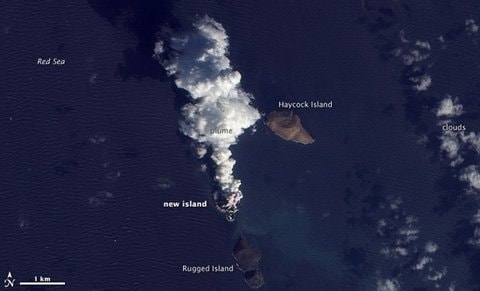
NASA satellites have captured images of the emergence of a new island in the Red Sea. These images, taken by the EO-1 radar, clearly show the Yemeni coastline, where numerous small islands have formed during volcanic activity. Within the region, there is a fault system created by the collision of tectonic plates in the Aravi and Africa.
In mid-December, an eruption began here from the underwater volcano. Ash and lava rose up to 30 meters from the surface. One photograph clearly shows the plumes of smoke and ash from the active underwater volcano. A small island is forming.
Why do other planets have several natural satellites while Earth has only one, the Moon? Recently, a group of French, Filipino, and American astrophysicists attempted to explain this "injustice." The scientists demonstrated that, theoretically, Earth once had a second satellite, but only temporarily. They even hypothesized that it might have been larger than the Moon.
Source: Vietnamnet