

Concerns about the spread of hand, foot, and mouth disease in schools.
Children aged 3-5 attending school account for 11.5% of the total number of children infected with hand, foot, and mouth disease. Additionally, one of the two deaths in Ho Chi Minh City since the beginning of the year was a student at a kindergarten in District 3.
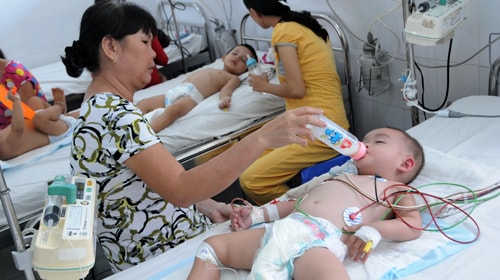
Children with hand, foot, and mouth disease are being treated at Children's Hospital 1, Ho Chi Minh City - Photo: Minh Duc
In Ho Chi Minh City, no schools reported more than two cases of hand, foot, and mouth disease in January, but this number rose to three schools in February and seven schools in March. Dr. Le Hong Nga, Deputy Head of the Department of Infectious Disease Control and Vaccines at the Ho Chi Minh City Center for Preventive Medicine, stated this at a conference summarizing the work on preventing and controlling hand, foot, and mouth disease in schools during the first three months of 2012, organized by the Ho Chi Minh City Department of Health on April 4th.
High number of school-aged children are getting sick.
Dr. Le Minh Hung, Deputy Head of the Medical Professional Department of the Ho Chi Minh City Department of Health, said that the current prevalence of hand, foot, and mouth disease in the community is very high because Ho Chi Minh City not only treats patients within the city but also receives about 50% of patients transferred from other provinces. Only about 10% of hand, foot, and mouth disease patients are treated in hospitals, while the remaining 90% are treated at home and in private clinics. If local authorities do not effectively monitor the disease in the community, infected children attending school will spread the disease to other children, posing a high risk of outbreaks in schools.
Meanwhile, Dr. Nguyen Dac Tho, deputy director of the Ho Chi Minh City Center for Preventive Medicine, said that 21.4% of children with hand, foot, and mouth disease contracted the disease from other children, mostly from schools. Children with hand, foot, and mouth disease may have atypical forms such as simple mouth ulcers, very few blisters interspersed with erythema, only erythema without blisters, or small dots hidden on the inside of the fingers. When children have these atypical forms, parents do not recognize them and still send their children to school. However, when the disease spreads to other children, it can still cause other children to become seriously ill. Furthermore, Dr. Tho emphasized that not only parents but also some schools are concealing the disease.
The education and healthcare sectors must cooperate.
Ms. Nguyen Thi Minh Nguyet, Deputy Head of the Education and Training Department of District 3, Ho Chi Minh City, expressed concern that the preschool sector is currently facing a shortage of teachers. She questioned whether teachers could handle additional tasks such as environmental sanitation and disease detection for young children. She noted that during disease outbreaks, teachers have to take on many extra jobs, but schools have never received any additional funding for this. Therefore, she suggested that support options should be considered.
Representatives from the District 8 Education and Training Department in Ho Chi Minh City also stated that public schools have isolation rooms when children are found to be sick or suspected of being sick. However, private daycare centers often have only one classroom for dozens of children, so where would they isolate them if a child is found to be sick? Should teachers be tasked with identifying illnesses early, as many cases are undiagnosable even by doctors? Should health center staff be sent to schools to monitor the situation, instead of relying solely on school reports?
Associate Professor Dr. Nguyen Tan Binh, Deputy Director of the Ho Chi Minh City Department of Health, believes that combating the epidemic requires mobilizing all forces in society, with the health sector playing a leading role. The number of children of school age contracting hand, foot, and mouth disease has increased and is concentrated in preschools. Therefore, the education sector has a heavy role in epidemic prevention and control. Here, the health sector does not require teachers to be like doctors, but rather to be like mothers, detecting abnormal signs in their children, identifying symptoms such as fever, blisters, etc. Of course, the role of the Preventive Medicine Center is very important in epidemic prevention and control. In schools with few teachers but many students, the Ho Chi Minh City Preventive Medicine Center will provide assistance.
According to Tuoitre.