
Quy Hop and Nghia Dan districts are focusing their efforts on combating drought to save rice crops.
(Baonghean.vn) - Right from the first heatwave of the season, many rice fields in Nghia Dan district, Thai Hoa town, Quy Nhon...
(Baonghean.vn) -Right from the first heatwave of the season, many rice fields in Nghia Dan district, Thai Hoa town, and Quy Hop district suffered from water shortages. Farmers and irrigation companies have been working hard to combat the drought and save the rice crops.
Looking at the parched rice fields of Cay Gao village in Con hamlet (Chau Quang commune, Quy Hop district), Ms. Vi Le (a local resident) sadly said: "When the rice plants were forming ears and flowering, the drought was severe. We waited for water from the Nam Ton stream from 3 am but couldn't get any. The water source was depleted due to siltation from tin mining. If the hot weather continues, all three plots of land might be destroyed by the drought."
Mr. Quan Huu Xiet, the village head, sighed: "In Con village, out of over 25 hectares of rice fields, more than 50% are lacking water. The Nam Ton stream has dried up, and if it doesn't rain, we will lose the crop. I traveled through Chau Cuong commune and saw that all the dams were dry, and the streambeds were full of rocks."
It is known that this spring, the Quy Hop Irrigation Company Limited was assigned the task of irrigating over 800 hectares of rice. To date, over 30% of the area has experienced water shortages due to the drying up of dams and streams, making it impossible to use temporary sluices to draw water. Currently, only the Muong reservoir in Chau Thai commune still has water. Mr. Le Si Mau, Director of the Quy Hop Irrigation Company Limited, stated: Given the water shortage, the company has directed its five local irrigation stations to manage irrigation water resources rationally and to encourage people to use water sparingly. In particular, for reservoirs with remaining water, they are operating water-saving irrigation systems appropriately for each cycle. The company is currently preparing mobile diesel pumps to deploy in downstream areas to pump water to areas in Chau Quang and Chau Cuong communes.
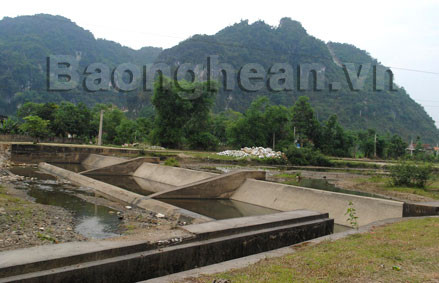
The dam in Chau Cuong, Quy Hop district, has run out of water.
In Thai Hoa town and Nghia Dan district, some areas are also experiencing water shortages. Mr. Hoang Van Son, Director of Phu Quy Irrigation Company Limited, said: The company is assigned to supply irrigation water for over 2,500 hectares of spring rice crops and manages over 12 large and small reservoirs and dams. However, as a midland and mountainous district, the terrain is complex, with many terraced rice fields, making irrigation very difficult. For example, the Khe Canh reservoir serves to irrigate over 200 hectares in Nghia Yen commune, requiring company staff to constantly monitor the area to regulate water appropriately. Since the beginning of the year, the company has organized the dredging of over 600 cubic meters of landslide debris, clearing over 100 km of canal beds, and the Canal Giua management station has cleared over 18 km of canals.
The Sao River reservoir has 3 management stations and over 20 operating staff. The unit implements a rotational water distribution system to prevent water competition. The company has prepared 4 mobile water pumps placed at the end of the canals to pump water to Nghia Thuan and Nghia Loc communes. Currently, the Lang Sinh (Nghia Thang commune), Truc Dong, Dong Diec (Nghia Loc commune), Khe Dua, Khe Lam (Nghia Thuan commune) reservoir and canal systems, built before the 2000s, are mostly degraded, causing water loss for irrigation, and urgently need state investment for repair.
Van Truong