

President Ho Chi Minh's meeting with world-renowned painter Picasso.
When mentioning Picasso, Vietnamese people usually think of a famous painter, but few know that he was also a renowned anti-war activist and a friend of President Ho Chi Minh.
Usually, before visiting a country, I read books about that country's various fields, such as geography, economics, society, and influential figures in the cultural and political life of its people.
Upon arriving in Spain, in addition to general knowledge, I was particularly impressed by three people: Mrs. Ibaruri, the leader of the country's revolutionary movement and a close friend of President Ho Chi Minh; FG Lorca, the brilliant Spanish poet and theater activist of the 20th century; and Pablo Picasso, the world-renowned painter, peace activist, and great friend of the Vietnamese people.
When stopping at
I particularly remember some of his works from that early period, which are now housed in the museum.
At the age of 16, Picasso had learned everything the academy could offer. But he understood that life was an endless school, and he continually grew through the richness of life and the inspiration provided by his work. Following in his father's footsteps and continuing the artistic tradition of his country, Picasso absorbed his mother's love and kindness, and early on developed a sense of self-reliance, ambition, and enthusiasm for absorbing and embracing the best of humanity – especially during his early years in Paris – combined with his innate genius, making him one of the greatest painters of humankind. He left behind an enormous and invaluable legacy: tens of thousands of works, including 1,885 oil paintings, 15,000 graphic works, 1,228 sculptures, 34,000 illustrations, thousands of ceramics, and thousands of sketches in progress.
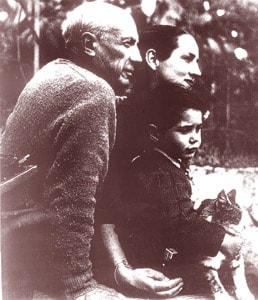
Picasso with his wife and son (1952).
;)
He passed away at the age of 92 in 1973 – the year the Paris Peace Accords were signed in Vietnam – in the very city where he had lived since the age of 18 and where he had emerged as a combative artist, steadfastly supporting the just struggle of a nation he knew and loved through a special person – Nguyen Ai Quoc, with whom he befriended at the headquarters of the Clarte group. It can be said that this friendship, like the friendship between President Ho Chi Minh and the revolutionary leader Ibaruri, served as a bridge connecting the two Vietnamese peoples.
According to the book "The Distinguished Guest of France" (People's Army Publishing House, 2001), President Ho Chi Minh's meeting with Picasso, when he was a distinguished guest of the French Government, took place at...
As Ho Chi Minh approached the door, Picasso recognized him immediately and rushed forward: "Hello, Mr. Nguyen!" The two embraced warmly. Picasso stepped back a little, gazing at his old friend:
- You've aged so quickly, but your eyes are still young and seem brighter than when we first met and talked.
Respectfully guiding President Ho Chi Minh on a tour of his art gallery, Picasso happily said:
Please give me some advice!
President Ho Chi Minh said:
- We came to admire your art. Any commentary on Picasso's paintings is merely an outline around the frame of the painting. Please excuse me, someone who doesn't know much about art.
Picasso laughed heartily, his voice brightening considerably:
- Mr. Nguyen, I still remember the paintings you did for the newspaper Le Paria (The Pariah)... Back then, I told Henri Basbusse: "Just these few strokes reveal a beautiful thought, a hidden soul." If you had continued on the path of painting, who knows, there might have been a Nguyen Ai Quoc as an artist. But today, Mr. Nguyen is President Ho Chi Minh, the leading figure in the struggle for independence and freedom for his nation and for other oppressed nations.
The artist offered President Ho Chi Minh a drink and then sketched a portrait of him. Afterward, he put it in his sketchbook and only gave it to President Ho Chi Minh when he saw him off at the door. President Ho Chi Minh then gave it to his private secretary for safekeeping. Sadly, due to the many years of war, the portrait was lost; if it had survived, it would have been a vivid testament to the friendship between these two great men.
In 1961, on the occasion of Picasso's 80th birthday, President Ho Chi Minh sent him a congratulatory letter. In the letter, he wrote: "The dove of peace painted by Picasso, so familiar to the Vietnamese people and people all over the world, brilliantly expresses the great artist's strong belief in the unstoppable pursuit of peace by all peoples."
Those were kind words that the supreme leader of our people bestowed upon the renowned painter – a man who had a special sympathy for the Vietnamese resistance movement.
"For us artists, our profession is here, in war and peace. Obviously, all modern art stands with Vietnam."
It's truly touching that, right up until his death, the great painter still had his heart set on Vietnam.
According to CAND-M