

China - Go, listen, and see.
(Baonghean) - China not only attracts tourists with its long-standing culture, thousand-year-old historical relics, and the beauty of its ancient streets, but also leaves a deep impression on visitors with its urban transportation planning and the construction of green, clean, and beautiful streets. China truly deserves to be called a civilized and modern country....
(Baonghean) - China not only attracts tourists with its long-standing culture, thousand-year-old historical relics, and the beauty of its ancient streets, but also leaves a deep impression on visitors with its urban transportation planning and the construction of green, clean, and beautiful streets. China truly deserves to be called a civilized and modern country....
Impressive transportation planning
On the more than 20-kilometer journey from Beijing International Airport to the city center, our car rarely had to stop at intersections or traffic lights thanks to the ring road system. Upon further investigation, we learned that Beijing's urban transportation planning is meticulously prepared, with thorough route surveys conducted before construction decisions were made, and each ring road has its own appropriate routes. Ring Road 1 encircles the inner city and dates back to the mid-20th century. Ring Road 2 dates from the 1960s. Ring Road 3 was built in the 1970s, with a planned distribution of residential areas, restaurants, hotels, and schools along its route. Ring Road 4, completed in the late 20th century, was built to expressway standards. Ring Roads 5 and 6, part of the 21st-century transportation system, were put into operation in 2008.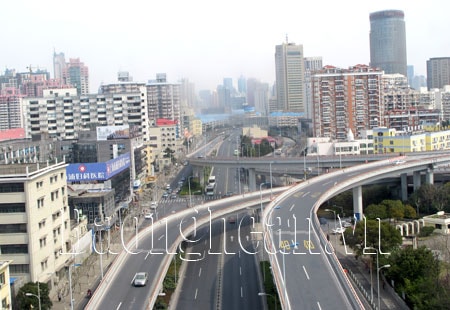
A multi-lane overpass in Shanghai.
“Beijing, with over 15 million inhabitants, is the economic, political, and social center of the country. A large volume of traffic from other cities converges here for meetings and work. The Beijing Municipal Government has made significant efforts in selecting solutions to address traffic congestion. Besides investing in the construction of a ring road and underground tunnel system with appropriate routes, the city government has also implemented measures such as: offering significantly lower parking fees for underground parking instead of above-ground parking; building multi-story parking garages; encouraging the use of public transportation; and applying new information technologies, including online meetings and remote group communication, to minimize travel and large gatherings at one location…” – added tour guide Zhang Yongtam.
In Beijing, it's easy to notice that this densely populated city has virtually no motorcycles. The three main modes of transportation in these cities are the subway, cars (including buses), and bicycles. Not only in Beijing, but also in other cities like Guangzhou, Shenzhen, Shanghai, and Hangzhou, motorcycles are banned from the city center. In Beijing and Shanghai, however, the ban is city-wide, not limited to the central area. It's known that Beijing still maintains a special license plate allowing the use of motorcycles in certain outer ring areas (the Fourth Ring Road). Because this special license plate was discontinued in the 1990s, some people are now using it to… buy and sell the right to use motorcycles in the city! The price of one of these plates is currently being offered at up to 12,000 yuan (approximately over 40 million VND), and this price is increasing quite rapidly each year. Due to the limited number of these "permits," the number of motorcycles seen on Beijing's streets (and only on ring roads or in alleyways) is very limited. Because of the ban on motorcycles, those who prefer two-wheeled vehicles have switched to bicycles and electric bikes.
According to the 2011-2015 plan, Beijing will build approximately 1,000 bicycle rental points, with over 50,000 bicycles soon to be operational at subway station entrances and exits on several streets. The removal of motorcycles in Beijing has had an immediate positive impact on the urban environment, particularly in significantly reducing noise. While the Chinese are known worldwide for their loud eating and speaking, the streets and alleyways of Beijing are surprisingly quieter than Hanoi and Ho Chi Minh City because there are no more motorcycle noises; no more sudden engine revving that would startle many people. Taxis in Beijing are not allowed to park and wait for passengers, so to catch a taxi, passengers simply wait and flag down any vehicle with its red light (indicating no passengers). When a taxi pulls over, passengers must get in immediately because the maximum time a taxi can spend on the road is only two minutes. On many streets, sidewalks are paved with stone or brick, 6-8 meters wide, for pedestrians. The road surface is marked with barriers separating lanes for motorcycles and bicycles from those for cars, preventing vehicles from crossing into each other's lanes. At intersections, there are overpasses, underpasses, and conveyor belts to help the elderly and disabled cross the road easily.
In China, it's also very rare to see traffic police officers stationed on the streets. For minor traffic accidents, drivers simply take photos of the incident and drive away. "Everything is monitored by cameras and properly documented; only serious accidents involve traffic police," the tour guide explained.
Furthermore, China is world-renowned for its transportation infrastructure, including: the Beijing-Tibet railway, the world's longest and highest railway; the Jiaozhou Bay sea bridge, considered the world's longest; and the Beijing-Shanghai high-speed railway.
Environmental protection and types of penalties
In large cities like Beijing and Shanghai, with their towering skyscrapers and intricate network of overpasses, there's no feeling of claustrophobia or congestion. Cleanliness and airiness are the feelings that anyone visiting these major Chinese cities will experience.
In high-rise residential areas, there are small parks planted with many trees to both create a pleasant landscape and provide shade. At traffic intersections, there are lush green lawns. Vines grow abundantly at the base of overpasses, and various types of healthy trees with vibrant flowers line the median strips.
The most striking feature of Hangzhou and Suzhou is the high density of greenery, averaging 112 trees per person. The streets of Suzhou and Hangzhou are lined with paulownia trees, a type of tree that sheds few leaves and has a wide canopy, creating a unique and distinctive characteristic. In particular, many streets are lined with rows of willow and peach trees, forming beautiful, long lines. "The people of Hangzhou believe that a city without five-star hotels is acceptable, but a city without greenery is unacceptable. A city with few (or no) trees, parks, gardens, or walking paths is considered lifeless, soulless, and, most importantly, lacking cultural space..." – tour guide Lin Xueqiao explained. The trees and flowers on the streets of China are meticulously cared for: they are watered daily, regularly pruned, and in winter, dry branches, oversized branches, and yellow leaves are removed, and the trees are shaped. The lower part of the tree trunk (about 1 meter) is protected by a "coat of armor" made of dry straw wrapped around it.
The streets are clean, with no littering; it's difficult to find wrappers, candy, cigarette butts, or plastic bags on the streets. In shopping centers, public trash cans with three compartments for sorting waste—solid waste, inorganic waste, and organic waste—are placed every 10 meters or so. Mobile street sweepers operate regularly. “The important thing is people's awareness. The streets are clean and beautiful, and there are so many trash cans that people don't dare throw even a piece of trash on the street. Environmental awareness is incorporated into the education program at the preschool level, penalties are imposed, and waste is used to produce fertilizer and generate energy… all of which have contributed to reducing environmental pollution in China,” said Mr. Nguyen Minh Quang, a tour guide from Hon Gai Tourism Company.
At tourist spots, if you accidentally throw a piece of trash down, sanitation workers will immediately pick it up and put it in the bin. On average, each tourist spot has about 10-15 sanitation workers dedicated to collecting trash left behind by tourists. In particular, public restrooms are staffed with brooms and mops. After visitors finish using the restroom, they will check and clean it. Therefore, even with a large number of visitors, public restrooms remain clean and odor-free. The work of these sanitation workers and cleaning staff in public areas not only ensures environmental hygiene but also sends a message to tourists: "You litter indiscriminately, and others pick up your trash right in front of you. Because of your carelessness, you have caused others trouble. So, do you have the 'courage' to be inconsiderate again?"
Most interestingly, the Chinese have various methods of punishing inconsiderate behavior in public places. In areas with "No Smoking" signs, if you accidentally smoke without reading the sign, they won't fine you but will make you stand there and find a second smoker before letting you go. If you can't identify anyone, you'll be forced to stay put. Of course, tourists are usually reminded of the rules beforehand and thoroughly briefed by their guides. Therefore, it's very difficult to find smokers in public areas; and large restaurants often have designated smoking areas.
However, if you litter or urinate in an inappropriate place, you won't be fined; you'll be reminded to pick up the trash, fetch water yourself, and clean up the area where you just urinated.
These observations and experiences from the world's fourth-largest economy are not intended for comparison, as all comparisons are flawed! My only hope is to learn from you, even the smallest things, so that you can easily apply them!
Thanh Phuc