

"When I listen to Uncle Ho, it's like listening to the voice of the nation..."
Throughout the history of our Party, propaganda work has essentially been ideological and theoretical work, considered a particularly important component. Ideological and theoretical work existed before and simultaneously with the founding of the Party, not just after the August 1945 Revolution, but was closely linked to the role of President Ho Chi Minh and other revolutionary predecessors, preparing in all aspects for the establishment of the Communist Party of Vietnam.
(Baonghean.vn) -Throughout the history of our Party, propaganda work has essentially been ideological and theoretical work, considered a particularly important component. Ideological and theoretical work existed before and simultaneously with the founding of the Party, not just after the August 1945 Revolution, but was closely linked to the role of President Ho Chi Minh and other revolutionary predecessors, preparing in all aspects for the establishment of the Communist Party of Vietnam.
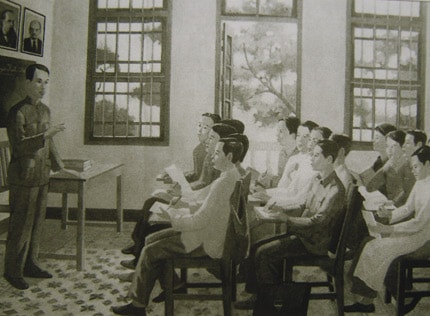
From then on, the Party and President Ho Chi Minh always attached great importance to ideological and theoretical work, considering it their top priority. Through propaganda, mobilization, and persuasion, the Party widely disseminated Marxism-Leninism, Ho Chi Minh Thought, and the Party's platform, guidelines, and policies throughout society; encouraging and motivating the entire army and people to act through each stage of the revolution, towards lofty goals.
During his lifetime, President Ho Chi Minh was a model of a propagandist and trainer for the Vietnamese Revolution. He valued effectiveness and substance, avoiding frills and embellishments, as he wrote: "A small program that is implemented properly is better than a hundred grandiose programs that cannot be done" (Letter to the Youth Conference, 1947). Comrade Le Quang Ba, former Chairman of the Central Committee for Ethnic Minorities, recounted: Uncle Ho paid close attention to the level of comprehension and understanding of everyone... When propagating, he always insisted on thoroughly understanding the target audience. For example, what hardships did farmers face? Why were workers so enthusiastic about participating in the revolution? What content would be appropriate for elderly people or soldiers to convey...?
The masses were very eager to read Uncle Ho's books and articles, and when he spoke, everyone seemed captivated. Why? Comrade Le Quang Ba explained: After writing a document, Uncle Ho would often give it to less literate people to read first. If any words or sentences were unclear to them, Uncle Ho would immediately correct them. After correcting, he would ask questions and make further corrections until the reader understood. Even complex and lengthy knowledge like "The Ten Principles of the Viet Minh," "Geography of the Northern Provinces," and especially "The History of Our Country," he devoted his efforts and intellect to transforming them into poetry, making them easy for all levels of society to read, remember, share, and follow.
I remember during the clandestine activities in Pac Bo, Uncle Ho directly supervised the training courses. The training time was very short, usually only 7 or 8 days. After the sections on the world and domestic situation, the program, and the regulations of the Viet Minh, Uncle Ho focused on thoroughly explaining the five steps of work: investigation, propaganda, organization, training, and finally, practical activities... The elements of opportunity and discipline were highly emphasized by Uncle Ho to the trainees. He reminded them: Study well, organize forces well, but only when there is an order from above, when the opportunity arises, should you attack! All of the above eloquently demonstrates a teaching of Uncle Ho, in his famous book "Correcting Working Methods": "Every thought, every sentence, every written word must clearly express the thoughts and aspirations of the masses" (1959).
The poet Tố Hữu wrote very aptly about him:
The voice of God, not thunder from above.
Each word is warm, penetrating the heart with heartfelt wishes.
Listening to Uncle Ho is like listening to the voice of the nation.
The voice of the past and the voice of the future...
(Poem "Morning in May" - 1951)
Speaking with veteran cadres and Party members in Nghe Tinh during his second visit to his hometown (1961), Uncle Ho emphasized the need for the Party to increasingly require more cadres and Party members who are exemplary in whatever they do, because the workload is growing; in the past, the Party organized the fight against the French and the Japanese, which was extremely difficult and arduous, but compared to then, the work now is even more difficult and complex! Propaganda work and ideological and theoretical work in the context of our country and the world over the past few decades are certainly more difficult and complex than before. Therefore, "improving the quality and effectiveness of ideological and theoretical work" has become one of the eight contents mentioned in the Political Report of the Central Committee of the Party at the 11th National Congress of the Communist Party of Vietnam, aiming to build a clean and strong Party, and gradually enhance the Party's leadership capacity and fighting strength.
The revolutionary period ahead presents many new opportunities and challenges for our Party. Propaganda work and ideological and theoretical work must be closely linked to organizational work and mass movements, with words matching actions; at the same time, correct and timely ideological guidance is needed, especially in the face of complex developments or turning points in the revolution... And the lessons and experiences of President Ho Chi Minh in ideological and theoretical work from years past are once again recalled, offering insightful perspectives!
Kim Hung