

The Ministry of Health will review the list of drugs covered by insurance.
Facing the risk of the insurance fund collapsing due to overspending, allegedly caused by the list of expensive drugs, Minister of Health Nguyen Thi Kim Tien said she would review the types of imported drugs that insurance must cover.
At a meeting discussing the implementation plan for universal health insurance in the 2012-2015 and 2020 periods, analyzing the reasons for the insurance fund's deficit, Mr. Nguyen Minh Thao, Deputy General Director of Vietnam Social Insurance, stated that too many people wait until they are diagnosed with an illness before purchasing insurance, while the list of drugs covered by health insurance has been expanded to include expensive drugs for cancer and cardiovascular diseases.
"With cancer treatment protocols, patients don't buy insurance in advance but wait until they are diagnosed to purchase it, yet they still receive annual payouts of up to several hundred million dong," Mr. Thao said.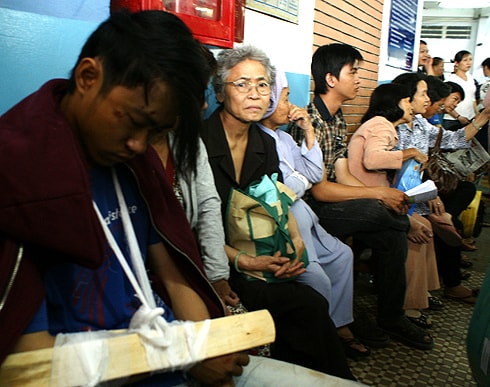
The health insurance benefit system will be reviewed. Photo: Thien Chuong.
The Minister of Health stated that it is difficult to withdraw drugs already included in the list of drugs covered by social insurance. However, to prevent overspending, the Ministry of Health will review and revise the list of excessively expensive imported drugs currently covered by health insurance.
According to the Minister of Health, doctors must be flexible in their treatment and cannot abuse or over-treat patients. However, to ensure that this flexibility does not harm patients, the Department of Medical Examination and Treatment Management must soon develop sufficient treatment protocols for all specialties so that doctors can use them as a basis for treatment.
Ms. Tien also suggested that the payment of health insurance benefits to different groups of participants should be reviewed. "It's unacceptable for those who pay the minimum premium or are new to insurance to receive the same benefits as those who have been insured for many years," Ms. Tien said.
Regarding the plan to implement the roadmap towards universal health insurance in the periods 2012-2015 and 2020, the Minister of Health emphasized that for the entire population to wholeheartedly participate in health insurance, the quality of examination and treatment for insured patients must first be improved.
According to the project's objectives, by 2015, over 75% of the population should participate in health insurance, and by 2020, approximately 90% of Vietnamese people should be insured. However, statistics from the end of 2011 showed that only nearly 64% of the population participated in health insurance, with the lowest participation rates including businesses, the near-poor, and those participating in voluntary health insurance.
According to Ms. Tien, public consensus is a crucial factor determining the success of the universal health insurance scheme. "To gain people's trust and encourage them to voluntarily purchase insurance, the service must be attractive through attitude and quality of service," Ms. Tien emphasized.
The Minister said that hospitals must reduce the hardship for patients by adding more examination rooms to shorten waiting times. The image of patients having to arrive at 5-6 am to see a doctor, then wait their turn, wait for test results, and queue to buy medicine should not be allowed to continue. "I am truly upset to see parents having to hold their children while waiting in the midday sun, and patients having to lie on double or triple beds," Ms. Tien said.
For the project to succeed, in addition to building trust through the quality of medical examination and treatment, Ms. Tien also requested that localities strengthen propaganda so that people understand the practical benefits and humanitarian significance of participating in health insurance, instead of waiting until they are diagnosed with an illness before buying insurance.
In Ho Chi Minh City in 2011, more than 4.6 million out of over 7.5 million city residents participated in health insurance, accounting for 61.70%. With this rate, Dr. Nguyen Tan Binh, Director of the Department of Health, believes that achieving a rate of over 80% of the population having health insurance by 2020 is achievable.
The Ho Chi Minh City Department of Health is also improving the quality of treatment to ensure patient satisfaction by establishing satellite clinics and implementing a family doctor model.
According to a representative from the An Giang Provincial Department of Health, in order for those participating in health insurance to enjoy more benefits, the province plans to develop a model of "family doctors and general practitioners practicing" who will provide insurance-covered examinations at health stations and private clinics.
According to Vnexpress - nt