
The road to school is still difficult.
(Baonghean.vn) - The start of the school year also coincides with the arrival of the rainy and stormy season, making attending classes for students in mountainous areas still fraught with difficulties...
(Baonghean.vn) -The start of the school year coincides with the arrival of the rainy season, making it difficult for students in mountainous areas to attend classes due to remote locations and rivers. When floods occur, villages are isolated, adults cannot leave the village, and children have to stay home from school.
Making bamboo rafts to take children to school.
The villages of Hong Thang and Hong Dien (Don Phuc commune, Con Cuong district, Nghe An province) are located on the road from Con Cuong town to Binh Chuan commune. Construction has been ongoing for many years but remains incomplete. Therefore, when going to the district market, in addition to money for essential supplies, residents have to prepare extra funds to cover frequent unforeseen circumstances, such as motorbike breakdowns along the way. These two furthest villages in Don Phuc commune are 5km from the commune's secondary school and require crossing two large streams. On sunny days, students have to wake up at 5 am to walk to class. On rainy days, they can only stay home, watching the torrential rain, hoping the rain will stop and the water recede so they can continue their education.
Hoang Thi My La, a 7th-grade student in Hong Thang village, expressed: "I just hope that a bridge will soon be built across the Phen stream (the main water source for the whole commune) so that I and my friends can go to school on rainy days." This girl, who has good academic performance, expressed her regret for the days she couldn't go to class.
According to information from the Don Phuc commune authorities, the completion date of the road is still unknown, as it is being constructed by several different companies. Therefore, it is also uncertain when children in these remote villages will be able to safely attend school during the rainy season.
According to Mr. Lang Vi Duc, Chairman of the People's Committee of Don Phuc commune: In these remote villages, people place great emphasis on their children's education. On days when the water level rises, many people take advantage of the opportunity to take their children across the fast-flowing water to school. In previous school years, there were times when the village was isolated for extended periods, and parents had to use bamboo rafts to take their children across the stream.
Mr. Ngan Van Tu (from Hong Dien village), whose daughter is in 6th grade, said: "When the water rises, even if I'm in the fields, I still have to go back to help my daughter cross the stream because I'm not comfortable letting her go alone."
They set up the shelter again at the beginning of the school year.
At the beginning of each new school year, parents from Tat and Xop Coc villages (Yen Thang commune, Tuong Duong district) gather at the commune's secondary school to build makeshift shelters for their children. Students from these two remote villages have no other choice but to study in these rudimentary shelters built from bamboo and reeds. Their meals consist only of wild vegetables and dried fish, with only occasional meals of fatty meat. But in the minds of the children at Yen Thang Secondary School, no matter how difficult things get, they must overcome the challenges to study well. Vi Thi Nhan, an 8th-grade student from Xop Coc village, said: “I don’t know what profession I will choose in the future, but I will definitely not drop out of school. I will continue my studies in high school and beyond.”
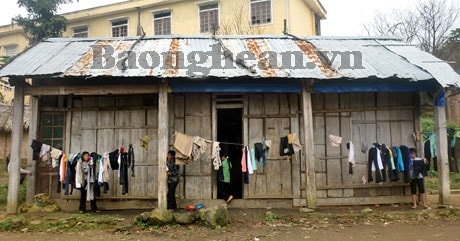
The boarding house for students of Na Ngoi Boarding Junior High School (Ky Son).
The new school year has begun, however, boarding students at Na Ngoi Boarding Secondary School (Ky Son district) are having to repair their old shacks to live and study in. In Ca Duoi village (Na Ngoi commune), there are nearly 40 temporary shacks housing more than 200 students, mostly Hmong people, located tens of kilometers away from the school.
Due to precarious living and learning conditions, the dropout rate among students in mountainous areas remains high. Difficulties in transportation mean that boarding students still live in makeshift, temporary shelters. This is a common problem in most mountainous and border districts and a major reason for high dropout rates. Therefore, as the new school year approaches, teachers in these areas have to travel to each village to encourage students to attend school. A teacher from Chiêu Lưu Secondary School (Kỳ Sơn District) calls these trips to encourage students to attend class "going to the fields," because to meet students and parents, teachers have to climb mountains and trek through forests to reach the villagers' makeshift huts.
Huu Vi