

Lesson 2: Those who escaped the "shadow of a waiting wife"
The people of Dien Hai commune, Dien Chau district, can never forget the pain of over 20 years ago, when a sudden tornado at sea claimed the lives of 36 men – the pillars of their small families. The seafaring profession has always been fraught with danger and uncertainty. Over the years, the pain, loss, and accumulated hardships have taught the women of this coastal region to be increasingly resilient, steadfast, and proactive. Even those whose husbands go out to sea silently prepare themselves mentally, ready to take charge of the family in case of a "bad situation." They need work and income to stabilize their lives and support their husbands in their arduous seafaring livelihood.
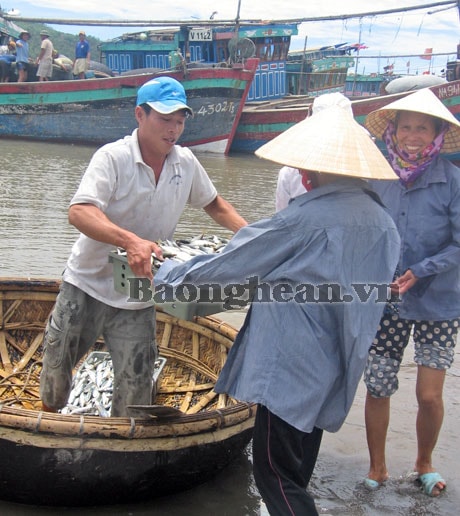
Women in coastal communes of Quỳnh Lưu district participate in seafood distribution services. Photo: Mỹ Hà
Meeting Ms. Nguyen Thi Ngan (38 years old) in Hamlet 4, Dien Hai Commune, Dien Chau District in the late afternoon, the owner of a fish, shrimp, crab, and squid wholesale business was busily selling goods to a bustling crowd. She recounted: "My family is struggling, so I have to work hard; I can't just sit around doing nothing. This small business won't make me rich, but it brings in 3-4 million dong a month, providing a solid foundation so my husband can feel more secure when he goes out to sea."
Like Ms. Ngan, the women in this coastal area all find work for themselves; some work in agriculture, some in trading, some go to school and work in healthcare or as teachers… if they can't find work, they take on odd jobs. They cannot leave the economic burden of the family to their husbands alone.
In Quynh Luu district, which has 14 coastal communes, I visited Mrs. Nguyen Thi Lien (54 years old) in Quang Trung village, Quynh Phuong commune. Looking at the woman with her sturdy build, dark complexion, and gentle smile, few would guess that she is the owner of one of the three largest seafood processing businesses in Quynh Luu. She began her story about her career during the most difficult years. That was in 1980, when the cooperative dissolved, leaving her and her husband with nothing but their bare hands. She had to give birth and work to support her family; with nine children—eight girls and one boy—if she didn't find a way to make a living, the whole family would starve.
Initially, she processed fish sauce. From 1987 to 2004, her fish sauce was sold throughout the district, eventually dominating the market in western Thanh Hoa province. However, as the economy became increasingly competitive, with unsold inventory and slow capital turnover, the woman from the coastal region sought a new direction. She decided to stick with what the local area already had – raw materials and labor – and switch to processing seafood, opening a fish steaming facility with about 40 employees. In 2006, she officially established Kim Lien Seafood Processing Enterprise. Ms. Lien said: "Our enterprise currently has about 100 employees, 90 of whom are women. Because the nature of the work is suitable for women, and also because it's a way to utilize surplus labor and create jobs for our people. Honestly, I don't want to say I'm successful, but life has taught me to do this kind of work."
Ms. Ho Thi Hoa (36 years old), a worker at Kim Lien Seafood Processing Enterprise, shared: “I’ve been working here for over a year. My main job is picking out the heads of anchovies and spotted fish after they’ve been steamed and dried, then drying them on the drying yards, because the other steps are done by machines. The work isn’t too strenuous, but the income is quite stable enough to help cover some of my family’s living expenses.”
“Women nowadays are not like they used to be, where every afternoon they would carry baskets to the beach to welcome their husbands home. Now, they all find themselves a stable job, with varying incomes, but no one is idle. They have become more proactive in life, not overly dependent on the unpredictable trips of their husbands and sons, and some are even very successful,” said Le Thi Mai, President of the Women's Association of Quynh Phuong commune.
Whether engaging in self-employment or working as laborers in processing plants, making ice, supplying fuel for fishing boats, salt production, clam harvesting, or net mending, women in coastal areas have long since escaped the shadow of the "waiting wife" mentality. Now, they immerse themselves in life, in the struggle for survival, working together as husband and wife to build a prosperous family.
Mothers and wives in coastal areas now place great emphasis on their children's education and family planning. Ms. Nguyen Thi Huyen (42 years old) from Quynh Lap, Quynh Luu shared: “In the past, children of coastal families dropped out of school very early, finishing only junior high school. Girls got married, and boys followed their fathers and brothers to sea. But now, we try to ensure our children get a proper education. Later, they can find a job, because going to sea is very hard work for both father and son, and we're always worried at home.” Her family has three children; the eldest is now in university, and the two younger ones are in high school and 8th grade, all well-behaved and academically successful.
Leaving the windy coastal countryside in the afternoon, the figures of the women, their skin tanned by the sun, still weary and hardworking, yet their smiles radiant and bright. One sees in them a renewed faith in life as they take control of their own destiny. And perhaps the storms of the sea, or the tempests of life, would find it very difficult to break these strong, resilient people.
(To be continued)
Ho Lai