

By 2012, 60% of documents were exchanged electronically.
On the morning of August 24th, the 16th Vietnam Information and Communication Technology Development Cooperation Conference, themed "Developing, Connecting, and Bridging the Digital Divide Towards E-Government," officially opened in Dong Nai.
The workshop was attended by representatives from central ministries and agencies; 63 provinces and cities; and businesses operating in the information technology sector from Vietnam and around the world.
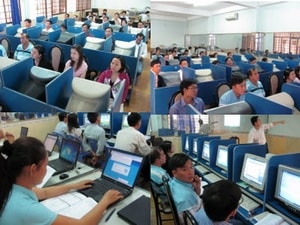
Training on information technology application skills for officials and civil servants in An Giang province. (Source: sogtvt.angiang.gov.vn)
This conference attracted the attention of numerous units, organizations, businesses, and experts working in the field of information and communication technology, with nearly 60 presentations focusing on issues such as models and experiences of e-government, e-government at the provincial, ministerial, and sectoral levels; ensuring information security; human resource training; and technology solutions and services.
According to the Ministry of Information and Communications, the information technology sector in Vietnam has made remarkable progress, with total industry revenue reaching US$20 billion in 2011. The dedicated data transmission network now covers the entire country, connecting nearly 4,000 locations across all ministries, agencies, and localities.
It is expected that by 2014, this network will expand to more than 11,000 communes and wards nationwide. Currently, 29 out of 30 ministries and ministerial-level agencies, and all 63 provinces and cities have electronic information portals. Central and local agencies have implemented more than 94,000 public services at levels 1 and 2, nearly 900 public services at level 3, and 11 public services at level 4.
In 2012, Vietnam's e-government was ranked 83rd out of 190 countries worldwide by the United Nations, an increase of 7 places compared to 2010.
Mr. Nguyen Minh Hong, Deputy Minister of Information and Communications, stated that the central task of the strategic plan to make Vietnam a strong country in information and communication technology is to promote the application of information technology in state agencies. The goal by 2015 is to build, perfect, and apply information infrastructure within government agencies, while simultaneously providing online public administrative services to citizens and businesses.
To ensure the effective application of information technology in state agencies and contribute to the goal of e-government, Associate Professor, Dr. Pham Van Sang, Director of the Department of Science and Technology of Dong Nai province, proposed that building a successful e-government requires the implementation of many measures, starting with the effective application of information technology in state administrative agencies.
To achieve this, we need to change the meaning of the term "traditional working methods," meaning shifting the mindset of employees from manual work methods to work methods that utilize information technology.
In addition, it is necessary to encourage officials and employees to apply information technology through emulation movements, making it mandatory and becoming a habit; and to reward those who work using information technology.
At the workshop, Mr. Nguyen Huu Hung, Director of the Government's Specialized Electronic Authentication Center, emphasized the goal of having 60% of official documents and materials from state agencies exchanged entirely electronically by 2015, and 50% of tax declarations from businesses and individuals submitted online. To achieve this goal, the Government Cipher Committee is ready to provide technical advice and support for the implementation of digital authentication applications in state agencies.
Within the framework of the conference, the organizing committee also presented computers to the Association of Elderly People and the Association of Victims of Agent Orange in Dong Nai province; awarded scholarships to outstanding information technology students from disadvantaged families at universities and colleges in Dong Nai; and organized a conference of the Central Council of member IT associations.
According to VNA - NT