
Mr. Kiem built the road.
Mr. Phan Van Kiem was a severely wounded veteran, receiving treatment at Camp C in Nho Quan, Ninh Binh province. Responding to the movement to bring wounded soldiers back to their villages, Mr. Kiem requested to return home due to his elderly father and young children. To supplement his income, he opened a small shop for his wife selling miscellaneous goods at the bridgehead of Xuan Thuy village, Thanh Xuan commune, a poor rural area in Thanh Chuong district.
(Baonghean)Mr. Phan Van Kiem was a severely wounded veteran, receiving treatment at Camp C in Nho Quan, Ninh Binh province. Responding to the movement to bring wounded soldiers back to their villages, Mr. Kiem requested to return home due to his elderly father and young children. To supplement his income, he opened a small shop for his wife selling miscellaneous goods at the bridgehead of Xuan Thuy village, Thanh Xuan commune, a poor rural area in Thanh Chuong district.
For the past four years, the road leading to Xuan Thuy village has been severely flooded and muddy. It's passable in sunny weather, but rainy weather is a nightmare. The worst part is that the students from Xuan Quynh and Xuan Thuy villages have no other way to get to school; they're covered in mud and often fall behind. Cars carrying construction materials or rural goods can only enter the village when it's sunny. Several springs have passed with the villagers enduring this situation. Mr. Kiem thought, "With Tet (Lunar New Year) approaching, what can we do? If no one else repairs the road for our children and grandchildren, then we must. Who would want to return home for Tet covered in mud like this?"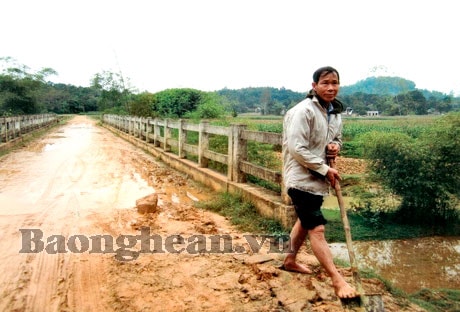
Mr. Kiem did just that. He hired people to collect and transport rubble from the dilapidated buildings of the two nearby primary and secondary schools to pave the road. He even had a section of his house wall demolished to open a barbershop, and he dumped that debris onto the road as well. Then, he personally dug drainage ditches on both sides of the road. After much hard work, over 50 meters of the dirt road at the bridge was finally passable, rain or shine. The students were especially happy; they no longer had to trudge through mud pushing their bicycles, their bodies covered in mud, to get to school.
I think there are probably many more muddy roads like this in Thanh Xuan and many other places. Hopefully, more individuals, organizations, and schools will follow the example of war veteran Phan Van Kiem and mobilize to repair roads, creating favorable conditions for people's travel and trade.
Nguyen Khac Ho (Thanh Xuan, Thanh Chuong)