
Now Muong Qua...
At the very end of the Giang River (Con Cuong), the Dan Lai ethnic group has for generations carried a tragic legend about a hundred golden bamboo stalks and a boat with oars. Once, an entire tribe hid themselves deep in the wild forests and mountains, and even today, the Dan Lai people still maintain their simple, gentle way of life… A legend, both fact and fiction.
(Baonghean)At the very end of the Giang River (Con Cuong), the Dan Lai ethnic group has for generations carried a tragic legend about a hundred golden bamboo stalks and a boat with oars. Once, an entire tribe lived in seclusion amidst the wild forests and deep mountains, and even today, the Dan Lai people still maintain their simple, gentle way of life…
Legends, both fact and fiction.
For generations, the elders of the Dan Lai people have passed down to their descendants the legend of their tribe. The story goes that in Hoa Quan region, now part of Thanh Chuong district, there lived a notoriously cruel tyrant. One day, the tyrant ordered the Le family to go into the forest and find "100 bamboo stalks made of gold and a boat with oars," threatening to massacre the entire family if they failed.
Knowing they couldn't find a hundred golden bamboo stalks and a boat to row, in the pitch-black night, the entire Le village packed their belongings and fled to the mountains.
The group ran and ran into the remotest corners of the land, upstream along the Giang River until they could no longer hear any human voices before finally stopping. “Following the deer’s footprints / Planting rice seeds / Following the tiger’s footprints / Planting corn seeds / Wandering on mountaintops / Desolate mountain slopes / Living in poverty / Like a small stream / Like the evening forest wind…”, their lives in the dark, nomadic forest, subsisting on bamboo shoots and wild yams, the Dan Lai people often cut banana leaves to build their nomadic huts. After a few times the banana leaves on their huts turned yellow, they would leave their old land to clear new territory. To avoid being hunted by the tyrant’s henchmen, the Dan Lai people changed their surnames from Le to La, concealing their identities.
Over 600 years ago, an unfortunate migration took place in a remote forest region. Through many ups and downs and changes, a segment of the Dan Lai people still maintain two strange customs: immersing newborn babies in cold water immediately after birth and… sleeping sitting up. “In the past, there were many fierce tigers upstream on the Giang River. Many people were captured by tigers in the middle of the night and dragged into the forest to be eaten. To avoid wild animals, and to escape at the slightest sound, people had to sleep sitting up. Moreover, in the cold season, every household had to light a charcoal stove to keep warm. Sitting by the fire, one hand propped on the chin, the other on a stick to stir the charcoal, they slept soundly. They were used to sleeping like that!” said La Van Yeu, the Party Secretary of Co Phat village. I asked Mr. Yeu: “Do the Dan Lai people still sleep sitting up today?” The Party Secretary of Co Phat replied: “It’s become less common now!” "Life is better now, everyone has a bed, so fewer people sleep sitting up!" The custom of immersing newborns in cold water is still quite common. As soon as a baby is born, the mother immediately immerses it in stream water, regardless of whether it's hot or cold outside. "Any baby that survives the cold will be healthy later. Moreover, doing so is also a way to clean the newborn's body," said a Dan Lai resident. Quite some time ago, a two-day-old baby was taken out by its mother and doused with cold water in freezing weather to "clean its body and boost its immunity." The result was that the baby turned blue and gradually fainted.
Reverse source of the gap
Poverty was a persistent and enduring problem; for a long time, the main source of livelihood for this small ethnic group in the remote mountains was cassava. Hunger lurked, and access to education was precarious; the number of Dan Lai people with college or university degrees could be counted on the fingers of one hand. Most Dan Lai people, after completing their studies, returned to their villages to teach their children: Distinguished Teacher La Van Bon (Chau Khe commune, Con Cuong district), Teacher La Van Tham, Teacher La Thi Huong, Teacher La Thi Hang (Mon Son commune)... I met Teacher La Thi Hang nearly 15 years ago, when she was a high school student at Nghe An Boarding School (Vinh). Now, Hang is a mother, and her husband is the Secretary of the Youth Union in Mon Son commune.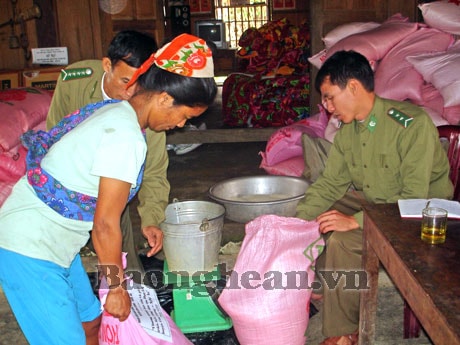
Providing rice assistance to the Dan Lai ethnic minority. Photo: Hung Phong.
To reach Cò Phạt, Bản Búng, home to the Dan Lai ethnic group, the only means of transportation is by boat upstream along the Giăng River into the Khặng ravine. The river meanders, its course winding and full of rapids and waterfalls. Many accidents have occurred on this treacherous waterway, where boats have crashed into cliffs, hit submerged rocks, or capsized in whirlpools during the rainy season. Quite some time ago, a journalist died while traveling to visit the Dan Lai people. Despite the dangers, dozens of boats travel back and forth daily. Volunteer youth, relief teams from distant provinces, and even teachers trek through the forest carrying education to poor students in this remote mountainous region.
“After graduating from the Nghe An Teacher Training College, I went to Mon Son, to teach in Khe Khang. Every two years, we rotate teaching locations from the village to the commune center,” Ms. La Thi Hang recounted. Coincidentally, during a village cultural performance, Ms. Dan Lai met Mr. Nguyen Van Thao, a Youth Union official. After a period of getting to know each other, they decided to get married. “The matchmaker was the shaman Ha Van Thong. The shaman, on behalf of the groom's family, brought betel nuts and other gifts to the bride's family to ask for the auspicious date and time for the wedding. The Thai people traditionally welcome the bride at midnight, but the Dan Lai people, like the Kinh people, welcome the bride during the day!” Thao explained. In the upper reaches of the Giang River, Mr. Thong is considered a shaman who is knowledgeable in both astronomy and geography; from prayers and exorcism to divining land, auspicious dates for groundbreaking ceremonies, funerals, and weddings, he can predict everything!
At dusk, the Youth Union Secretary of Mon Son commune, Nguyen Van Thao, led us to the boarding house for Dan Lai students in the center of Mon Son commune. “At home, we eat cassava all year round, it’s so hard! At school, we get to eat rice every day and have clothes to wear all day! Going to school is much better, sir!” said Le Thi Di, a 7th-grade student from Bung village. With a subsidy for food and education, the school transfers the monthly food money for the Dan Lai students to the boarding house's caregiver to buy food and provide daily meals for them. Most Dan Lai people bear the surname La, but some still retain the surname Le. The boarding students at the center of Mon Son commune are divided into two groups: one group lives in a spacious house on the edge of the Muong Qua rice fields, where the rice is plentiful and they live comfortably; the other group lives by the river. The students by the river face more difficulties because “the school doesn’t have the funds to build a boarding house,” so they have to use wooden platforms as beds. Simple and cramped, but filled with laughter.
With the water returning, Dan Lai will be revived.
The gnawing hunger and age-old poverty were once a haunting specter for the people of Dan Lai, not just during the lean season. A decade ago, cassava was a "traditional" food in the upper reaches of the Giang River, passed down through generations. Before 2000, visiting the villages of Bung and Co Phat, we were moved to tears by the sight of the locals' meals consisting entirely of boiled cassava. Occasionally, their evening meal would be improved with a small fish from the stream or a rare piece of wild boar meat they had hunted.
In 2002, the migration to Thach Ngan commune and to the center of Mon Son commune (in Tan Son and Rao Tre villages) marked a new turning point, changing the lifestyle and mindset of a segment of the Dan Lai people. "Hands-on guidance," Con Cuong district officials went down to the villages to help the Dan Lai people build new houses, cultivate rice intensively, and raise poultry. Alongside this were urgent relief efforts with rice and money to help the Dan Lai people quickly adapt to the new land and stabilize their lives. But when the officials left, things seemed to revert to their old ways. The inertia of centuries-old habits and ways of life based on hunting and gathering had deeply permeated the mountainous upstream areas of the Giang River. Lack of water led to abandoned fields, overgrown with weeds.
Bringing water from the Pha Lai dam near the Muong Qua rice fields to the people, providing irrigation to reforest the barren fields, is what Con Cuong district is doing. With water, life in this arid land will soon be revived. "The lives of the Dan Lai people in the valley are still very difficult!" said Party Secretary La Van Yeu. The resettled people in the two villages of Cua Rao and Tan Son, although poor, still have enough food to eat in many families. If water is brought in, and the Dan Lai people work hard in the fields, every household will be well-fed. The head of Tan Son village, Mr. Ha Van Canh, said the village has 21 households, nearly 100 Dan Lai people. This area has 11.7 hectares of cultivated land, including 4 hectares of rice paddies. Such an area of land could be transformed into a fertile rice and crop field to support the people.
The engine roared to life, and in an instant, the boat left the Lai Ferry dock, speeding swiftly along the winding Giang River. It takes about two hours by boat from the central village of Mon Son to Co Phat village. Bung village is further away, requiring nearly four hours. Teacher La Thi Hang once again left the Muong Qua fields, carrying her knowledge to the remote forests to teach the Dan Lai students. "Next year, I'll go back to Mon Son. A few years after that, I'll go back to the valley to teach!" said Ms. Hang. Her life as a teacher continued quietly and patiently, traveling back and forth on this small river amidst the vast forest.
Quang Long