

For the sustainable development of the raw material area.
(Baonghean) - Anh Son district has nearly 6,000 hectares of flat hilly land, distributed in the communes of Hung Son, Tuong Son, Duc Son, Long Son, Binh Son, Thanh Son… which are very suitable for short-term industrial crops.
In particular, over 22,000 hectares of red-yellow ferralite soil are also suitable for growing long-term industrial crops and fruit trees. The Resolution of the 18th District Party Congress, term 2005-2010, identified three economic zones for investment, with Zone 1 as the central area for developing and establishing a closed-loop system for raw material crops such as sugarcane and tea. Based on this perspective, the district has accelerated sustainable economic development by forming large-scale, concentrated raw material production zones linked to processing industries.
In fact, in Anh Son, farmers have many advantages for developing raw material crops. For sugarcane, besides the Song Lam Sugar Factory right in the raw material area with a processing capacity of 700 tons/day, there is also the Song Con Sugar Factory in Tan Ky. Regarding tea, the district has three fresh tea processing factories: Anh Son Black Tea Processing Factory, Hung Son Processing Plant, and Bai Phu Tea Processing Enterprise, with a total processing capacity of over 75 tons/day.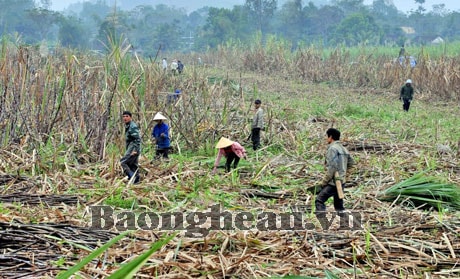
Sugarcane harvesting in Hung Son. Photo: SM
Based on these advantages, Anh Son has issued resolutions and projects with annual planting targets for tea and sugarcane. In directing communes to plant raw material crops according to the plan, the district always makes adjustments and additions to ensure effective implementation. In addition, Anh Son has also issued mechanisms to support, encourage, and mobilize people to reclaim land, convert the crop structure, and shift less productive hillside and outlying land to tea and sugarcane cultivation; coordinating with companies to commit to supporting people in land reclamation, new planting, transportation in raw material areas, digging and constructing reservoirs to retain moisture, and especially committing to raw material purchase prices.
Thanks to synchronized policies, farmers in Anh Son have boldly transformed their land structure from low-yield acacia, corn, and cassava plantations to sugarcane and tea cultivation. To date, the entire district has formed a fairly large sugarcane raw material area, covering 1,600 hectares out of a total planned area of 1,800 hectares (an increase of 116% of the plan) of the Song Lam Sugarcane Company, covering the entire Thanh-Binh-Tho region and several communes of Anh Son. Some areas bordering Tan Ky district, such as Binh Son, Vinh Son, and Tam Son, have switched to selling sugarcane to the Song Con Sugar Factory. Regarding tea, the entire district now has over 1,400 hectares under cultivation. Tea cultivation has expanded beyond the factory and enterprise raw material areas to forest hills in communes such as Phuc Son, Long Son, and Cam Son. Notably, the district is introducing clean tea production according to VietGAP standards in Hung Son and Phuc Son.
In recent years, thanks to the application of intensive farming techniques, the productivity and output of raw materials have been high. Specifically, sugarcane production in the district has reached approximately 9,000 tons, with an average yield of 60 tons/ha, ensuring sufficient raw materials for the current factory with a processing capacity of 800 tons/day, generating nearly 9,000 tons of refined sugar annually. For industrial tea production, output has reached nearly 15,000 tons, with a yield of 10-12 tons/ha, only ensuring about 60-70% of the processing capacity of the 3 tea processing facilities in the area…
However, for the sustainable development of raw material areas in Anh Son district, several difficulties still need attention and solutions. These include insufficient attention to annual investment in new tea plantations. In reality, due to high investment costs, some localities have failed to meet their planting targets because of high initial investment and unstable purchase prices. Roads in sugarcane and tea growing areas are also inadequate. Furthermore, there are currently three tea processing factories in the district, and the raw material area only meets 60-70% of the processing capacity. However, due to poor harvesting practices, localized shortages and surpluses of raw materials still occur during processing.
In particular, regarding investment and expansion of new planting areas for tea and sugarcane, the coordination between businesses and farmers in the area has not been consistent or continuous. For sugarcane, although the Song Lam Sugar Mill has implemented sugarcane purchasing based on sugar content, farmers are still not reassured by this method. Sugarcane prices are erratic, and there is no clear policy mechanism between the mill and farmers in the raw material area to encourage them to invest in sustainable development of the raw material region.
Luong Mai