

Mexico discovers 110-million-year-old fish fossil.
Mexican scientists recently discovered fossils of two fish species dating back 110 million years, to the Cretaceous period, in the El Chango settlement, Ocozocoautla de Espinosa district of Chiapas state, a region known as the "fossil home" of many animal species in Mexico and Latin America.
According to Dr. Marco Antonio Coutiño, Director of the Institute of Paleontology under Mexico's Ministry of Environment and Natural History, the two fish fossils were given the scientific names "Pepemkay maya" and "Zoqueichthys carolinae" to honor the Maya and Zoque cultures that still exist in the state of Chiapas.
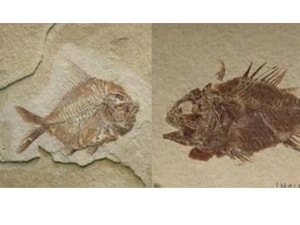
Fossil images of two fish species. (Source: flickr.com)
Preliminary assessments suggest that these two fish species belong to the vertebrate fauna of the modern era.
In appearance, the "Pepemkay maya" fish has a well-developed brain, fins with five bones and eight soft ridges, while the "Zoqueichthys carolinae" fish has a crest, and fins with up to eight bones and 12 soft ridges.
For many years, fossils of these two fish species have been discovered in England, Israel, Italy, Lebanon, Morocco, and Portugal.
Archaeologists believe that this discovery provides science with further evidence to confirm that the Chiapas region of Mexico was highly diverse in terms of biodiversity and animal life even in prehistoric times.
According to the plan, the two fossils will be displayed at the Eliseo Palacios Aguilera Museum in Tuxtla Gutiérrez, the capital of Chiapas state in southeastern Mexico, to serve both domestic and international tourists.
According to (VNA) - VT