

The rivers refuse to be dividing lines.
In the early spring of 1971, the Tri Thien battlefield achieved a complete victory in the counter-offensive campaign on Route 9 - Southern Laos, followed by the fiery summer of 1972, liberating Quang Tri completely from south of the Ben Hai River to north of the My Chanh River. Subsequently, our troops continuously repelled the enemy's frenzied counter-attacks, with the decisive battle taking place at the Quang Tri Citadel. In early 1973, we crushed their encroachment operation south of the Hieu River in Long Quang, Thanh Hoi, and Cua Viet, immediately after the Paris Agreement was signed – now exactly 40 years later.
(Baonghean)In the early spring of 1971, the Tri Thien battlefield achieved a complete victory in the counter-offensive campaign on Route 9 - Southern Laos, followed by the fiery summer of 1972, liberating Quang Tri completely from south of the Ben Hai River to north of the My Chanh River. Subsequently, our troops continuously repelled the enemy's frenzied counter-attacks, with the decisive battle taking place at the Quang Tri Citadel. In early 1973, we crushed their encroachment operation south of the Hieu River in Long Quang, Thanh Hoi, and Cua Viet, immediately after the Paris Agreement was signed – now exactly 40 years later.
Throughout this period, the journalists from the Tri-Thien-Hue news agency each went their separate ways along the length of the campaign, and in early 1973, they had to temporarily stop at the northern bridge abutment of Quang Tri - Thach Han. Meeting Thanh Phong, a reporter from the Vietnam News Agency, we looked at each other for a moment, clasped hands, raised them to the sky, towards the southern bank of the river and the ancient citadel dimly visible in the enemy's shadows, and said:
- After nearly twenty years between the two rivers, we've finally managed to push the temporary demarcation line this far, Hien Luong - Thach Han!
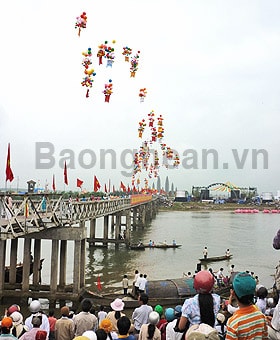
Hien Luong Bridge, Ben Hai River, on April 30, 2012.
We understand that for nearly twenty years (1954-1973), our army and people endured countless hardships and shed much blood to regain over thirty kilometers, and thousands more kilometers still lie ahead: Thach Han, Bo River, Huong River, Han River, Central Highlands, Saigon, Vung Tau, Ca Mau... After saying goodbye, we quickly parted ways with the soldiers to head to the front lines – where the enemy was cunningly encroaching on every inch of land in Sai Market, Tich Tuong - Nhu Le, Ong Do, Co Bi, Hien Si, Bong, Nghe, Mo Tau...
In the summer of 1974, the Tri Thien Military Region and the 2nd Corps jointly opened a writing class in Tra Lien, right by the Thach Han River, where the sounds of gunfire against the invading enemy at the Sai Market outpost still echoed. One afternoon, Duy Khan, Vu Thuoc, Hoang Nhuan Cam, Vu Am... and a few others traveled from Tra Lien through the scorching sun to the northern side of Quang Tri Bridge. This place had witnessed countless waves of our troops crossing the river to participate in the immortal 81-day and 81-night battle at the ancient citadel, many of whom never returned; it had witnessed the repatriation of our captured comrades, their bodies still bearing the deep scars of American and puppet regime prisons, returning to the liberated zone... We stood silently on that land still scarred by bombs and bullets, when suddenly one of us and all of us lay down, kissing the burning earth at the bridgehead, spreading our arms to embrace the land - the riverbank - to our hearts.
In that quiet moment, everyone seemed to be contemplating the Ben Hai River and the Hien Luong Bridge, now behind them: "Now the bridge has been built / The fragrant new wood planks allow us to meet again / You return to Quang Tri, Gio Linh / Climbing up the temple slope, silently gazing at Quan Ngang / The grass overgrown the desolate fields / Birds chirp on broken branches under the blazing sun" (To Huu).
Ahead lay the Thach Han River and the collapsed Quang Tri Bridge. Before the writing class was finished, we were all ordered back to the military region and corps to advance in the Spring-Summer 1975 Campaign. At this time, we had just liberated Buon Ma Thuot, terrifying the enemy in the Central Highlands and causing panic throughout the region. The corps and military region forces from the two provinces north and south of the Truoi, Huong, and O Lau rivers advanced into Pho Trach and My Chanh, cutting off the southern flank from Highway 1 in Phu Loc, blocking the Tu Hien and Thuan An gates, coordinating with the inner-city base to seize Hue, crossing the Trang Tien Bridge and the Huong River into Thuong Tu and Ngo Mon, and directly capturing the forward command post of the puppet 1st Corps at Mang Ca on the afternoon of March 25th, the same place where, during the Tet Offensive of 1968, we only managed to capture the western part of the fort before having to withdraw.
Here, we found reporters from Nghe An and Ha Tinh provinces, such as Ngoc Dan and Quoc Viet, who were part of the 2nd Corps that liberated Da Nang. Less than a week earlier, the engineering troops, acting on orders from the Commander of the Truong Son Army, Dong Si Nguyen, had completed the Quang Tri bridge, allowing over 1,000 vehicles carrying the 1st Corps from Vinh - Ben Hai into the campaign. Just over a month after the liberation of Hue, the swift and daring Ho Chi Minh Campaign achieved complete victory on the afternoon of April 30th. From Quang Tri to Ca Mau, thousands of kilometers along the country, and even reaching Truong Sa, Con Dao, Phu Quoc, and Tho Chu, were completely liberated!
Swift, swift, bold, bold—that's how it was. The country was united. In the days after liberation, journalist Hoang Nhuan Cam wrote the long poem "Between Two Rows of Six-Eight Verse," which evokes the space of the Han and Huong rivers with the folk verse: "Students from Quang Nam come to take the exam / Seeing the Hue girl, they can't bear to leave." Once, on the occasion of poet Huy Can's visit, writers and journalists gathered by the Huong River, near the school where President Ho Chi Minh once studied. Many of them had lived in enemy territory, such as Trinh Cong Son, Vo Que, Thuy Mai, Tran Pha Nhac... In the meeting room, Hoang Nhuan Cam, without notes, with his Hanoi accent from the time of "Going to the front lines when cicadas are singing," read the long poem from beginning to end. We heard some words somewhere:
- Liberation poetry, poetry of Uncle Ho's soldiers, poetry of Hue, that's what real poetry is!
The brothers assigned to produce the radio program for the Liberation Army of Tri Thien Hue chose to introduce Cam's poems on Hue radio!
The poetic voice on the Perfume River, the poetic voice of that powerful May river. Vietnam is one, the Vietnamese people are one. Nothing is more precious than independence and freedom! Uncle Ho's words are truly sacred, so close to the heart of the liberated city - the place where Uncle Ho spent his sorrowful childhood and his vibrant student days.
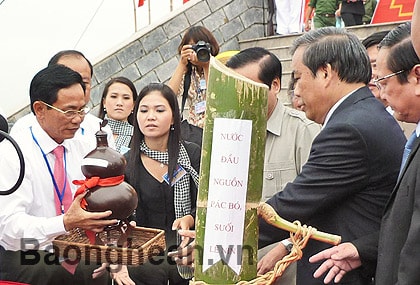
The ceremony of merging the waters of the three sacred rivers of Vietnam takes place during the festival celebrating the reunification of the country.
Even now, returning in this spring and summer, the memories of those days, the people, and the river—which now firmly connects the two banks and stretches from Lung Cu in the far north to Ca Mau in the far south, reaching even the distant islands of our homeland—remain deeply etched in our hearts.
Rivers never accept being a dividing line!
Doan Yen (Vinh City)