

Real estate inventory tension
(Baonghean)The current real estate market is gloomy and has a large inventory of unsold properties. As a result, many projects have been temporarily suspended, stalled, or unable to commence construction.
Currently, there are 110 real estate development projects by 74 enterprises in the province, of which 94 are in Vinh City, and the rest are in Cua Lo Town and other districts and towns. Similar to the general situation in many provinces and cities nationwide, the real estate market in Nghe An province continued to face difficulties in 2012 and the first three months of 2013. Real estate transactions through trading floors (selling houses by real estate businesses) and transactions not through trading floors (buying and selling houses by individuals) were very sluggish, with a sharp decrease in the number of transactions, and many projects even had no transactions at all.
Residential real estate prices have fallen across all market segments. According to incomplete statistics, the inventory of low-rise housing units in housing development projects in the province is 2,595 units (valued at approximately VND 3,554 billion); apartment units are 1,120 units (approximately VND 1,325 billion); office space and commercial premises for rent in real estate projects amount to 12,982 m2 (valued at approximately VND 245.98 billion); and the inventory of land plots is 5,148 m2 (valued at approximately VND 23.166 billion).
However, the above figures do not reflect the actual situation of unsold real estate, not to mention projects with unsold inventory that have not been reported. Many of these unsold projects have partially raised capital; completed land clearance; and invested in infrastructure but have been halted due to a lack of market demand. Secondary investors have purchased these properties but have been unable to sell them. Therefore, the actual amount of unsold real estate is likely higher than the reported figures.
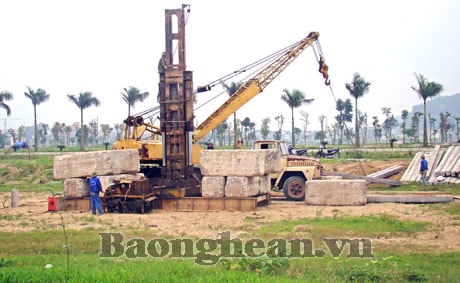
Vinh Tan Eco-Urban Area Project (Vinh City). Photo: Canh Nam
While supply is in surplus, those looking to buy a home are still waiting for prices to fall further. Consequently, the number of successful transactions is low, and the total transaction value is not high. Seven out of sixteen real estate agencies in Nghe An province had no successful transactions in 2012 and the first three months of 2013. Mr. Pham Thai Duong, General Director of Vinaconex9 (Construction Corporation No. 9), stated: Although the company is actively working to revitalize the market through various incentives such as price reductions, accelerated construction progress, improved apartment quality, and interior design promotions, the inventory and outstanding customer debts at the project amount to 315 billion VND. At the Nghi Phu project, the company still has 15,700m2 of residential land with infrastructure, 7,600m2 of low-rise houses under construction, 9,500m2 of apartment units, and 1,200m2 of office space for rent in inventory.
Meanwhile, at the Nghe An Oil and Gas Building Project, completed in December 2012, after more than two years of operation, there are still 20 unsold apartments (106 out of 126 apartments have been sold); only 20% of the office space has been occupied, and the shopping center has yet to open. The reasons for this delay, besides the general market difficulties, include the fact that the Nghe An Oil and Gas Building Project is a complex comprising a shopping center, office space for rent, and residential apartments. Therefore, there is currently no policy to issue individual property ownership certificates to organizations and individuals who lease or purchase properties built on state-owned land with annual payments.
Similarly, at the Vinh Tan Eco-Urban Area project, as well as the Le Nin Boulevard East Apartment Complex project and the CT1 Quang Trung high-rise apartment project, investors are facing many difficulties in recovering capital due to the frozen real estate market. Even in the Vinh Tan Eco-Urban Area project, the Corporation has invested over 700 billion VND, but currently, capital mobilization and recovery are progressing very slowly, affecting the reinvestment in the project.
The current difficulties in the real estate market cannot be attributed solely to its inherent shortcomings. These include unplanned development, a lack of market research, and high inventory levels that are difficult to sell. This is further compounded by the fact that, over the years, businesses have focused heavily on investing in high-end, large-sized homes, neglecting apartments of suitable size and price to meet the needs of the majority of the population.
At a recent conference organized by the Provincial People's Committee to address difficulties in the real estate market, Mr. Nguyen Nam Dinh, Deputy Director of the Department of Planning and Investment, stated: There is actual market demand, especially for housing for those with average or below-average incomes (who can only afford houses under 400 million VND). However, because the supply is mainly geared towards those with higher incomes or due to speculation, the supply and demand are mismatched, leading to a low success rate in transactions.
According to the Nghe An Department of Planning and Investment, the current real estate inventory is partly due to the fact that land and house prices remain very high compared to their actual value and compared to people's income (5 to 10 times higher than the standard). As long as prices remain excessively high, solutions to support the market will be difficult to implement effectively because people in need of housing do not have sufficient funds. Current real estate prices (houses, land, apartments) are about 10% lower than the same period in 2011 and about 20%-25% lower than their peak prices. In reality, the real estate market still has many bottlenecks; the cost structure of real estate is influenced by too many factors, especially land prices and bank interest rates, which currently account for more than 40% and 50% of the cost.
The frozen market has caused significant difficulties for many real estate businesses and real estate service providers, especially small and medium-sized enterprises (SMEs) with limited financial resources, who have to borrow from banks or rely on capital raised from customers to implement projects. The output of real estate businesses is the input for other sectors, including construction materials; high inventory levels mean an economic slowdown. The frozen real estate market not only creates difficulties for real estate businesses but also affects the liquidity of credit institutions because, along with inventory buildup, bad debts in the real estate sector are also increasing.
Addressing the real estate inventory surplus is one of the key tasks in 2013. To alleviate the difficulties in the real estate market, the Provincial People's Committee has implemented a comprehensive solution, including stimulating domestic consumption and a credit policy with reasonable interest rates. The question is, how should this be implemented?
Thu Huyen