

In the old market, who sold what and who bought it?
This afternoon, as I finished preparing the offerings for the New Year's Eve ceremony, hearing the shouts of people calling out to each other as they went to the last market of the year, my heart suddenly sank, a pang of nostalgia rising within me. A fragrant yet intensely pungent and spicy scent of incense stirred my soul, bringing back hazy and vivid memories of old markets, of bustling street vendors and the rhythmic chewing of betel nuts by my grandmother, as if they were echoing somewhere nearby.
(Baonghean)This afternoon, as I finished preparing the offerings for the New Year's Eve ceremony, hearing the shouts of people calling out to each other as they went to the last market of the year, my heart suddenly sank, a pang of nostalgia rising within me. A fragrant yet intensely pungent and spicy scent of incense stirred my soul, bringing back hazy and vivid memories of old markets, of bustling street vendors and the rhythmic chewing of betel nuts by my grandmother, as if they were echoing somewhere nearby.
She used to count down the days and weeks until market day. When market day arrived, she would busily prepare from dawn, from her small basket to her brown áo dài (traditional Vietnamese dress), from her headscarf to her sandals, bought since her maidenhood, cherished her whole life, even tucking them into her basket when she went to the market. In my hazy memory, I still retain her radiant face, her small figure, her unsteady steps, pushing open the creaky door as she hurried out of the house in the early morning mist, hurrying along the winding dirt road through the green fields and thatched houses still asleep, not yet ready to smell the smoke from their kitchens. It wasn't until I was six or seven that I was allowed to go to market with her. So much excitement, so much wonder, that first time! From childhood until then, I had only known the kitchen, the thatched house, and my universe was confined within the worn-out apron of my grandmother, so the market day seemed so vast to me. In my eyes back then, nothing was better than the market fair, and I believe that everything in the world originated from these fairs.
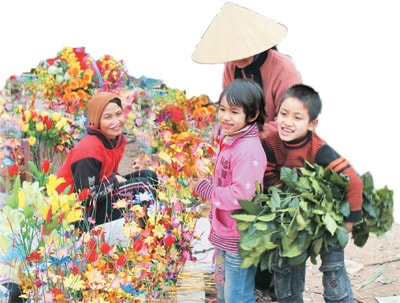
Going to the market with Grandma - Photo: Internet
The market day was so much fun! From adults to children, from men to women, everyone found their own delights. I loved it most when my grandmother gave me a coin to buy snacks, but I wouldn't eat anything because I was too busy admiring the clay figurines and whistles, blowing into them to produce their delightful, melodious sounds. I often secretly longed to see the children being led by their grandmothers or mothers to the stalls of figurines at the market gate, buying one to blow into, filling the whole market with its sound. My dream was finally fulfilled. I timidly offered the coin to the kind-faced old man, who seemed to have a soul not only from the clay but also from the clay itself. I happily received a small, beautiful whistle, hesitantly bringing it to my lips and blowing gently, startled by the clear, resonant sound that still echoes in my ears to this day. My grandmother, meanwhile, was busy buying bunches of green bananas to place on the altar. Nowadays, when we go to the market, we often pause for a few seconds as we pass stalls selling offerings and ceremonial items, reminiscing about how our grandmothers used to spend hours carefully selecting a bunch of fifteen bananas, offering them as incense to show respect and fragrance. Who remembers, who still takes the time to count and search like that? It's a pity for the bunch of bananas lying precariously by the stall; our grandmother is gone. Who would cherish and meticulously preserve it with all their faith and reverence? While the women are busy buying offerings and betel nuts, the men are engrossed in the animal stalls, arguing loudly about which pig has a yin-yang swirl, which is considered very auspicious, or which buffalo has long, curved horns, a slender belly, and wide hips – truly a beautiful buffalo, and that the price they paid wasn't expensive at all. The little boy, whom his grandfather took to the market, paid no attention to the adults' seemingly "wise" conversation, as he was too busy playfully teasing the bewildered calves venturing far from the yard and garden for the first time.
The old markets were always so noisy and lively, because they weren't held every day, but on specific days, usually the 2nd, 7th, 25th, and 27th of each month. Partly because in the old days, people were poor and spent their lives tending to their pigsties, vegetable gardens, and small rice paddies; their lives revolved around these worries, and even a whole day seemed insufficient, leaving no time or money for shopping or enjoyment. Furthermore, the old production methods were small-scale and self-sufficient, so each household was responsible for its own food, and only rarely did they buy things they couldn't produce themselves. But perhaps it was precisely because of this that the market days became so precious, so eagerly awaited, a sacred ritual, a festival full of color and sound. Looking back now, we realize how endearing those seemingly simple and rustic things of the past were. Suddenly, I found myself fond of the people in their wrinkled clothes, hurrying along with their carrying poles from dawn till dusk, coming from far and wide to this market. Their accents, clearly from the countryside, revealed the hardships of working under the sun and rain, the years of toil and toil. I also loved the women selling chickens and ducks, their plump figures seemingly heavy, yet surprisingly quick on their feet, nimble on their hands, and quick on their tongues. Their hands never stopped examining the gizzards of one chicken, lifting the necks of another, while they chattered away, praising the delicious chicken and plump duck to the customers. And then, when the chickens were safely placed in the dangling baskets held by the buyers, both sides smiled happily at their successful transaction. We love the small, skillfully woven baskets, still fragrant with the scent of bamboo and rattan; we love the large fish splashing in the water, bringing back the salty smell of the river and sea; we love the Dong Ho folk paintings, their colors seemingly still damp on the rough, sticky rice paper, depicting scenes of coconut harvesting, mouse weddings, mother pigs and piglets, or the colorful Tet market, vividly alive in our minds as if they were painted just yesterday.
Oh, my ancient market! Where can I find it now? Memories are shrouded in dust. Those hurried afternoons of the 27th of Tet, rushing to catch the last market day of the year, the bustling haggling in one corner, the throngs of people admiring kumquats and peach blossoms in another. Does the old woman selling those pretty sticky rice cakes still wrap them with the same firmness and fragrance as before? Do the whistles we loved so much still retain the warmth of freshly fired clay, their sound still clear and resonant like modern toys? The old calligrapher, with his toothless mouth, leisurely sitting on a mat, with a brush and inkstone, his eyes dim, his hands weak, has he allowed spring within me to fail to sprout and bud, remaining forever asleep in the faded red hues of those Tet couplets of yesteryear? Sitting absentmindedly on a pre-Tet afternoon, noticing the wind is less cold, the rain less incessant, and the peach blossoms less vibrant than in past Tets, I suddenly remember a few lines of poetry by Xuan Dieu and tears well up in my eyes.
"I want the sun to go out."
Make sure the color doesn't fade.
I want to tie the wind down.
Let the fragrance not fly away.
Oh, Xuân Diệu, Xuân Diệu, the springs of yesteryear are tightly packed away in our memories, but how long will heaven grant us in our youth? As spring cycles and the earth and sky turn, who knows how different we will be? Will those lovely, precious springs of yesteryear live on in our hearts forever, or will they fade and lose their fragrance with the passing years? The old markets have become a thing of the past. Markets now open year-round, so easily and daily that they have become commonplace for us, no longer worth anticipating or cherishing. We no longer eagerly seek out the smiling, flirtatious market-goer, or stop by the tea stall of the old woman with graying hair and black teeth, constantly chewing betel nut and chatting about the old days. We no longer have time to remember or cherish those simple joys, perhaps only a fleeting ten or fifteen minutes to quickly buy some vegetables or a few ounces of meat after a day of struggling with the worries of food and money. Besides, where have those people gone now? Or are they also busy chasing after rising rice and gasoline prices, calculating profits and losses, trying to buy and sell at high prices, and hardly anyone cares about nostalgic, sentimental customers anymore?
This afternoon, my mother sat on the porch, cradling her grandchild, leisurely singing lullabies that I vaguely heard in my childhood dreams: "I am a country girl, I have always been a trader. From the headwaters of the river to the source, I trade in whatever is in season, keeping up with the demand..." Suddenly, I felt as if my mother, too, was pouring out her own sorrowful feelings in her song. This Tet holiday, instead of going to the market, my mother and I went to the supermarket, to the shopping mall, where there were escalators to the second and third floors, where goods were "tested and guaranteed food safety," where the electric lights were dazzling and warm, while outside it was gloomy and rainy. But was that place the place my mother had longed for and been attached to since she was eighteen or twenty, until she became a young woman singing lullabies to her grandchild, and even now, as a grandmother? So, while we, with our youthful hair, are still restless and nostalgic for the old markets, those of our mothers' and grandmothers' generations must surely miss them five or ten times more. How much longing is enough? The market is over; who is left to buy and sell now?
We know that modern life can only move forward, not backward. At some point, we will have to reluctantly let go of familiar and cherished things to embrace more advanced and convenient ones. But is it necessary to turn our backs so cruelly, only to be left feeling lost and heartbroken, longing for the old places and people of the past? If only we could still innovate and modernize, but in a way that blends old wine with new, preserving a bit of the old, our hearts would surely be less burdened, and our descendants would still know about our ancient traditions and culture, instead of being "brainwashed" by foreign cultures. Therefore, business models with the idea of returning to the past, to bygone days, such as restaurants serving delicious dishes from all three regions of Vietnam, or the restoration of traditional craft villages like pottery villages, painting villages, and rattan and bamboo weaving villages, are truly worthy of praise. Though it's hard to find that timeless, ancient charm, recreating a few simple, rustic touches of the past amidst the vastness of modernity is enough to soothe our nostalgia, enough to remind us of our grandmothers and mothers, to rekindle the feelings within us, instead of being chilled and hardened by the hustle and bustle of modern life. But such exemplary models are not numerous, and how many people recognize the precious value of these humane entrepreneurs? Thinking about this, my heart suddenly feels heavy and weary. Is it because I'm getting old that nostalgia rushes back, chilling my soul? Or is it because I know my longing and yearning are in vain, when everyone else is busy chasing money, food, and a luxurious life rather than cultural values?
Hai Trieu (Mail from Paris)