
The difficult problem in Nghi Loc
From 2004 to the present, Nghi Loc has been one of the districts with the largest area of agricultural land confiscated in the province, leading to thousands of rural workers losing their jobs or experiencing underemployment...
(Baonghean)From 2004 to the present, Nghi Loc has been one of the districts with the largest area of agricultural land confiscated in the province, leading to thousands of rural workers losing their jobs or experiencing underemployment...
People are fending for themselves.
In 2004, Mr. Dang Van Lanh's family in Hamlet 4, Nghi Thuan Commune, had over 10 sao (approximately 1000 square meters) of rice paddy land confiscated for the construction of Zone A of the Nam Cam Industrial Park. With 131 million VND in compensation, in 2006, after paying off all debts, Mr. Lanh invested in sending his two sons to work abroad in Taiwan. Thanks to their hard work and diligence, both of Mr. Lanh's sons earned a decent and stable income, which they then sent back to their parents to build a house, buy furniture, and support their three younger siblings' education. From a poor household, Mr. Lanh's family has now become one of the well-off families in the hamlet.
In the same hamlet of Nghi Thuan commune, after receiving compensation for 6 sao (approximately 0.6 hectares) of rice land, Mr. Ha Van Men's family sent their son to work abroad in Malaysia, and from there, the family rose out of poverty. Near Mr. Men's house is the family of Mr. Nguyen Van Dai, who, after land reclamation, sent his son to learn welding and opened a workshop at home, providing a stable income.
However, in Hamlet 4, Nghi Thuan Commune, the above cases are only a very small number of households that have used compensation money effectively after their land was confiscated. Hamlet head Tran Van Loan said: “Hamlet 4 has 65 households whose land was confiscated to serve the construction of the Nam Cam Industrial Park and the Cam River embankment road, with an average of more than 10 sao (approximately 1000 square meters) per household. Many households, after receiving compensation, rebuilt their houses and bought furniture and appliances, so there was little money left for them to change professions. Currently, more than 90% of the laborers in the households whose land was confiscated are having to go to the South to find work or work in freelance jobs such as bricklayers, construction workers, small traders, and manual laborers... with unstable incomes.” When asked if the district and commune authorities had any policies to support farmers in changing occupations after their land was confiscated, Mr. Thuan said that at the time the households received compensation, they only heard that a portion of it was for supporting occupation change, but they did not see any announcement about a specific policy (!). According to Mr. Tran Nguyen Hoa – Chairman of the Nghi Thuan Commune People's Committee, the entire commune has 408 households whose agricultural land was confiscated, totaling 76.5 hectares, affecting 658 people. Finding employment for these workers is difficult because most of them are unskilled laborers with low awareness of occupation change and low skill levels, making it very difficult for them to find new jobs. The commune has also coordinated with some businesses to introduce some small-scale handicraft trades such as rattan weaving and embroidery... but these have not attracted workers and have had to be abandoned.
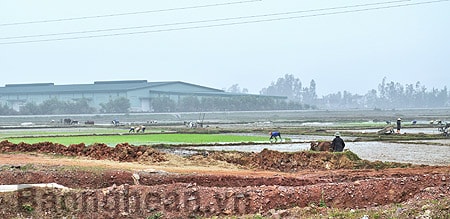
People in Nghi Long commune are still cultivating the land that has been reclaimed.
Nghi Long is one of the communes in Nghi Loc district with a large area of agricultural land reclaimed, totaling 76.32 hectares, affecting 1,246 workers from 251 households. The entire reclaimed land was used for the construction of the Nam Cam Industrial Park. To date, this industrial park has 24 businesses in operation, including many large companies and factories located within Nghi Long commune such as Hanoi Beer Factory, VNT Superfine Limestone Powder Factory, NPK Compound Fertilizer Factory, Tien Phong Plastic Factory, etc., but most of these units do not employ local workers. Mr. Le Van Nghia, Chairman of the Nghi Long Commune People's Committee, stated: “The commune currently has over 4,000 laborers. Those aged 18-25 have largely found employment through overseas labor export or working in companies and businesses in the South… while those aged 25-45 are either unemployed or underemployed, and most are relying on supplementary jobs. When discussing land clearance with the authorities, businesses promised to employ local workers, but once the production facilities started operating, they showed no interest. As a result, the number of commune workers employed by these businesses is now less than 100. The commune leaders have repeatedly discussed the issue with representatives of the businesses and have also repeatedly petitioned higher authorities, but the problem remains unresolved.”
Unable to find jobs in factories within the industrial zone, and lacking government support for career transition, coupled with little or no remaining arable land, thousands of laborers from households whose land was expropriated in Nghi Loc are struggling to make ends meet and support themselves and their families. However, only a small number go abroad for work, mainly to middle-income markets such as Malaysia, Taiwan, the Middle East, and Laos. The majority work as factory workers in the South, construction workers, seasonal laborers, or stay at home to run small businesses or cling to their meager remaining agricultural land. Because many laborers whose land was expropriated have no or insufficient jobs, while much of the expropriated land remains fallow, and compensation policies for land clearance are inconsistent, in recent years, people have returned to cultivating the agricultural land that was expropriated but not yet leveled. For example, in Hamlet 1 of Nghi Long commune, there are 131 households, all of whom have had their agricultural land confiscated, totaling approximately 20 hectares – accounting for more than 50% of the hamlet's agricultural land. Residents have returned to cultivate over 5 hectares of the confiscated land that remains unused. Even more significantly, in Hamlet 2 of Nghi Thuan commune, due to the large discrepancies in compensation payments between different periods, between the commune and other localities, and the lack of suitable employment opportunities after land confiscation, residents continue to cultivate over 90% of the confiscated land (approximately over 25 hectares). When businesses need land to implement projects, residents demand additional compensation, making land clearance difficult and complicated…
Furthermore, in communes where a large area of agricultural land has been reclaimed, the lack of employment has led to an increase in social vices and insecurity, particularly drug addiction and dog theft. At the end of 2011, the Nghi Loc District Police, in coordination with Nghi Xa and Nghi Long communes, held review meetings for 20 young men residing in these two communes who were involved in dog theft. Mr. Vo Thanh Long, Head of the Nghi Long Commune Police, stated: "In recent years, due to unemployment, the number of young people in the commune involved in dog theft in the district has increased dramatically, and most of them are drug addicts. After the review meeting, about half of the dog thieves, out of shame, went south to find work, but a few others continued their old ways. In 2012, most dog theft cases discovered by authorities and residents in Nghi Loc district involved young people residing in Nghi Long, and among them was Hoang Cong Hiep, who was beaten to death by residents of Nghi Xuan commune on October 12, 2012."
A comprehensive solution is needed.
Mr. Nguyen Van Ba, Head of the Labor, War Invalids and Social Affairs Department of Nghi Loc District, stated: To date, 4,483 laborers (accounting for 5% of the district's total workforce) from households whose land was expropriated in Nghi Loc have received support for vocational retraining according to Decisions 2345/QD.UB-DC dated September 18, 2004 and 74/2005/QD.UBND dated August 31, 2005 of the Provincial People's Committee, with support ranging from 8,000 to 15,000 VND/m2. However, this support money is paid directly to the laborers, and the district does not have information on how this money is being used.
Mr. Ba also stated: “On the district's side, in order to provide vocational training for the laborers of households whose land has been expropriated, the District People's Committee issued Official Document No. 685/UBND-NVLĐ requesting communes to review and compile a list of households whose agricultural land has been expropriated by 30% or more of the total allocated area, report the number of laborers in need of vocational training, and widely publicize the forms and content of training (free training, support for training materials, on-site classes, etc.). In recent years, the district has introduced trades such as rattan weaving, mushroom cultivation, flower and ornamental plant cultivation, animal husbandry, veterinary medicine, etc., to communes with large areas of expropriated land, but due to low income and uncertain market demand, the effectiveness has not been significant. By 2009, only two communes, Nghi Xa and Nghi Long, registered for vocational training with the district, but only 13 people registered for training in 6 trades! Due to the small number of trainees and their scattered distribution, even though the Department of Labor... The Ministry of Labor, War Invalids and Social Affairs allocated funds for vocational training to the district, but the district's Vocational Guidance and Training Center (now Nghi Loc District Economic and Technical Vocational College) was unable to open classes.
Regarding loans for job creation, the district has coordinated with the Social Policy Bank to disburse loans to 124 households, with an average amount of 5 million VND per household; and supported labor export for 102 workers, with a total loan amount of 897 million VND; however, the district does not know how this loan capital is being used (!?). Regarding creating local jobs for workers in areas with large land acquisition areas, the district annually organizes conferences inviting businesses located in the area to discuss vocational training and job creation, but currently, the number of workers hired by businesses located in the area is very small, because most workers have low skills and do not meet the requirements of the businesses. Furthermore, although many workers have had their land acquired, businesses in the district's industrial parks do not employ many workers, averaging only a few dozen, with the largest employer employing 400 people.”
Commenting on this issue, Mr. Tran Huu Lam – Vice Chairman of the Nghi Loc District People's Committee, in charge of culture and social affairs, acknowledged: “The biggest difficulty currently is the relatively low level of education and technical skills of rural laborers in Nghi Loc district, with over 60% lacking vocational training. Furthermore, due to some objective factors, the district's capacity for vocational training to create new jobs has not kept pace with and does not meet the needs of industrial and service development. Therefore, the ability to change careers and find jobs for rural laborers whose land has been expropriated is very low. In addition, job information and transaction channels in rural areas are underdeveloped, the role of job placement organizations is still unclear, and government organizations in some places have not paid sufficient attention, often relying mainly on people to find work themselves, so rural laborers often seek jobs through family, relatives, and friends... In addition, localities where land has been expropriated are not proactive enough.” "Flexibility in restructuring crop and livestock production is crucial to increasing people's income. However, it's also necessary to frankly acknowledge that currently, due to the persistent mentality of small-scale farmers among those whose land has been reclaimed, they are not proactive in learning new skills to find employment. They are also hesitant to work for businesses in industrial zones and prefer to seek freelance work in Vinh City... All these reasons make the already slow shift in the rural labor structure of the district even more challenging after the reclamation of agricultural land, resulting in a surplus of agricultural labor."
It can be said that the current situation regarding employment for laborers whose agricultural land has been expropriated in Nghi Loc is also a common situation in several localities in the province. This stems from inadequacies in compensation and land clearance, in the campaign to encourage and promote vocational retraining, in vocational training, and in coordination between local authorities and businesses. Therefore, to solve this problem, the province and district need to implement comprehensive solutions with practical policies such as reviewing the planning of industrial park construction projects that require the expropriation of agricultural land; implementing adequate compensation policies to effectively resolve the conflict of interest between investors and households whose land has been expropriated; improving the educational and vocational skills of rural laborers; developing a system of on-site vocational training facilities; strengthening linkages and socializing vocational training; and connecting businesses, employers, and vocational training institutions. Promoting economic restructuring to suit each region, developing rural infrastructure, developing information systems, providing labor market consulting, and widely disseminating information about support programs and job placement services in rural areas...
According to a report from the Department of Labor, War Invalids and Social Affairs of Nghi Loc District, from 2002 to the present, Nghi Loc has five communes where agricultural land has been confiscated for the construction of the Nam Cam, Truong Thach, and Dong Tro industrial zones and other infrastructure projects. These communes are Nghi Xa, Nghi Long, Nghi Quang, Nghi Thuan, Nghi Truong, and Nghi Thach. The total area of land confiscated is 251.8 hectares, affecting 2,618 households. Of these, Nghi Xa commune has the largest area of confiscated land with 161.56 hectares. The entire commune has 1,139 households whose land has been confiscated, mainly agricultural land, with approximately 400 households having 70-100% of their land confiscated. The number of laborers in these households is over 2,100 people, accounting for about 67% of the total workforce in the commune.
Text and photos: Minh Quân