

Successful cloning of human embryos from human skin.
On May 15th, American experts announced an unprecedented breakthrough in the field of stem cell research: they have been able to create embryonic stem cells from human skin cells.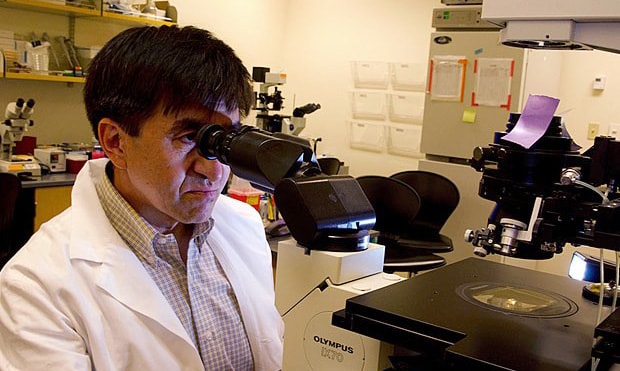
Expert Shoukhrat Mitalipov from the Oregon National Center for Growth Research - Photo: US News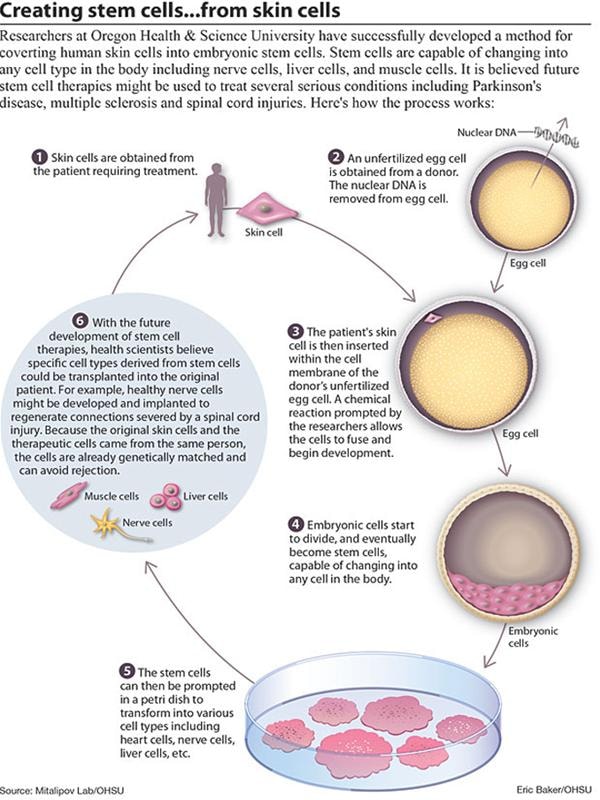 Diagram of embryo cloning from human skin.
According to AFP, scientists at Oregon State University published this achievement in the scientific journal Cell. For the first time in the world, experts have been able to create stem cells capable of transforming into any other type of cell in the body without the need for embryos.
Shoukhrat Mitalipov, an expert at the Oregon National Center for Growth Research, said the technique involves implanting an individual's DNA into an egg cell from which the genetic material has been removed. "Tests have shown that stem cells extracted using this technique can transform like embryonic stem cells, becoming various types of cells such as nerve, liver, and heart cells," Mitalipov stated.
He asserted that creating stem cells from the patient's own genes would eliminate the risk of the patient's body rejecting the transplanted organ. "Of course, there is still much work to be done to develop safe and effective stem cell therapies, but we believe this is a major step forward in the development of stem cells for transplantation," Mitalipov emphasized.
However, the goal of the research was not to create cloned humans, but simply to create stem cells that could develop into muscles, nerves, or other cells that make up body tissues. This process, according to Professor Mitalipov, took only a few months, a surprisingly short time for such a significant milestone.
"This breakthrough raises the question of whether human cloning is possible. However, that is not the issue we are concerned with, and we believe that this discovery will not help to realize the possibility of human cloning," the research team emphasized.
Scientists hope that stem cell therapy will help medicine develop treatments for Parkinson's disease, arteriosclerosis, spinal cord injury, blindness, and more.
In the case of Dolly the sheep 17 years ago, these cells were allowed to develop into an embryo, which was then implanted into a female sheep to produce a cloned sheep. But Mitalipov says he has no intention of creating a human clone, but only stem cells, which would then be processed to create hearts, nerves, or other cells to help treat diseases.
“I think it’s a breakthrough,” said Dieter Egli of the New York Stem Cell Research Foundation at Columbia University. “I’m very confident that this technique will work effectively.” Egli is one of only a few scientists working to perfect techniques for creating cloned human stem cells.
In 2004, Woo Suk Hwang, a South Korean scientist at Seoul National University, claimed to have successfully cloned human stem cells, but he later admitted to falsifying his research and data. The scandal, along with ethical concerns about the potential creation of cloned humans, has significantly slowed research over the past decade.
“Although we didn’t do anything entirely new, the right combination, the right timing, and the right focus made all the difference,” Mitalipov said. He estimated that 50% of successful stem cell creation depends on egg quality and the other 50% is related to the process performed by humans.
According to Tuoi Tre - TH