

Steadfastly moving forward from industry
The mountainous district of Anh Son has a well-developed commercial agriculture sector thanks to the presence of numerous factories in the area: 4 tea factories, 1 sugar factory, and 2 cement factories. The potential and strengths of the locality continue to be exploited with the recent addition of a Tunnel Kiln brick factory and an industrial garment factory…
(Baonghean)The mountainous district of Anh Son has a well-developed commercial agriculture sector thanks to the presence of numerous factories in the area: 4 tea factories, 1 sugar factory, and 2 cement factories. The potential and strengths of the locality continue to be exploited with the recent addition of a Tunnel Kiln brick factory and an industrial garment factory…
With its abundant land potential, Anh Son is renowned for its corn, sugarcane, tea, and now rubber. Currently, the district has 10 state-owned enterprises, 14 joint-stock companies, 29 limited liability companies, and many private enterprises… Among them, many enterprises play an extremely important role in the development of the district, such as Anh Son 12/9 Cement Factory, Thanh Son Cement Factory, Song Lam Sugar Factory, Bai Phu Tea Factory, Hung Son Tea Factory, Thang Muoi Tea Factory, Anh Son Black Tea Factory…
Mr. Nguyen Van Thuan, from Hamlet 5, Hung Son Commune, is one of the pioneering households in industrial tea cultivation in Hung Son Commune, Anh Son District, since 2001. He recounts that Hung Son was very poor back then; farmers left their villages to work in the South, and transportation was difficult because the area was on the other side of the river, only accessible by ferry. Tea seedlings and fertilizers had to be carried across the river, handled with extreme care, to cultivate the first tea plants in Hung Son. He, along with Mr. Vo Van Hien and Mr. Nguyen Van My from the hamlet, successfully planted the first 3 hectares of tea, which proved economically viable. This led the people of Hung Son to quickly follow suit. By 2004, tea cultivation had flourished in Hung Son, and by 2008, the barren hills and wasteland had been covered in a vast expanse of green tea plantations.
To date, Mr. Thuan has 1.5 hectares of tea plantations, providing him with a stable monthly income of 12 to 15 million VND. When we visited, he had just harvested and sold 7 tons of tea, earning 21 million VND from Hung Son Tea Enterprise. In Hung Son, the minimum income from tea is 4 million VND per household, while countless households earn 10-15 million VND per month: Mr. Nguyen Van Nghi, Mr. Nguyen Van Tri, Mr. Nguyen Van Vinh, Mr. Pham Van Qui, Mr. Pham Xuan, Mr. Vo Van Hien… They are not only skilled tea growers but also invest in tea harvesting machines and cultivate tea according to VietGAP standards. For example, in Hamlet 5, Hung Son, there are currently 60 tea-growing households out of a total of 80 households. In 2012, tea production reached 800 tons, bringing in 2.4 billion VND. The hamlet now has 44 tea harvesting machines, each costing 13 million VND. The active involvement of the Nghe An Tea Investment and Development Company, specifically the Hung Son Tea Enterprise, has helped Hung Son farmers change their mindset and practices, leading to a new life through professional commodity production.
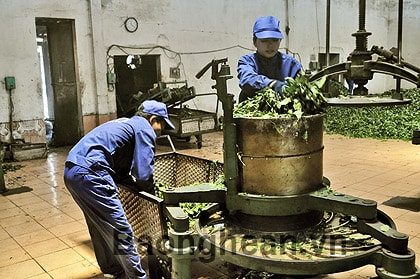
Tea production line at Hung Son Tea Factory - Anh Son.
The communes of Phuc Son, Long Son, Hoa Son, etc., have also stabilized their livelihoods thanks to tea cultivation, considering tea as a sustainable means of poverty alleviation. Many communes have received investment from the Northern Institute of Agricultural and Forestry Science and Technology in cooperative model projects and the application of integrated mechanization in tea production, including single-leaf and double-leaf tea harvesting machines and pesticide sprayers to enable farmers to produce tea professionally. The involvement of four stakeholders: farmers, factories, scientists, and the government, has created a large and valuable tea raw material area in Anh Son, making it an irreplaceable crop in many communes. Currently, the total tea area in Anh Son is 1,734.6 hectares, of which 114 hectares were newly planted in 2013.
After the Song Lam Sugar Factory relocated from Hung Nguyen to Anh Son, sugarcane took root there, becoming a key crop for the two districts of Anh Son and Con Cuong. For decades, many mountainous communes in Anh Son such as Thanh Son, Binh Son, Tho Son, Cam Son, Khai Son, Hung Son, and Hoa Son have had a stable income from supplying raw materials to the Song Lam Sugar Factory. The sugarcane area in Anh Son has now reached 1,718 hectares. In the 2012-2013 crushing season, the Song Lam Sugar Factory achieved a sugarcane yield of 90,340 tons, producing 9,493 tons of sugar – the best sugar production year ever. The factory paid nearly 80 billion VND to Anh Son farmers for the entire crushing season.
Many households earn substantial incomes from sugarcane, such as: Mr. Bien Duc Ly, Hamlet 2, Tho Son, who cultivated 1.45 hectares and earned 90,000,000 VND; Mr. Nguyen Khac Hong, Hamlet 3, Tho Son, who cultivated 1.85 hectares and earned 78.6 million VND; Mr. Nguyen Dinh Hoa, Hamlet 2, Tho Son, who cultivated 2.1 hectares and earned 90.4 million VND; Mr. Nguyen Van Su, Hamlet 1, Binh Son, who cultivated 1.6 hectares with a yield of 85.9 tons/ha and earned 120 million VND; Mr. Tran Ngoc Phuong, Hamlet 1, Thanh Son, who cultivated 1.8 hectares and earned 119 million VND… Farmers in Anh Son also grow sugarcane for the Song Con Sugar Factory in communes near Tan Ky. Sugarcane yields in Anh Son are quite high: 606 quintals/hectare, with some areas reaching 100 tons/hectare. Mr. Le Thanh An, Deputy Director of Song Lam Sugar Factory, said: The factory's sugarcane raw material area currently has contracts with 4,240 households, with 1,074 hectares of ratooned sugarcane and over 700 hectares of newly planted and replanted sugarcane. For the 2013-2014 crushing season, Song Lam Sugar Company invested 1,700 tons of organic microbial fertilizer for the sugarcane.
Anh Son district possesses large reserves of limestone suitable for cement production, estimated at 361.4 million m3, widely distributed in Tho Son, Dinh Son, Hoi Son, Hoa Son, Phuc Son, and Long Son. Approximately 33 million m3 of this limestone is suitable for cement production. Therefore, the district has focused on attracting investment and creating breakthroughs in the development of the cement industry. Currently, Anh Son has two cement plants: The 12/9 Anh Son Cement Plant, now a member of the Vietnam Oil and Gas Group, is undergoing capacity expansion and equipment upgrades with a total investment of over 1200 billion VND and is being built in Hoi Son. Upon completion, it will supply 1,500 tons of clinker per day, equivalent to 550,000 tons per year, thereby creating thousands of jobs for workers.
In Anh Son district, there is also Thanh Son Cement Plant, a subsidiary of Thanh Son Cement Company Limited, specializing in the production of PCB30 and PCB40 cement, building materials, and mining operations. Located in Hoi Son commune, it produces between 90,000 and 100,000 tons of cement annually, providing stable employment for over 400 workers. These industrial plants have contributed to the development of a thriving commercial service network, acting as a driving force in the local economy.
Developing sustainable commercial agriculture linked to processing and attracting investment to effectively exploit potential resources has been a strategic task throughout many terms in Anh Son. The proud achievements in economic development demonstrate the dynamism, perceptiveness, and creativity in the thinking and actions of the local Party committee and government. Anh Son is currently developing rubber plantations and other new crops such as green asparagus for export, while also focusing on investing in infrastructure, transportation in the raw material areas, bridges, roads, and the Dinh Son industrial cluster to create new momentum for the development of industry, agriculture, and services.
Text and photos: Chau Lan