

Hai Vai Archipelago
Traveling west from the Dien Chau town intersection on National Highway 1A along National Highway 7A for 8km, you will reach the Hai Vai rock formation – a national historical and cultural relic. Hai Vai is a massive natural rock formation measuring 800m in length, 120m at its widest point, and 141m at its highest. The formation consists of several peaks, including the main, larger peak named Hai Vai (Luong Kien Son, or Dam Rock) and a smaller peak (Ho Linh Son), both standing out amidst the vast fields of three communes: Dien Binh, Dien Minh, and Dien Thang.
(Baonghean)Traveling west from the Dien Chau town intersection on National Highway 1A along National Highway 7A for 8km, you will reach the Hai Vai rock formation – a national historical and cultural relic. Hai Vai is a massive natural rock formation measuring 800m in length, 120m at its widest point, and 141m at its highest. The formation consists of several peaks, including the main, larger peak named Hai Vai (Luong Kien Son, or Dam Rock) and a smaller peak (Ho Linh Son), both standing out amidst the vast fields of three communes: Dien Binh, Dien Minh, and Dien Thang.
According to historical records, the Hai Vai rock formation was created after an earthquake more than 50 million years ago. Through many changes, the rock has acquired its current stable appearance. Since 1964, archaeologists have found fossilized human bones, some stone tools, and seven pottery vessels at the rock. This discovery proves that the Hai Vai rock was once inhabited by prehistoric people.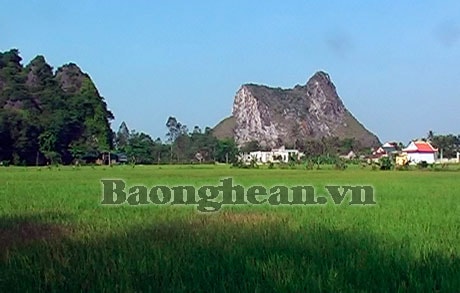
Hai Vai rock formation.
Previously, the hill was covered with dense forests teeming with birds and wild animals. In spring, the climate was cool, the trees were lush and green, and flowers bloomed in abundance. In a travelogue of Indochina by a French author, Hai Vai Hill was ranked as a beautiful scenic spot in Central Vietnam. What was particularly appealing were the uniquely structured caves hidden beneath the trees, each with its own name and associated with intriguing legends. The air inside the caves was cool and refreshing. In the past, scholars used to come here to relax and study literature.
To the southeast lies the Hang Hang (Neck-Strangling Cave). The cave is located 30 meters above ground level. Inside, there are many strangely shaped rocks. Particularly noteworthy is a stalactite formation resembling a human figure leaning against the rock wall, with raised rock patterns above the neck; hence the cave's name, Hang Hang Hang. At a height of 15 meters above ground level is Hang Da (Snake-Strangling Cave). At the bottom of the cave is a cool, never-drying spring. In addition, there are many other caves such as Hang Khan (Khan Cave), Hang Co Tu (Co Tu Cave), and especially Hang Guom (Sword Cave), which is incredibly deep.
From different angles, the mountain peak is seen in various forms. In the minds of the people of Dien Chau, the Hai Vai mountain peak is considered a symbol of mystery. In the Ly Trai and Dong Thap areas, the peak resembles a stone tablet – a region known for its high-achieving people. In the Dien Dong and Dien Thai areas, abundant in rice, the Hai Vai peak is seen as a giant carrying rice. In the Nho Lam area, home to many blacksmiths, the Hai Vai peak is seen as an anvil. In the Dien Thinh and Dien Trung areas, frequented by traditional medicine practitioners, the peak resembles a curved knife. In the eastern part of Dien Hoa, the elegant women see the mountain as a girl with flowing hair and rounded shoulders...
Moreover, the mountains and rivers are cultural features of the region. Len Hai Vai is a place with many advantages. In the past, when fishermen lacked means of transportation, they viewed the rock formation as a lighthouse. Whenever they encountered bad weather far from shore, the fishermen of Dien Chau used Len Hai Vai to navigate and bring their boats back to shore.
With a good wind, the sails will soar like fairies.
Running away from the Van area, we saw the Hai Vai rock formation.
In the military sphere, Hai Vai Hill was a fierce battlefield during the clashes between the Le and Mac feudal factions. During the Nguyen dynasty, Hai Vai Hill served as a base for the uprising led by Nguyen Xuan On. During the periods of 1930-1931 and 1936-1939, Hai Vai Hill was used for printing Party documents and for gatherings and demonstrations. From 1939 to 1945, it became a military training ground and weapons storage area for the uprising to seize power. During the years of war, Hai Vai Hill was used as a shelter, a place to hide weapons and food, and a lookout point for American aircraft from the sea. And today, Hai Vai Hill holds immense significance for the development of Dien Chau. Local people still regard Hai Vai Hill as a sturdy wall protecting against storms, strong winds, and tidal surges, allowing them to live and work in peace.
Currently, the Hai Vai mountain range is being protected and preserved by Dien Chau district. With its unique and diverse structure, colorful landscape, and gentle, pristine, and graceful beauty, the Hai Vai mountain range has attracted many tourists. At Ho Linh Son mountain, the sacred and ancient Co Am pagoda has been rebuilt on the mountainside. The tranquil and unspoiled scenery of the primeval forest has become an attractive destination for tourists who enjoy exploring nature and immersing themselves in the fragrance of flowers and the cool air. Besides its fascinating natural landscape, what makes the Hai Vai mountain range even more appealing is its connection with the Bung River, creating a picturesque scene and making it a famous tourist destination that anyone visiting Dien Chau cannot fail to know.
Mountains, rivers, and human kindness have created the charm and nobility of the land and people of Dien Chau. The Hai Vai cliffs and the Bung River will forever remain a source of pride and a place where the people of Dien Chau entrust their faith, dreams, and love for their homeland, encompassing their profound joys and sorrows. The Hai Vai cliffs symbolize character, culture, and moral principles, and have become ingrained in the very being and consciousness of the people of Dien Chau. No matter where they go, the people of Dien Chau always remember the Hai Vai cliffs – a place where the image of their homeland is reflected, with affection as high and enduring as the rivers and mountains.
Mai Giang (Dien Chau Radio Station)