

Benefiting from the "vast forests along the coast"
Salt-tolerant plant species, introduced and planted in the riverside and coastal mangrove areas of Nghe An province over the past several years, are yielding tremendous results. They not only create sturdy green walls protecting the lives of coastal residents but also generate significant economic benefits.
(Baonghean)Salt-tolerant plant species, introduced and planted in the riverside and coastal mangrove areas of Nghe An province over the past several years, are yielding tremendous results. They not only create sturdy green walls protecting the lives of coastal residents but also generate significant economic benefits.
On World Wetlands Day (February 2nd), thanks to an introduction from the Nghe An Red Cross Society, I visited Dien Kim commune, Dien Chau district – a coastal area with a considerable area of wetlands, now covered in layers of salt-tolerant trees such as Rhizophora and Avicennia. Mr. Vu Xuan Tinh, one of the four members of the Dien Kim commune's protection team responsible for caring for and protecting the mangrove forest, enthusiastically showed me this "vast forest by the sea." What struck us were the lush, green mangrove forests stretching along the dike beside the Van stream, their trunks reaching high, their roots densely penetrating the acidic mud. Occasionally, from within the vast expanse of green, white egrets would soar.
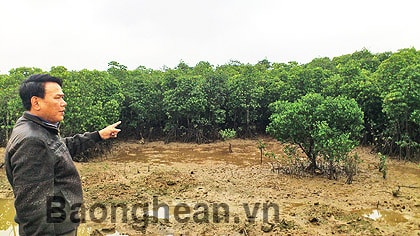
Mangrove forests thrive in Dien Kim commune, Dien Chau district.
Mr. Tinh said: “Previously, the mangrove area was left fallow, so every time the tide rose or there was a storm, it caused erosion of the dike, threatening the lives and property of the people. But since planting mangrove forests, not only has the ecological environment changed, creating green patches along the river and preventing dike erosion, but it has also brought practical economic benefits to the people in the commune.” The benefit Mr. Tinh is referring to is the revival and abundant development of brackish water aquatic species. And the rational exploitation by local residents is creating a large source of income, helping to develop the local economy. Mr. Nguyen Ngoc San, a fisherman on the Van creek in Tien Tien 2 hamlet, is someone who clearly feels the change in this acidic, saline land outside the dike that was once considered abandoned. He said: “Previously, the catch of fish, shrimp, and crabs in the estuary was very small, and the economic efficiency was not high. But since planting mangrove forests, aquatic life has not only diversified but also increased significantly, including species with high economic value.” The diversity that fisherman Nguyen Ngoc San refers to includes red snails, grouper, crabs, clams, and mussels… In fact, on some days, residents of Dien Kim commune harvest several tons of clams and mussels from the mangrove forests… This abundant aquatic resource has made Dien Kim a supplier of high-quality breeding stock to many places throughout the country.
The benefits that mangrove forests bring to Dien Kim are evident, thus raising people's awareness of forest protection. Ms. Ngo Thi Huong, who has lived along the Van estuary dike for 15 years, said: "Since the mangrove forest was established, the dike has not been eroded, and we feel more secure during storms and heavy rains, no longer as worried as before. Everyone understands that protecting the forest is protecting the lives and property of their own families and villages."
Thanks to significant changes in people's awareness, although there are only 4 guards protecting over 200 hectares of mangrove forest in the commune, the forest is virtually untouched. "Initially, some people came to collect dry firewood or hunt egrets. We reminded them, dealt with them decisively, and combined this with public awareness campaigns through the radio system, so the situation of forest encroachment has almost disappeared."
The story of planting, protecting, and benefiting from mangrove forests is not unique to Dien Kim, but has also emerged in many localities along the 82km coastline of Nghe An province since 1997, following a reforestation project funded by the Japanese Red Cross.
Over the past 16 years, the Japanese Red Cross has funded the "Mangrove Reforestation - Risk Reduction" project through the Vietnam Red Cross Society. In Nghe An province, the provincial Red Cross has directly implemented the project with a total budget of over 7.2 billion VND, planting 1,375 hectares of mangrove trees, including Rhizophora apiculata and Avicennia marina, in saline-affected areas, lagoons, and saltwater rivers along the coast from Quynh Luu district to Hung Hoa commune, Vinh City. They have also planted Casuarina, eucalyptus, and bamboo along the Lam River in Hung Nguyen and Nam Dan districts. Ms. Bui Thi Mai, President of the Nghe An Red Cross Society, stated: “Planting forests on mangrove areas contributes to environmental protection, enhances the ability of local people to respond to climate change and disasters. In addition, people also directly benefit from the recovery of aquatic resources. Given the results achieved, in the coming time, the Japanese Red Cross will continue to support Nghe An to further protect and maintain the forests, helping people improve their capacity to protect forests in wetland areas.”
Text and photos: Thanh Duy