
Back to the origins of the revolution
May has arrived again, and amidst the nationwide celebrations commemorating the 123rd anniversary of the birth of the great President Ho Chi Minh, we – the people of Nghe An – journeyed to Pac Bo, Cao Bang, the cradle of the Vietnamese revolution. The long journey through historical sites closely associated with his revolutionary life was truly a trip filled with admiration and faith.
(Baonghean)May has arrived again, and amidst the nationwide celebrations commemorating the 123rd anniversary of the birth of the great President Ho Chi Minh, we – the people of Nghe An – journeyed to Pac Bo, Cao Bang, the cradle of the Vietnamese revolution. The long journey through historical sites closely associated with his revolutionary life was truly a trip filled with admiration and faith.
Departing from Vinh City in the early morning, by noon on May 17th, the delegation from the Nghe An Provincial Party Committee, People's Council, People's Committee, and Vietnam Fatherland Front Committee arrived in Lang Son province, a border region, amidst the sweltering May sun. After a quick lunch, we left Lang Son and continued our journey along National Highway 4A, winding through the mountains along the northern border to Cao Bang province. The route from Lang Son to Cao Bang is over 120 km long but holds immense historical value. Along this journey, we gradually reached That Khe and Dong Khe, and saw Bao Dong mountain – where President Ho Chi Minh observed the Battle of Dong Khe. These are historical landmarks associated with our victory in the 1950 Border Campaign, which opened the Vietnam-China border and marked a major turning point in the resistance war against French colonialism. Finally, after a three-hour drive filled with excitement, Cao Bang City welcomed us in the gentle afternoon sun. Our itinerary was already set; after spending a night in Cao Bang City, we continued our journey to Pac Bo the following morning.
The journey to Pac Bo is no longer as arduous as it once was, thanks to a smooth 55-kilometer paved road connecting Cao Bang City to the final destination: the Pac Bo National Special Historical Site in Truong Ha commune, Ha Quang district. Along the road, the mountainous landscape of the northern border region is a lush green, filled with tobacco plants, corn, and forests whose leaves gradually turn red. Glimpses of moss-covered tiled roofs of the highland villages, faintly visible through the early morning mist, further enhance the mystical beauty of this land. All the fatigue from the long journey dissipates, giving way to a mix of emotions, difficult to express in words, upon first embarking on this historical journey to the "roots of the mountains and the source of the rivers."
The starting point for the Pac Bo Special National Historical Site is the Temple of President Ho Chi Minh. The temple sits atop a majestic mountain. In front of the temple flows the clear, tranquil Lenin Stream; in the distance are the magnificent mountains surrounding the beautiful landscape of our homeland.
At this sacred site, associated with a vibrant period in President Ho Chi Minh's life, everything evokes his image: the 79 steps, stained with red bricks, leading up to the shrine symbolize the 79 springs our nation has had under his leadership. In a solemn and moving atmosphere, the people of Nghe An, his birthplace, led by Comrade Ho Duc Phoc – Secretary of the Provincial Party Committee, respectfully offered flowers and incense to pay homage to the spirit of President Ho Chi Minh. Immediately afterwards, the Secretary of the Provincial Party Committee and leaders of various departments and agencies in the delegation carefully and respectfully planted a commemorative flowering tree in the grounds of the shrine.
Among the crowds visiting Pac Bo was Mr. Dam Van Quan, from Group 30, Song Hien Ward, Cao Bang City – a 76-year-old veteran. When he learned that we had traveled all the way from Nghe An, President Ho Chi Minh's birthplace, to Cao Bang to personally offer flowers and incense to his spirit, Mr. Quan emotionally shared: “Nghe An is where President Ho Chi Minh was born. Cao Bang is where he first set foot after returning to the country after 30 years of wandering abroad searching for a way to save the nation, and from here he led the Vietnamese revolutionary movement. Therefore, Cao Bang is like his second home. As people of Cao Bang, we are very honored, excited, and proud. We hope that our two provinces in particular, and the whole country in general, will develop more and more properly and beautifully, as President Ho Chi Minh wished. This is my ninth time visiting the historical site, especially on May 19th – President Ho Chi Minh's birthday.”
In a moving atmosphere, we left the Ho Chi Minh Memorial Temple to visit Karl Marx Mountain, Lenin Stream, Coc Bo Cave… all closely associated with his life and work. These unforgettable milestones were vividly and emotionally recounted by the tour guide. In 1941, after 30 years of wandering abroad searching for a way to save the country, Uncle Ho returned to his homeland via milestone 108 on the Vietnam-China border. He chose Pac Bo as his place of residence and work to formulate strategies and lead the Vietnamese revolutionary movement, liberating the country from slavery and suffering, and regaining national independence, freedom, and happiness for the people.
Therefore, in the hearts of every Vietnamese person, Pac Bo has become the cradle of the national revolution. "Pac Bo, in the local language, means 'mouth of the source,' the place where the Giang stream with its clear blue water reflects the towering Dao mountain. When Uncle Ho visited Pac Bo, he suggested to the people that they rename the stream to Lenin Stream and Mount Karl Marx to commemorate the contributions of the pioneers who researched scientific socialism (Karl Marx – named the mountain) and the first person to successfully lead the proletarian revolution in the world (Lenin – named the stream)," said the cheerful and beautiful Tay ethnic tour guide, Nong Thi Lieu, dressed in traditional attire, as she began her story on this journey back in history.
Following the winding stone path along the Lenin Stream – the same path Uncle Ho walked years ago – we felt as if we were traveling back 72 years. Along the way, we could still see the spot where Uncle Ho used to sit and relax by fishing after long hours of work, the guava tree where he used to pick leaves to boil for tea, and on the other side of the Lenin Stream, the stone table where he translated the history of the Party.
At the foot of the third mountain in the Karl Marx mountain range, after climbing 79 stone steps – symbolizing the 79 springs in his life – and passing by the former home of Mr. Ly Quoc Sung, a Chinese immigrant – where Uncle Ho lived and worked after returning to Vietnam from January 28, 1941 to February 7, 1941 – we were able to see Coc Bo Cave. The total length of Coc Bo Cave is only about 20 meters, and its widest point is only 7 meters.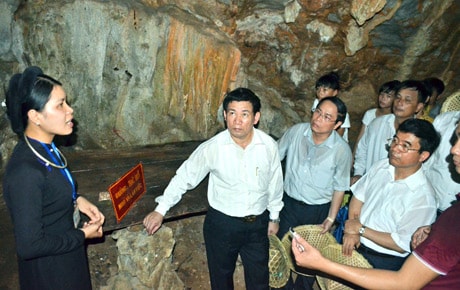
Provincial leaders visit Coc Bo Cave - the humble residence of President Ho Chi Minh.
Inside the cave, there are still inscriptions in Chinese characters by Uncle Ho, reading: "1941/ February 8th," marking the day he moved into the cave to live and work on February 8, 1941. There is also a statue of Karl Marx on the cave wall, which he sculpted during his rest periods. It was in this dark, cold cave, with only a bed made of a few planks and covered with the leaves of the May Tet tree readily available outside the cave entrance, that he led the way to liberate the Vietnamese people from oppression and slavery.
As tour guide Nong Thi Lieu finished her explanation, everyone was deeply moved by the simple and humble life of President Ho Chi Minh. Mr. Vo Xuan Tho, an 82-year-old tourist from Binh Dinh, shared: “I truly admire President Ho Chi Minh’s revolutionary spirit and character. For the revolutionary cause of liberating the country, he sacrificed so much.” That character has also earned the admiration of friends from all over the world for his willpower and integrity. For example, the son of the late US President JFK Kennedy visited Pac Bo in 1997. Upon returning to the United States, filled with admiration and reflection, he wrote an article published in the Washington Post, which included the passage: “I kept thinking about how, in such a small, narrow, and damp cave, Ho Chi Minh could have lived there, devising a long-term plan to reclaim the country without anyone knowing.”
The admiration for President Ho Chi Minh's willpower and love for his country seems to be present in every visitor to the historical site. The tour guide explained that the annual celebration of President Ho Chi Minh's birthday has truly become a festival for the people of various ethnic groups, not only in Cao Bang province but also for the Chinese community living in Nam Quang village, Jingxi district, Guangxi province, China. For us, the people of Nghe An province – the birthplace of our beloved Father of the Nation – visiting Pac Bo, considered his second home, is a way to deepen our faith, love, and respect for the great man's character.
Thanh Duy