

When rural areas face labor shortages
In many localities in Nam Dan district, there is a phenomenon of workers aged 25-35 leaving agriculture to seek jobs with more attractive incomes. Of the district's 82,000 workers, up to 1,000 find employment in other localities each year. This has led to a shortage of seasonal labor locally.
(Baonghean)In many localities in Nam Dan district, there is a phenomenon of workers aged 25-35 leaving agriculture to seek jobs with more attractive incomes. Of the district's 82,000 workers, up to 1,000 find employment in other localities each year. This has led to a shortage of seasonal labor locally.
Agricultural labor is a worrying issue in Nam Dan district. Mr. Tran Van Sinh, Secretary and Chairman of Nam Anh commune, stated: “From the model of cultivating lilies in the fields on a total area of 12 hectares, each household earns 300 million VND/year, 5-6 times more than growing rice… However, the general trend among young people in the commune is that they don't want to stay in the fields. Currently, nearly 1000 young people in the commune are working outside the commune, over 400 are working abroad, and about 300 are working as factory workers in garment factories in the neighboring commune. The majority of the workforce in the fields of Nam Anh commune is now… past working age!”
According to Mr. Sinh, compared to developing the local economy, laborers who find jobs in industrial zones and through overseas labor export earn much higher incomes. Now, in Nam Anh, every family with a car and a multi-story house owes their income to overseas labor export. Young people in Nam Anh aged 20-35 all hope to have the opportunity to work abroad. Mr. Le Van Chien, a veteran from Hamlet 6, Nam Anh commune, who owns a 20-hectare farm with gardens, ponds, and livestock that generates an annual income of 200-300 million VND, shared: “Only older people like us who don't have other skills stay at home, but our younger children and grandchildren have to find other jobs with higher incomes. Small-scale livestock farming like this is manageable for old people like us.”
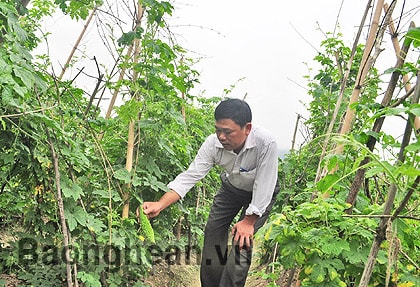
Bitter gourd fields provide a high income in Nam Anh commune. Photo: Thu Huyen.
In Nam Anh commune, in recent years, many hamlets have been unable to hold youth union activities due to a lack of members. In 2012, the entire commune only admitted 8 young people into the Party. Not only in Nam Anh, but many communes are also facing labor shortages. In Hong Long, many villages have long been known as "men's villages" because most women go abroad for work, leaving their husbands to manage the fields, gardens, and houses. In other communes, rural youth do not have the mindset of staying in the fields and farms but often choose to go south, to Laos, or work abroad. Due to labor shortages, many places have to hire people from other regions to plant and harvest crops during the planting season. For example, in the spring of 2013, some communes in the Southern region had to hire laborers from Thanh Chuong to plant rice. Farming is hard work. Once they harvest their rice, farmers have to factor in expenses such as seeds, fertilizers, pesticides, labor, transportation, and threshing costs. Not to mention the dilemma of a good harvest leading to low prices, or high prices coinciding with a poor harvest. Because of this, many people are no longer enthusiastic about farming, lending their land to others to pursue other, higher-paying side jobs.
According to Mr. Pham Mau Tung, Head of the Department of Labor, War Invalids and Social Affairs of Nam Dan District: Of the district's 82,000 workers, thousands find employment in industrial zones in both the North and South each year. Recently, the operation of garment factories has provided jobs for nearly 3,000 workers, including many from Nam Dan, with an average income of about 3 million VND per person per month. While not high, it is more comfortable compared to farming. For workers aged 40-45, who find it difficult to get jobs in factories, they seek employment in the service industry. Therefore, in Nam Dan, the workforce in the fields is now mainly comprised of the elderly and children.
As the birthplace of President Ho Chi Minh, Nam Dan district has received significant attention from the Party and the State. However, the people of Nam Dan have not become complacent; instead, they are very diligent in their work and production. In agricultural production, the district has implemented numerous resolutions on restructuring livestock and crop production, and has provided practical and timely support policies for farmers, such as: annual deferred payment for fertilizers, technology transfer to members, and assistance in accessing preferential interest rate loans for production and business investment.
However, these investments will not be truly effective if Nam Dan does not soon find a solution to the rural labor shortage. Nevertheless, while the locality needs time to research and find long-term solutions, it is thought that in the short term, the policy of "land consolidation and exchange" should be effectively implemented. Only then can the locality apply mechanization to agricultural production, helping farmers become wealthy right on their own fields; this is also an important solution to overcome the current labor shortage.
Thanh Nga