
Dragon Ferry - Ngự Wharf
On a summer afternoon, the western part of Nghe An province is still scorching hot. The intense heat has driven farmers in Tuong Son commune (Anh Son district) to the banks of the Lam River to enjoy the cool breeze. Plump buffaloes are also happily wallowing in the water. The wind rustles through the bamboo groves and cornfields. From the newly built suspension bridge across the river, gazing at the Dragon Ferry and the Royal Wharf, a myriad of emotions are evoked by the majestic and poetic beauty of the mountains and the river...
(Baonghean)On a summer afternoon, the western part of Nghe An province is still scorching hot. The intense heat has driven farmers in Tuong Son commune (Anh Son district) to the banks of the Lam River to enjoy the cool breeze. Plump buffaloes are also happily wallowing in the water. The wind rustles through the bamboo groves and cornfields. From the newly built suspension bridge across the river, gazing at the Dragon Ferry and the Royal Wharf, a myriad of emotions are evoked by the majestic and poetic beauty of the mountains and the river...
The Dragon Ferry and the Royal Wharf are closely associated with Lang Trang beach. This is a wide, long stretch of land constantly enriched by the Lam River's alluvial deposits, making the soil always fertile. Corn, peanuts, and mung beans sown on Lang Trang beach all grow lush and yield abundant harvests. Legend has it that over 600 years ago, the Tran family from the lowlands came here to cultivate the alluvial plain and build a settlement, hence the name Lang Trang. "Where the land is good, birds will flock," other families successively came here to cultivate the land, expand the fields, and gradually it became bustling and prosperous: "Below the ferry, above the market is bustling / Western and foreign streets are built on both sides."
The local people are very proud of the beauty of their homeland's landscape and have used the proverb "First the capital city, second Lang Son coconuts" to affirm that beauty. Later, following the policy of relocating people to mountainous areas to develop agricultural production, Lang Trang beach became a cultivated area for the farmers of Tuong Son.
Returning to the place name Dragon Ferry - Royal Wharf, many people are undoubtedly puzzled by this name. After all, mentioning Dragon Ferry and Royal Wharf means mentioning the imperial capital, the royal city – a place where emperors and kings of the past often came to admire and enjoy the scenery. So why does it have that name? Before answering this question, the author would like to briefly touch upon some aspects of this place name, which bears the strong imprint of royalty.
As the Lam River flows downstream from its source, a mountain suddenly juts out at the beginning of the Lang Trang riverbank, blocking its course. Taken by surprise, the river's flow abruptly changes direction, concentrating towards the left bank. The water then surges violently against the bank before rebounding and heading towards the right bank.
The constant back-and-forth movement has turned this stretch of river into a swirling vortex with countless dangerous whirlpools, posing a significant risk to passing boats. Only skilled and experienced oarsmen, familiar with every channel and whirlpool, dare to navigate through this area. Occasionally, locals see large logs "emerging" from the whirlpools, only to disappear again. These are the remnants of rafts of timber that were sucked down to the bottom of the deep river by the swirling currents.
The name Dragon Ferry - Royal Wharf has two different explanations regarding its chronological origin, but both share a common connection to the contributions and achievements of historical figures in fighting foreign invaders. The first explanation is that the name Dragon Ferry - Royal Wharf is linked to the career of King Le Thai To. Legend says that, following the strategy of Dinh Liet, King Le Loi of Binh Dinh advanced from western Thanh Hoa to western Nghe An to develop his forces, expand his base, and create favorable conditions to repel the Ming invaders. After achieving the "Thunderous Battle of Bo Dang" in Quy Chau and the "Tra Lan Battle where bamboo shattered and ashes flew" in Con Cuong, Le Loi sought to advance south to capture Nghe An.
However, with the enemy positioned ahead, advancing downstream required first eliminating the enemy forces blocking the way at Bo Ai and Kha Luu (today located in Duc Son and Vinh Son communes, Anh Son district). Furthermore, the enemy frequently scouted along the riverbanks, making it very difficult for the Lam Son rebels to gather intelligence on enemy activities and the terrain to develop an appropriate attack plan.
Therefore, Le Loi decided to choose a location with swirling water and many eddies to cross the river to the right bank, ascending to the summit of a mountain jutting out into the river to observe the enemy's movements and defenses. He chose this particular section of the river because the leader of the Lam Son rebels believed that the most dangerous place was actually the safest. From here, enemy ships could not approach to intercept his troops.
With the help of the local people, Le Loi successfully crossed the river and found the optimal strategy to win the battles of Bo Ai and Kha Luu. Later, the place Le Loi chose to cross the river was called the Dragon Ferry, and the place where he sat observing the enemy was called the Royal Wharf.
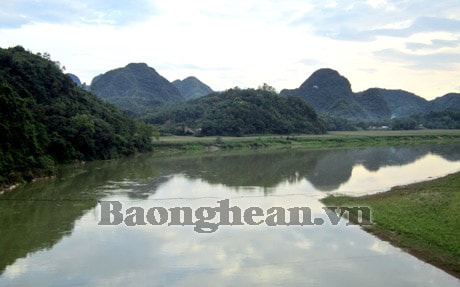
Scenery of the Dragon Ferry and the Royal Wharf.
The second explanation for the name Dragon Ferry - Royal Wharf is linked to King Hàm Nghi's resistance against the French. When this patriotic king issued the Cần Vương (Support the King) decree, many scholars in Nghệ An province actively recruited soldiers to join the resistance army. The Cần Vương movement spread to Anh Sơn district, and the people enthusiastically responded. With growing strength, the Cần Vương resistance built a mountain fort at Mực Điền (now in Hùng Sơn commune) to concentrate on training soldiers and organizing counterattacks against French forces. Legend says that King Hàm Nghi planned to visit Mực Điền, but his plan was thwarted when the patriotic king fell into enemy hands.
Meanwhile, the rebel army in Mực Điền planned and arranged for King Hàm Nghi to cross the river at a section with many whirlpools to create surprise and avoid attracting the enemy's attention. Although this plan failed, the location was still called Dragon Ferry - Royal Wharf by the rebels and the people. Therefore, later generations were inspired to write these verses: "There is the tomb of the tea-offering man at Royal Wharf / The old steps are now covered with moss / Hàm Nghi built the ramparts at Bàu Mây / Dragon Ferry, in the abyss, erected the divine sword."
The suspension bridge that people are crossing today was inaugurated less than a year ago. For the people of Hung Son, it is considered a miracle. Because it has eliminated the barrier of river crossings; the rickety ferry journeys and the anxieties of the rainy season and floods are now just memories.
For me, besides its main function of "connecting joyful shores," the Dragon Ferry Bridge also offers moments of leisure, allowing me to admire the peaceful and fertile scenery of the countryside. There are coconut groves stretching as far as the eye can see, the endless green fields of corn and streams in Lang Trang, Mo, and Hoi villages, the vast tea and acacia hills that seem to stretch on endlessly, and peaceful villages nestled among the trees... Standing here, you can see the entire view of the Ngự Wharf - Dragon Ferry, a place with a history spanning hundreds of years. The Lam River flows gently, the mountains rise majestically, and the clouds are reflected in the river's surface. The scenery is both vast, majestic, and incredibly poetic…
Tuong Anh