

The person who posted wild boar from Nghe An online.
(Baonghean) - Following the address of Mr. Le Van Phuong in Hamlet 1, Tien Thanh - Quynh Thang (Quynh Luu), we found the wild boar farm of the owner of the website "Nghe An Wild Boar". It took several phone calls to find him. It turned out that Phuong was collecting money from wild boar sales at various establishments. Unlike the difficulties we encountered when contacting him by phone, the homeowner was quite open when the conversation revolved around the wild boar.
(Baonghean) - Following the address of Mr. Le Van Phuong in Hamlet 1, Tien Thanh - Quynh Thang (Quynh Luu), we found the wild boar farm of the owner of the website "Nghe An Wild Boar". It took several phone calls to find him. It turned out that Phuong was collecting money from wild boar sales at various establishments. Unlike the difficulties we encountered when contacting him by phone, the homeowner was quite open when the conversation revolved around the wild boar.
In 2009, Phuong started building a wild boar farm. At that time, the trend of raising specialty animals was booming, such as porcupines, turtles, crocodiles, etc. But Phuong chose wild boars because of their high feasibility, or in other words, their market was "closer to the average person." After building the enclosures, Phuong traveled all the way to Hoa Binh and Bac Giang to learn from experienced farmers and bought 27 wild boars of various sizes. At an average price of 350,000 VND/kg, this was a significant asset for the young man not yet 30 years old. Then came the hardships of the early days: the largest wild boar in the herd, weighing over 64 kg, died after unsuccessful treatment.
Following the advice to buy pregnant sows for a quick harvest, he brought home three. After two days of raising them, one died due to the long transport. He lost tens of millions of dong. Undeterred by these "accidents," he diligently researched materials and accumulated experience. Today, his wild boar herd has grown to seventy or eighty animals of various generations. The farm, covering about five acres of land on a hillside, is neatly constructed, with each pen, measuring several hundred square meters, built sturdily under the canopy of fruit trees such as lychee, mango, and longan. Each pen has a play area, a bathing pool for the pigs, and shelters for them during rainy or windy weather.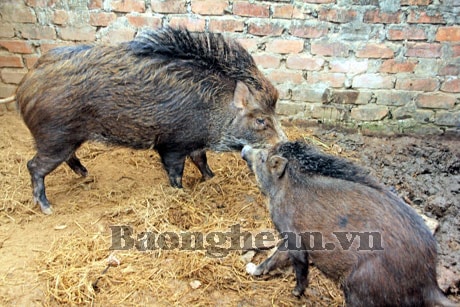
Purebred wild boars at Mr. Le Van Phuong's farm.
According to Phuong, raising wild boars is not difficult because, being wild animals, they have high resistance to disease, their food is easy to find, and the market demand is "common," resulting in high profits. In 2012, his farm supplied 2.7 tons of live pigs to the market. Of that, the farm raised 700 kg, and the rest was provided to other households. The 700 kg of pigs sold at an average price of 200,000 VND/kg, bringing in 140 million VND. Feed and labor costs amounted to 45 million VND, resulting in a net profit of over 90 million VND.
The most difficult aspect of raising wild boars is finding a market. To ensure a stable and widespread market, Phuong immediately thought of online marketing and enlisted the help of friends and family to build a website for him: lonrungnghean.com. Since having the website, he no longer has to rush around marketing, and large restaurants in Hanoi, Hai Phong, and Thanh Hoa regularly contact him to discuss prices and place orders. As a result, sales volume has steadily increased.
Currently, Phuong's farm serves as the "outlet" for 10 other wild boar farms in the region, and is expanding its network to guarantee product sales to other farms. For sustainable development, Phuong is currently collaborating with a product distribution facility in Hanoi to develop and register the trademark "Nghe An Clean Pork". If all requirements are met, the "Nghe An Clean Pork" brand will appear on the market in the near future.
Speaking about the future development of the profession, Phuong affirmed that the market will not be saturated in the next five years. Even if the price of live pigs drops to 100,000 VND/kg, farmers will still make a profit (currently it is 150,000 VND/kg). On the other hand, to continuously improve meat quality, it is necessary to find ways to improve and select breeding stock and feeding processes. Currently, the pigs raised on his farm have more fat than wild pigs. Phuong assured me that in just one year, the lean meat ratio of his farm-raised pigs will be equal to that of wild boars. As we parted ways, we hoped that he would one day discover the complete secrets of raising wild boars to transform "domesticated wild boars into real wild boars."
Cong Sang