

Identify the organizations and individuals responsible for budget revenue and expenditure irregularities.
Continuing the agenda of the 5th Session, on the morning of May 25th, the 13th National Assembly considered the draft Law amending and supplementing Article 170 of the Enterprise Law.
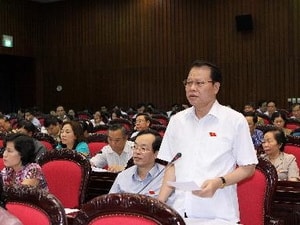
Deputy Prime Minister Vu Van Ninh delivers his remarks. (Photo: Duong Giang/VNA)
According to the Government's submission presented by Minister of Planning and Investment Bui Quang Vinh, authorized by the Prime Minister, at the Assembly Hall, Clause 2, Article 170 of the 2005 Enterprise Law stipulates that foreign-invested enterprises currently managed and operating under the Law on Foreign Investment in Vietnam have the right to choose to re-register to manage and operate according to the provisions of the Enterprise Law within 2 years from July 1, 2006, or not re-register. If they do not re-register, the enterprise is only entitled to conduct business within the scope of the business lines and for the duration specified in the Investment License.
According to statistics, as of July 1, 2011, the deadline for re-registration, out of 6,000 foreign-invested enterprises, 2,916 had re-registered in accordance with point a, Clause 2, Article 170; while approximately 3,000 enterprises did not re-register as required by point b, Clause 2 of this article. These enterprises have a total registered capital of US$18.5 billion and employ 446,000 people. To date, some enterprises whose operating period stipulated in their investment licenses has expired wish to re-register to continue operations; some enterprises whose operating period is still valid as stated in their investment licenses wish to add or expand their business lines.
The amendment to Article 170 of the Enterprise Law aims to remove obstacles and create favorable conditions for foreign-invested enterprises to continue operating, especially those that have entered into stable production and business, have a long-term committed workforce, and contribute to society and the state budget. This amendment also aims to create a legal basis to encourage foreign-invested enterprises that have not yet re-registered to undertake new investment projects and expand their investments in Vietnam.
Accordingly, the Government proposes amending Clause 2, Article 170 of the Enterprise Law as follows: Abolish the re-registration deadline for foreign-invested enterprises to allow enterprises to choose not to re-register or to re-register at a time appropriate for the enterprise. This amendment aims to ensure the autonomy of enterprises in deciding on their organizational management and business operations.
During the review of the draft Law amending and supplementing Article 170 of the Enterprise Law, the majority of members of the Economic Committee agreed with the proposed amendments by the Government. However, the reviewing body also suggested that a specific review is needed, and that enterprises should only be allowed to re-register or expand their business lines if their investment activities do not violate the law (regarding environmental protection, tax obligations, etc.) and are consistent with the planning and foreign investment attraction policies of the Vietnamese State.
Also during this morning's session, the National Assembly discussed in the plenary hall the settlement of the state budget for 2011.
According to the Report on the State Budget Settlement for 2011 by the Finance and Budget Committee of the National Assembly, the total revenue of the State budget in 2011 was VND 962,982 billion (including revenue carried over from 2010 to 2011, surplus revenue from local budgets in 2010, recovery of budget loans, and revenue from investment mobilization by local budgets as stipulated in the State Budget Law). Of this, revenue according to the National Assembly's projected target for 2011 was VND 721,804 billion, exceeding the target by VND 126,804 billion (21.3%). This is a positive result in the context of the country's economic difficulties, reflecting the efforts of all levels, sectors, and the business community, including the significant contributions of the Tax and Customs sectors.
According to the report, the total state budget expenditure was 1,034,244 billion VND (including funds carried over from 2011 to 2012); the state budget deficit was 112,034 billion VND, equivalent to 4.4% of GDP (excluding local budget surpluses).
However, the audit report also assessed that: Although state budget revenue increased significantly, it lacked stability and did not originate from the internal strength of the economy. The budget for value-added tax refunds in 2011 was not realistic (the 2011 budget was 42,000 billion VND, while the actual refunds amounted to 61,000 billion VND, an increase of 19,000 billion VND).
Despite a 17,065 billion VND increase in import and export revenue, a debt of 14,532 billion VND in value-added tax refunds remains unpaid, creating further pressure on the budget balance in subsequent years. In the context of implementing a tight fiscal policy, requiring both savings in recurrent expenditures and cuts in public investment, the total state budget expenditure still increased significantly (61,954 billion VND), exceeding the projected amount by 8.5%, primarily due to increased development investment spending (56,306 billion VND).
Inspection, audit, and monitoring results show that a significant number of projects are unfinished or behind schedule, causing waste; the amount of outstanding construction investment debt is increasing; violations in basic construction investment occur at all stages, from planning to project settlement; the effectiveness of basic construction investment spending is limited, causing significant losses and waste of state budget funds. Spending in some important areas such as education, health, science and technology, economic development, and national target programs has not met targets, affecting the implementation of tasks and overall socio-economic development goals.
Commenting on these issues, delegates suggested clarifying the effectiveness of state budget spending in 2011, especially for investment and basic construction expenditures; they also requested identifying individuals and organizations that spent improperly, inefficiently, and caused waste and losses of state budget funds.
Representative Vo Thi Dung (Ho Chi Minh City) argued that, in the context of the country's many difficulties, the use of the State budget in 2011 still showed signs of waste and loss. Representative Dung proposed that the National Assembly should clarify violations in the use of the State budget in order to take strict disciplinary action in accordance with the law.
Sharing this view, delegate Do Manh Hung (Thai Nguyen) argued that the budget settlement report should be accompanied by a report on the prevention and fight against corruption and waste, especially in basic construction investment projects and the spending and use of state budget funds, in order to have a basis for handling violations.
Also this morning, the National Assembly discussed in the plenary session several remaining points of disagreement in the draft Law on Science and Technology (amended).
According to (VNA) - LT