

Images of President Ho Chi Minh on postage stamps.
“Stamps bearing Uncle Ho’s image on them / Stamps add strength, add love to the stamps…”, these are the verses celebrating the first set of stamps featuring Uncle Ho in 1946, created by artist Nguyen Sang, and appearing at the Chi Linh flower garden “stamp market” (Hanoi). Since then, these delicate postage stamps have served as a kind of “chronicle” of his life.
(Baonghean.vn) -“Stamps bearing Uncle Ho’s image on them / Stamps add strength, add love to the stamps…”, these are the verses celebrating the first set of stamps featuring Uncle Ho in 1946, created by artist Nguyen Sang, and appearing at the Chi Linh flower garden “stamp market” (Hanoi). Since then, these delicate postage stamps have served as a kind of “chronicle” of his life.
According to current statistics, President Ho Chi Minh remains the most frequently featured figure on postage stamps, with 131 designs and dozens of artists drawing inspiration from his image. Furthermore, in many countries around the world, images of President Ho Chi Minh are also featured extensively on postage stamp publications.
"The stamp bears the image of Uncle Ho..."
To commemorate the first anniversary of the August Revolution and the first National Independence Day, on August 27, 1946, the President of the Democratic Republic of Vietnam signed Decree No. 172-SL, entrusting the Revolutionary Postal Service of Vietnam with the issuance of a new type of postage stamp, the first of its kind in the Democratic Republic of Vietnam.
The first set of postage stamps bearing the national name of Vietnam was issued on September 2, 1946.
The image chosen for the first set of stamps was President Ho Chi Minh, the number one citizen and founder of the Democratic Republic of Vietnam. The artist who had the honor of designing this first stamp was the late Nguyen Sang, then only 23 years old, from My Tho, Tien Giang province. A talented art student, a graduate of the Gia Dinh School of Fine Arts and the Indochina College of Fine Arts (Hanoi) before 1945, Nguyen Sang had previously painted propaganda posters and designs for Vietnamese banknotes. With boundless patriotism and reverence for President Ho Chi Minh, he focused his talent on painting a portrait of President Ho Chi Minh, meeting the requirements of a postage stamp: detailed, distinctive, highly accurate, true to graphic style, and suitable for the difficult and limited printing conditions of the early days of nation-building.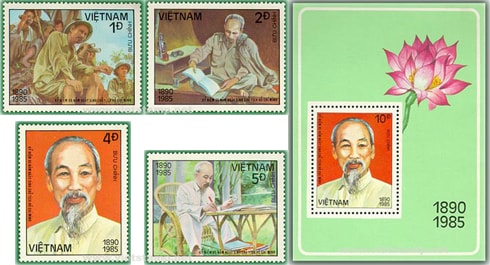
The stamp features an image of President Ho Chi Minh.
During the resistance war against the French and in subsequent periods, many talented artists successfully depicted President Ho Chi Minh's image on postage stamps. Artist Bui Trang Chuoc is considered to have closely followed President Ho Chi Minh's footsteps, creating stamps of him in the Viet Bac war zone with a strong mountainous and forest feel. Artists Trinh Quoc Thu, Tran Huy Khanh, and Nguyen The Vinh produced beautiful and unique stamp designs. Artists Tran Luong, Do Viet Tuan, and Nguyen Hiep showcased diverse themes and styles, as well as a large number of works depicting President Ho Chi Minh. Similarly, Nguyen The Vinh's memorable stamps such as "President Ho Chi Minh," "Portrait of the Leader," and "Children Wishing President Ho Chi Minh a Long Life..." brought forth touching images.
Stamps featuring President Ho Chi Minh in five continents.
Not only is the image of President Ho Chi Minh a source of inspiration for domestic stamp designers, but it is also a subject for artists across the globe, reflecting the events of the Vietnamese nation and his career. To date, no fewer than 15 countries and territories have issued postage stamps featuring President Ho Chi Minh. The world's first postage stamp set featuring President Ho Chi Minh was the "80th Anniversary of Ho Chi Minh's Birth" set, consisting of 7 stamps designed by the late artist Felix René Mederos Pazos (1933-1996), officially issued by the Republic of Cuba on May 19, 1970. This artist visited Vietnam twice, in 1969 and 1972, to paint several pictures about the Vietnam War. The Cuban stamp set commemorating the 80th anniversary of Ho Chi Minh's birth vividly depicts scenes of daily life and combat between the people and soldiers of both North and South Vietnam, such as engineering workshops, rice harvesting, and underground classrooms. Among them, one stamp with the highest face value of 13 centavos features a portrait of President Ho Chi Minh against the backdrop of the red flag with a yellow star.
On September 2, 1970, commemorating the first anniversary of President Ho Chi Minh's death and the 25th anniversary of the National Day of the Democratic Republic of Vietnam, the German Post Office issued one stamp in a series of seven stamps with a surcharge. This stamp featured a portrait of President Ho Chi Minh with the words "In memory of President Ho Chi Minh" in black German and "Vietnam is invincible" in red. Subsequently, on May 19, 1972, Cuba issued a set of three stamps titled "Third Conference on the Anti-American War in Indochina," including one stamp with a face value of 3 centavos featuring Jose Marti and Ho Chi Minh, the two great revolutionary leaders of the two countries, against a backdrop of stylized images of the Cuban and Vietnamese flags. May 19th is both the birthday of President Ho Chi Minh and the death anniversary of Cuban leader Jose Marti.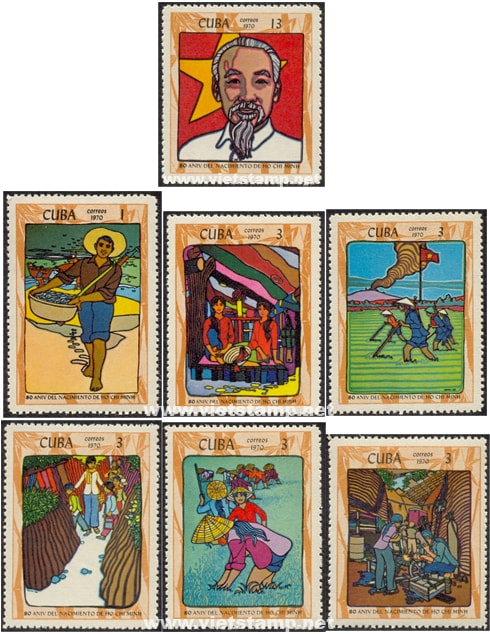
A stamp from our friend Cuba about Uncle Ho.
On February 17, 1973, to commemorate the signing of the Paris Agreement on Vietnam, Algeria issued a stamp with a face value of 0.40 dinar. The stamp features a reddish-brown map of unified Vietnam prominently displayed on the yellow Indochina Peninsula against the backdrop of the deep blue South China Sea, with a portrait of President Ho Chi Minh placed respectfully within an oval frame. The stamp bears the French inscription "In honor of the Vietnamese people" and the date of signing of the Paris Agreement on Vietnam, "January 27, 1973".
Stamps from the (former) Soviet Union
To commemorate the 90th anniversary of President Ho Chi Minh's birth on July 12, 1980, the Soviet Union issued a 6 kopecks face value stamp. On this stamp, President Ho Chi Minh's portrait is beautifully depicted in striking blue against the backdrop of the red flag with a yellow star, alongside the Hanoi Flagpole.
On March 15, 1999, the Republic of the Marshall Islands issued a set of 15 stamps titled "The Decade of Danger and Development 1950-1959," each with a face value of 60 cents, as part of the "20th Century" series. This stamp set depicts many important events of the 1950s. The ninth stamp, titled "Sunsets on Colonial Empires," features a portrait of President Ho Chi Minh alongside a vivid red map of Vietnam divided at the 17th parallel, and an image of Vietnamese People's Army soldiers raising the red flag "Determined to Fight, Determined to Win" atop the bunker of French General De Castries during the Dien Bien Phu campaign in July 1954.
In 2000, the United Dominican Republic, a small Caribbean nation, issued a 17-stamp "20th Century, 1960-1969" series of stamps, each with a face value of 55 cents, as part of the "Millennium 1000-2000" series. This beautifully printed stamp set depicted many significant events of the 1960s, including one commemorating the death of President Ho Chi Minh in 1969. Also in 2000, a nine-stamp set bearing the national emblem of Afghanistan was released, featuring portraits of nine prominent world politicians of the 20th century, including President Ho Chi Minh. In 2001, Rwanda issued a "Millennium" series of stamps, each containing four stamps with a face value of 300 Rwandan Francs, to honor world leaders in all fields during the past millennium. President Ho Chi Minh was featured on postage stamps in the 1940s with a benevolent portrait wearing glasses and sporting a long, white beard.
A postage stamp from the Lao People's Democratic Republic featuring Uncle Ho.
To commemorate the 25th anniversary of the Laos-Vietnam Friendship and Cooperation Treaty, on July 18, 2002, the Lao People's Democratic Republic issued a set of two stamps titled "Laos-Vietnam Cooperation," including one stamp with a face value of 3,500 kip depicting President Ho Chi Minh conversing with President Kaysone Phomvihane, Chairman of the Lao People's Revolutionary Party and President of the Lao People's Democratic Republic. The images of the two leaders on the stamp are simply drawn in black and white.
In particular, in 1990, on the occasion of the 100th anniversary of the birth of President Ho Chi Minh, who was honored by UNESCO as a World Cultural Figure and a National Liberation Hero, five countries respectfully issued stamps featuring him. On February 3, 1990, the former Soviet Union issued a stamp with a face value of 10 kopecks. The portrait of President Ho Chi Minh on the stamp has a solemn beauty, based on a photograph of him taken in the 1960s.
In Nghe An province, the birthplace of President Ho Chi Minh, there was once a stamp exhibition titled "Nghe An Postal Stamp Exhibition 2010 - The Glorious Party, the Great President Ho Chi Minh" to commemorate the 120th anniversary of President Ho Chi Minh's birth (1890-2010). Each small stamp, or even the entire set of stamps, seems to have captured a part of his tireless life and radiant personality.
With a total of 116 thematic stamp frames, thousands of stamp samples, actual envelopes, postcards... from Vietnam and many countries around the world bearing images of President Ho Chi Minh, the exhibition introduced and conveyed to a wide audience an understanding of the life, career, and noble moral ideology of Uncle Ho. Each delicate stamp, carrying a letter heavy with the sender's feelings and the recipient's hopes, soared across seas and forests. How heartwarming it is to see Uncle Ho's benevolent and radiant image on it. "Uncle Ho's love illuminates our lives...", perhaps that's why letters traveling far will surely only bring good news.
Tran Hai