

Concerns about providing food for students.
By the last month of the 2012-2013 school year, thousands of ethnic minority boarding school students in Ky Son district only received their second semester's food and accommodation support according to Decision No. 85/2010/QD-TTg of the Prime Minister on "Issuing a number of policies to support boarding students and ethnic minority boarding schools". There are many "reasonable reasons" for this delay, but it is clear that from January to May 2013, the students had to attend school in a state of "meal-only" hardship.
(Baonghean)By the last month of the 2012-2013 school year, thousands of ethnic minority boarding school students in Ky Son district only received their second semester's food and accommodation support according to Decision No. 85/2010/QD-TTg of the Prime Minister on "Issuing a number of policies to support boarding students and ethnic minority boarding schools". There are many "reasonable reasons" for this delay, but it is clear that from January to May 2013, the students had to attend school in a state of "meal-only" hardship.
The Nậm Càn Ethnic Boarding Secondary School has 211 students, of whom 139 are eligible for a monthly meal allowance equivalent to 40% of the minimum wage as stipulated in Decision 85/2010/QD-TTg (over 400,000 VND). According to regulations, the allowance is transferred to the schools for disbursement, and students receive it twice a year, at the beginning or middle of each semester, during the nine-month period. However, by the end of April 2013, the students had still not received their second-semester allowance. Consequently, parents and students have repeatedly approached the school's administration demanding the money for rice. Due to the district's delayed disbursement of funds, the school has often found it difficult to explain the situation to parents and students. This situation at Nậm Càn Ethnic Boarding Secondary School reflects the common plight of all 17 ethnic boarding secondary schools in Kỳ Sơn district.
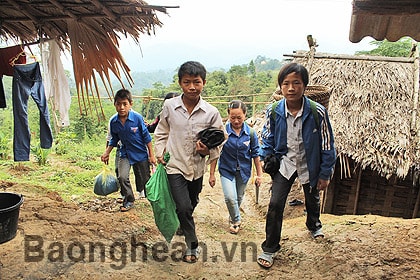
Students from Nậm Càn Ethnic Boarding School return to their village to get more rice to bring to school.
According to statistics from the Ky Son District Department of Education and Training, in the 2012-2013 school year, 2,603 students in the district received monthly meal allowances totaling nearly 9 billion VND. In the second semester alone, the amount received was over 4 billion 400 million VND. The first semester's payment was made at the end of the semester, and the second semester's payment was also made near the end of the school year. Given the practical and essential needs, the delayed payment of this support significantly impacts daily life, especially ensuring students have enough food to eat at school each day. According to Mr. Nguyen Hong Hoa, Head of the District Department of Education and Training, the 400,000 VND per month is a crucial source of funding for ethnic minority households to buy rice for their children. The Education Department is aware of this and ensures that schools disburse the funds immediately whenever available. However, due to various stages in the application and budget approval process, the disbursement of these funds is delayed.
During the discussion, Mr. Lo Khan Lai, Head of the Finance Department of Ky Son District, stated that the delay in payments to students under Decision 85/2010/QD-TTg was due to the fact that the documents submitted by schools to higher levels sometimes required revisions and went through various stages of appraisal. However, in reality, the funding for supporting ethnic minority boarding students is directed by the Government to the province, allocating budget funds to the districts at the beginning of each semester. In principle, the number of students and the total amount of money to be paid have been approved at the beginning of each school year. A simple calculation is that schools only need to know the fluctuations in the number of 9th-grade students graduating and students entering 6th grade to immediately determine the number of students eligible for support. The appraisal of eligible recipients is the responsibility of the local government and people in the communes; the district-level departments and agencies organize the payment and supervision.
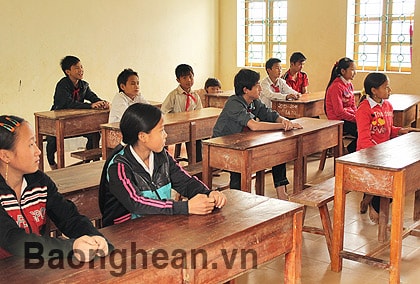
Many students were absent from class on the weekend.
Over the years, thanks to various investments, the facilities of schools in the mountainous Ky Son district have been upgraded and become more modern. Surveys show that many ethnic minority boarding schools have confirmed they can organize communal kitchens to cook meals for students, so that they don't have to carry rice and salt home to school on weekends, and to minimize the need for them to go into the forest to gather vegetables and bamboo shoots as they have done in the past.
Mr. Nguyen Cong Danh, Principal of Nam Can Ethnic Boarding High School, said: "The school can do it, but only if the funding is transferred to the school at the beginning of the semester so that we can plan and spend it wisely. Ensuring stable meals helps students focus on their studies. For a long time now, after each class, students have to scramble to gather firewood to cook rice, and food is rarely available, so boarding students are not getting enough nutrition. Many students show signs of exhaustion by the fourth lesson and cannot absorb the lecture. And on Saturday mornings, the number of absent students is high because they go home to get rice… If we can organize a communal kitchen, it will reduce the long-standing problem where the financial support for students is used by parents for other things. Some families use the money to buy household items, some parents use it to pay off debts, and some fathers even spend it all on alcohol. Therefore, worrying about food remains a daily challenge for the students."
The Ministry of Education and Training is working diligently with local authorities, social organizations, and businesses to ensure that students have "three essentials" (enough food, enough clothing, and enough textbooks) to attend school. This initiative truly warms the hearts of students in impoverished areas. Like many other disadvantaged regions, thanks to donations from organizations and individuals, students in remote areas basically have enough textbooks and clothing to go to school, but daily meals remain the biggest concern. In mountainous areas, the weather is unpredictable, often leading to crop failures, and government support is often delayed. Particularly in the mountainous district of Kỳ Sơn, where the poverty rate is still over 72%, providing food for students is a major challenge.
On weekend afternoons, on the slopes of the remote border district of Ky Son, groups of students carry baskets back to their villages to get more rice, potatoes, and cassava to continue their "long march" with literacy and knowledge, burning with the desire to escape poverty.
Text and photos: Nguyen Son