

A person deeply attached to their homeland.
As someone who directly protected President Ho Chi Minh, successfully created the fluorescent material used in the South Vietnamese Army's identity cards for intelligence purposes, spent 42 years researching the East Sea, and authored 100 research papers on diplomatic issues, he remains sharp-minded even at the age of seventy and is one of the two most respected advisors to the Ministry of Foreign Affairs... He is Major General Le Van Cuong.
(Baonghean)As someone who directly protected President Ho Chi Minh, successfully created the fluorescent material used in the South Vietnamese Army's identity cards for intelligence purposes, spent 42 years researching the East Sea, and authored 100 research papers on diplomatic issues, he remains sharp-minded even at the age of seventy and is one of the two most respected advisors to the Ministry of Foreign Affairs... He is Major General Le Van Cuong.
Recently, I saw him on television giving an interview about the Boston terrorist attack. His voice was still clear and his arguments concise, befitting someone who specializes in domestic and international strategic issues. He offered insightful comments and timely observations on a superpower he had spent decades studying as a scientist.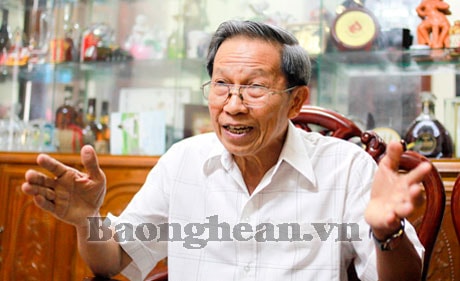
Major General Le Van Cuong.
Let's talk about a natural scientist specializing in security research for intelligence purposes. In 1967, having just graduated from the University of Hanoi, majoring in Biochemistry, young Le Van Cuong was retained to teach at the university. During a time of national crisis, when every front needed intelligent and courageous individuals, he was invited by the Ministry of Public Security to join Team 9 to protect food for President Ho Chi Minh. Those were incredibly beautiful days for the young man from President Ho Chi Minh's hometown. Even a jar of soy sauce or a piece of meat had to be tasted beforehand before being given to President Ho. This meant he had to take on danger himself to protect President Ho Chi Minh. He recounted: "Back then, every morning we would go to the market to buy food. Before the food was brought into the kitchen to cook for President Ho Chi Minh and the seven members of the Politburo, it had to be sent to the biochemistry lab to test for any harmful chemicals. If anyone offered us any food, we had to eat a little first before offering it to President Ho Chi Minh!"
Although he rarely met Uncle Ho, the visits he received left him with profound memories. He recounted: “Back then, we in the biochemistry lab were all around 20-25 years old, very mischievous. One day, while we were working, the security guard announced, ‘Uncle Ho has come to visit!’ We were stunned, but then Uncle Ho appeared, incredibly simple and unassuming. He smiled kindly and said, ‘I’ve come to observe your work, not to be welcomed.’ Everyone burst into laughter. That day, I remember most vividly Uncle Ho’s words: ‘When we do science, we must necessarily approach the science of advanced countries. While our conditions don’t allow us to do that yet, we will apply it in a Vietnamese way. I believe we will succeed!’”
"That saying has stayed with me throughout my scientific journey." That year, during Tet (Lunar New Year), Uncle Ho came down to his biochemistry lab and gave the two of them a sticky rice cake. The whole lab shared it, celebrating the New Year together, their hearts filled with warmth! Although he didn't often meet Uncle Ho, the beloved leader was a shining example of compassion and selflessness in his eyes. Later, despite facing many hardships and difficulties in life, he always looked to those beautiful days as a guide.
After President Ho Chi Minh's death in 1970, recognizing his capabilities, Comrade Tran Quoc Hoan – former Minister of Public Security – invited him to work in security for intelligence purposes. Following a request from the Politburo, his unit required him to research and create fake identity cards for American and South Vietnamese soldiers. Previously, orders for these cards had been sent to the German Democratic Republic and the Soviet Union, but were rejected because the order was for hundreds of thousands of cards. They only accepted orders for intelligence purposes in quantities of a dozen or less. The identity cards were made of fluorescent material, an organic compound shaped like five crocodiles, and glowed when illuminated with ultraviolet light. Even now, Vietnam has not been able to manufacture this organic compound.
After months of meticulous research, studying documents for three months, and spending five months developing a fluorescent substance using inorganic compounds that still glowed when tested, he employed a technology that involved grinding metal elements like Zn and Fe, and the compound ZnS, into powder form, then heating it to thousands of degrees Celsius. This resulted in hundreds of counterfeit South Vietnamese identity cards. Thanks to these forged cards, our troops infiltrated the South Vietnamese army, achieving many great victories. Experts from other countries told him: "How are you so clever? Even in wartime conditions, you were able to create a fluorescent substance that could even fool hundreds of ultraviolet light devices?"
With 42 years of research on China, he believes that the vast majority of its people are good, and most members of the Chinese Communist Party are also good. We maintain relations with them because of these good qualities and base our relationship on them. Regarding our neighbor's expansionist military strategies, we calmly consider them based on a historical frame of reference spanning millennia. From the time of King Trieu Da - Hung Vuong, to our people's history of fighting against the Ming invaders, we see that even if two neighbors clash, they will eventually realize the truth: "Friends may change, brothers may part, but neighbors remain constant." These are highly cultured concepts, based on a scientifically grounded historical foundation.
In 1970, he was sent to study for two years in East Germany on ultra-fine analytical technology, an advanced technology that promised great benefits for the country's science. However, during the years of the US embargo, the project and the scientific knowledge he had acquired abroad had to be "stored away" because the equipment could not be purchased. From natural sciences, he veered into philosophy, a passion he had since his student days, when he was only familiar with chemical elements, compounds, and laboratories. And it was this passion that drove him to research the US war of aggression in Vietnam, the United States as a superpower, and its neighbor, China. It was also through that diligent research that he successfully defended his PhD in Philosophy in 1980. In 1987, he was promoted to Deputy Director, in 1992 to Deputy Director of the National Institute for Strategic Studies, and then in 1995 he was entrusted by his superiors with the position of Director of the National Institute of Strategic Science - Ministry of Public Security, and was promoted to Major General in the same year.
Throughout his life, what always weighed heavily on his heart was the word "homeland," even though he could return home many times a year, even though there were months when he had to rush back and forth between Hanoi and Nghe An to keep up with work in his hometown and his duties as an advisor. Yet, he still felt indebted to his homeland. He confided: "Even now, I still vividly remember my village teacher, Ms. Minh Phuong, from my childhood, who guided me from my first steps in learning to write. It was from her that I learned my first lessons about humanity and filial piety, which have stayed with me to this day. After being away from home for many years, I happened to learn through a friend that her family was very poor. Since then, whenever I have the chance to return home, I always visit her. I don't need gifts or food; sometimes, just a simple inquiry from someone in the countryside is enough to warm the heart. This year, she is over 80, but there hasn't been a single year that I haven't sent her a gift on Teacher's Day."
During a meeting with a high-ranking official from his hometown of Nghe An in mid-December 2012, he had the opportunity to express his feelings and innermost thoughts as a son far from home. Through these sentiments, he also had the chance to offer insightful suggestions on the province's investment attraction strategy. For him, Nghe An is a place where "good wine needs no bush," possessing all the favorable conditions for economic development in the direction of industrialization and modernization. "To develop the economy, the only way is to attract foreign investment. This is the right time for our province to attract investment from Japan because of the disunity between Japan and China – an investment market that Japan has always been loyal to. Moreover, Japan is very fond of Vietnam because of its discipline and eagerness to learn. So, what are we waiting for to send the most positive signals to this significant investor?" he said.
"No matter how far across the ocean, my homeland is always in my heart," that's the sentiment of a son who, after 51 years away from his hometown, still feels deeply indebted to it as a token of gratitude.
Thanh Nga