

Underwater archaeology is trained... on land.
With its long coastline and vast underwater heritage reserves, Vietnam, however, lacks a dedicated underwater archaeology department. While the world and the region are aggressively focusing on the sea, underwater excavation and archaeology in Vietnam are still limited to addressing only small-scale cases.
With its long coastline and vast underwater heritage reserves, Vietnam, however, lacks a dedicated underwater archaeology department. While the world and the region are aggressively focusing on the sea, underwater excavation and archaeology in Vietnam are still limited to addressing only small-scale cases.
Last July, although archaeologists successfully excavated an ancient shipwreck underwater in Binh Chau (Quang Ngai), a significant number of artifacts were lost in the year from discovery to excavation. Looking back, it's shocking to realize that because we lacked a dedicated underwater archaeology team, we could only respond to incidents when they occurred.
Given this situation, concerned individuals are wondering when Vietnam will finally have a force of underwater archaeologists? NNVN newspaper conducted an interview with Dr. Nguyen Dinh Chien, Deputy Director of the National Museum of History, on this issue.
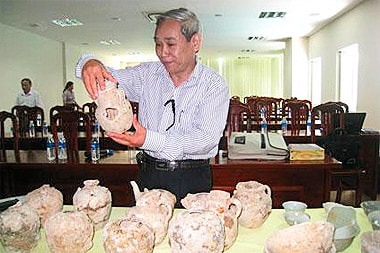
Dr. Nguyen Dinh Chien
As a country with a long coastline and a strategically important location on the trade routes of Asian civilization, how do you assess the potential of our underwater heritage?
The potential of underwater archaeological sites in Vietnam is enormous. It's possible to estimate the number of traces by studying archives in the Netherlands, France, etc., but determining them precisely isn't easy. Some foreign organizations have come to Vietnam to help create underwater archaeological maps, but we haven't agreed. Vietnam's sea area is vast, but some areas are military-controlled and inaccessible. Furthermore, if discovered, preservation is very costly. Without a thorough understanding, the damage could be immeasurable. For example, the shipwreck at coordinates X3 in Ba Ria - Vung Tau cost nearly 1 billion VND to preserve, but when excavated, the artifacts were gone because the ship had been destroyed by fishermen. Once discovered, excavation is necessary, and excavation is very expensive. The shipwreck in Ca Mau, which I supervised, cost 1 million USD. Meanwhile, the shipwreck in Cu Lao Cham, a joint venture with a foreign company, cost 6 million USD. The costs are very high.
Until now, underwater archaeological discoveries in Vietnam have been accidental, stemming from the findings of fishermen. Since these discoveries have been made, they have been processed.
But so far, we still don't have an underwater archaeology department. Do you think this is regrettable?
To date, Vietnam has not yet established a field of underwater archaeology, which is far too late. For nearly 20 years, many underwater archaeological excavations have been directed by the National Museum of History. Those of us assigned as excavation team leaders are all trained in terrestrial archaeology.
In recent years, there have been several training courses on underwater archaeology, such as the one organized by the National Museum of History with the Korean Institute for Maritime Cultural Heritage Research. However, these courses only train a few staff members for observation and research purposes. Organizing a 15-20 day diving course wouldn't solve anything. If we want to establish an underwater archaeological excavation team, we need investment, from policy to infrastructure, which is very costly in terms of equipment, boats, diving equipment, experts, and trained divers…
In the long term, do you think there should be a training program for this field?
In Vietnam, underwater archaeology is limited due to the lack of dedicated organizations, insufficient investment, and a shortage of trained experts. We are reluctant experts, only knowledgeable in the field of ancient artifacts. When divers bring up artifacts, we will comment and identify their type, period, and age. Training experts, building infrastructure, and providing equipment such as boats and diving equipment require long-term policies. In neighboring countries like China, the underwater archaeology center is located in Guangdong, but is under the direct control of the National Museum of History in Beijing. Or like South Korea, they have established the National Institute for Marine Heritage Research…
Thank you, sir!
"Hopefully, there will be a well-trained class in underwater archaeology so that this team can preserve heritage like the shipwreck at Binh Chau. Our other ships should be auctioned off. Because we borrowed money for archaeological excavations, and then we have to sell them to repay the loan. But international conventions do not encourage that. Either preserve them in situ, or find a suitable form, because they are national heritage."Dr. Nguyen Dinh Chien.
According to NNVN - NM