
It was an honor to have my picture taken of President Ho Chi Minh visiting his hometown.
On June 14, 1957, President Ho Chi Minh visited his hometown for the first time after 50 years of separation. Photographer Van Dong was contacted by the Provincial Party Secretary Vo Thuc Dong, who instructed the Department of Culture to assign him to photograph President Ho Chi Minh. Van Dong was both nervous and moved by the opportunity to photograph the leader; it was a tremendous honor for him.
(Baonghean)On June 14, 1957, President Ho Chi Minh visited his hometown for the first time after 50 years of separation. Photographer Van Dong was contacted by the Provincial Party Secretary Vo Thuc Dong, who instructed the Department of Culture to assign him to photograph President Ho Chi Minh. Van Dong was both nervous and moved by the opportunity to photograph the leader; it was a tremendous honor for him.
Van Dong was a skilled and experienced photographer, so when performing his duties, he enthusiastically and quickly found the perfect angles to capture the clearest and most beautiful images of President Ho Chi Minh. He had the honor of being present on the sacred morning of June 14, 1957, when President Ho Chi Minh visited his hometown for the first time. President Ho Chi Minh stood with the villagers in front of the garden of the house where he lived with his father and siblings during his childhood; he visited his old friend Thuyen; he visited the children of Nam Lien, the children's camp in the South; he visited the construction site of the Vinh Power Plant; and he visited military units. President Ho Chi Minh spoke with representatives of the people of Nghe An at the Provincial Party Committee hall in the ancient citadel of Vinh. Hearing President Ho Chi Minh's words, Van Dong was deeply moved, tears blurred his vision, and he couldn't see clearly enough to take pictures.
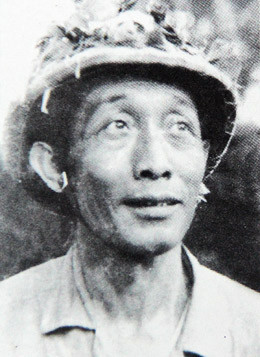
Photographer Van Dong
On December 8, 1961, President Ho Chi Minh visited his hometown for the second time. Van Dong took a photograph of the plane carrying him landing at Vinh Airport amidst the joyful welcome of the people. Comrades Chu Huy Man and Vo Thuc Dong went to the stairs to greet him. The open-top car carrying President Ho Chi Minh, with him waving, was warmly welcomed by the people of Nghe An.
Uncle Ho worked with the Provincial Party Committee, visited the Provincial Party Committee's collective dining hall, spoke with officers and soldiers of Military Region 4; visited the wounded soldiers' camp; and laid wreaths to commemorate the Soviet Nghệ Tĩnh martyrs in Thái Lão. He sat in the courtyard with provincial, district, and commune officials and relatives from his maternal hometown of Chùa village, beside the thatched house of Mr. Hoàng Xuân Đường, his maternal grandfather, which he built for his parents and where he was born.
Many vivid and valuable photographs were taken by Van Dong, such as: Uncle Ho visiting the Vinh Mechanical Factory, talking with cadres and students of the Mountainous Region Teacher Training School; Uncle Ho singing along with outstanding students in Vinh town; Uncle Ho with Vietnamese expatriate delegates from Thailand in Vinh; Uncle Ho giving candy to actors after a performance of the traditional opera "The Girl of the Lam River"; Uncle Ho presenting a badge to author Nguyen Trung Phong; Uncle Ho meeting with journalists and visiting the Vinh Thanh Cooperative in Yen Thanh district; Uncle Ho visiting the coffee plantation of Dong Hieu Farm (Nghia Dan); Uncle Ho taking a group photo with experts from friendly countries working in the Nghia Dan area…
Many of the most representative and vivid photographs taken by artist Van Dong, among the valuable images he captured during President Ho Chi Minh's two visits to his hometown, are still preserved in the museum and published in the photo book "President Ho Chi Minh and His Homeland." Van Dong recounted: one day, President Ho Chi Minh met him and said in front of everyone: "You are very enthusiastic and dedicated in taking these photos... sit close to me so we can take a commemorative photo together." Afterwards, he received a letter of commendation from the Nghe An Provincial Administrative Committee for his service in welcoming President Ho Chi Minh on his two visits to his hometown. He was moved, saying: "This is the most precious memory in my life as an artist."
Van Dong was born in 1920 in Vu Thu district, Thai Binh province. During the French colonial period, his family moved to Vinh, where he worked many jobs to make a living, but photography became his calling. In 1959, his work "Tien Phong Cooperative Plowing in the Early Morning Mist" was awarded a certificate of merit at the Bifota International Photography Competition in the German Democratic Republic. Van Dong was passionate about photography, always exploring, researching, and creating: During the war against the US, he wore a steel helmet, carried various cameras with attached telephoto lenses provided by the cultural sector, plus an air rifle, a knife, a canteen of liquor, and a rickety bicycle. With all that equipment, he traveled to the remote corners of Nghe An province, capturing in his lens the atmosphere of labor and production – "Sick in hand, gun in hand," "Hammer in hand, gun in hand" – of farmers, workers, or soldiers on artillery aiming at the enemy, and American planes like torches in the sky of his homeland…
Van Dong was elected a member of the Executive Committee of the Vietnam Association of Photographic Artists, 7th term, in charge of the front lines in Zone 4. He was also a member of the Executive Committee of the Provincial Association of Literature and Arts, 1st and 2nd terms. He lived a simple and austere life. Life was like a whirlwind; he passed away suddenly, when his professional aspirations and hopes still burned brightly within him. Van Dong ended his earthly life at the age of 63, leaving behind a legacy of sorrow among the artists and writers of his province.
Text and photos: Bui Xuan Luong