

A place that preserves the nation's Han Nom heritage.
Under the Nguyen dynasty, a system of libraries was established to copy and preserve numerous state documents and records. Besides the National Historical Archives, the Nguyen dynasty also established libraries such as the Cabinet Library (also known as the Eastern Pavilion) and the Tu Khue Library. These libraries all contributed significantly to the preservation of many valuable state documents that still exist today.
(Baonghean)Under the Nguyen dynasty, a system of libraries was established to copy and preserve numerous state documents and records. Besides the National Historical Archives, the Nguyen dynasty also established libraries such as the Cabinet Library (also known as the Eastern Pavilion) and the Tu Khue Library. These libraries all contributed significantly to the preservation of many valuable state documents that still exist today.
According to the book "Kham Dinh Dai Nam Hoi Dien Su Le," the agencies responsible for storing documents of the Nguyen dynasty (including imperial decrees, various types of documents, books, etc.) were the Imperial Library, the Imperial Edict Library, the Inner Court Library, and the Royal Treasury, established in the first year of Gia Long's reign (1802). The Imperial Library and Imperial Edict Library were responsible for drafting, distributing, and safeguarding imperial edicts and documents of the Gia Long dynasty. The Inner Court Library oversaw the emperor's personal correspondence, while the Royal Treasury guarded the imperial seals and precious jewels. In the first year of Minh Menh's reign (1820), the Imperial Library was renamed the Secretariat, bringing the three departments of Imperial Library, Secretariat, and Inner Court Library under its jurisdiction. In the tenth year of Minh Menh's reign (1829), the Secretariat was renamed the Inner Cabinet. Within the Cabinet, there was the Secretariat (also known as the Secretariat), which, in addition to recording imperial decrees and poems, was responsible for safeguarding the court's books and official documents related to foreign and vassal states; and the Bureau of Memorials, which was responsible for safeguarding the imperial decrees and copies of internal and external memorials.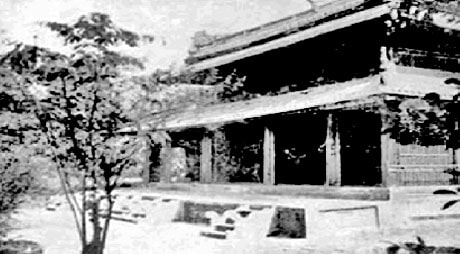
Cabinet Library, 1942.
To store documents within the Cabinet, in 1826, Emperor Minh Mệnh ordered the construction of a separate building called the Đông Các (Eastern Pavilion), located behind the Tả Vũ (Left Wing). To access this area, Cabinet or Secretariat staff who were directly employed in the Đông Các had to possess a "Cabinet Entry Pass." From there, the upper floor of the Đông Các preserved: all treaties signed by the Nguyễn dynasty with foreign countries; diplomatic documents with foreign countries; imperial poems and writings; maps; and imperial records (documents written in Chinese characters on paper and approved by the emperor) from various dynasties.
On the lower floor of the Eastern Pavilion is the Tu Khue Library, established in the 5th year of Tu Duc (1852), with its own staff to look after the various "classics," "history," "philosophy," and "collections," most of which were Chinese texts collected by King Minh Menh (the rest were kept at Di Luan Hall. Di Luan Hall was considered a subsidiary archive for storing books and literary works).
From May 2nd, 1933, Emperor Bảo Đại established the Imperial Office, led by Phạm Quỳnh, to replace the Cabinet. At this point, the Cabinet was officially abolished after a 104-year history. Consequently, the Cabinet was abandoned, neglected, lacking doors, and susceptible to leaks, resulting in significant damage to the imperial documents and archives stored within.
Currently, valuable Sino-Vietnamese documents from the cabinet have been transferred to the National Archives Center for storage, such as the Nguyen Dynasty's imperial records, the Nguyen Dynasty's land registers, and many other valuable books and documents currently stored in major libraries in Hanoi: the Library of the Institute of Sino-Vietnamese Studies, the National Library, the Library of the Institute of History, the Library of the Institute of Social Sciences Information... These documents and manuscripts can be considered an extremely valuable source of historical information for many scientific fields and are an indispensable part of the nation's Sino-Vietnamese heritage.
Nguyen Huy Khuyen (Faculty of Oriental Studies – Da Lat University, 01 Phu Dong Thien Vuong Street – Da Lat City – Lam Dong Province)