

Preventing skin diseases in the elderly.
In elderly people, in addition to weakened immunity, the collagen and connective tissues of the skin also become fibrotic, and the function of the sebaceous glands is significantly reduced...
Skin is a unique organ of the human body. It covers most of the body's surface. In elderly people, in addition to weakened immunity, the collagen and connective tissues of the skin also become fibrotic, and the function of the sebaceous and sweat glands is significantly reduced. As a result, the skin of elderly people becomes wrinkled, less elastic, drier, and more susceptible to disease. However, this disease is preventable if elderly people and their family members pay close attention to their skin.
Common skin diseases in the elderly
Keratosis pilaris (age spots): This is a very common skin condition in the elderly, characterized by areas of increased keratinization on the skin. These areas are dry, rough, smaller than 10mm in size, and yellow or dark brown in color. Keratosis pilaris most commonly occurs in areas frequently exposed to sunlight, such as the back, hands, neck, and face.
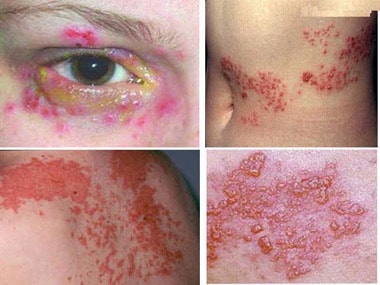
Shingles lesions
Atopic dermatitis (allergic dermatitis): This condition often becomes chronic and may resolve but reappear after a period of time. Itching commonly occurs in the armpits, between the breasts, elbows, behind the knees, groin, and flanks. Excessive scratching can cause skin abrasions, thickening, and a high risk of infection and pus formation, potentially spreading to other areas of the skin.
Stasis dermatitis: commonly occurs in the lower part of the leg (e.g., ankle), causing the skin to become rough, red, bumpy, and blistered. If infected due to excessive scratching, pustules may form.
Warts: commonly appear on the back and neck. Warts are raised, oval or round nodules, quite large in size (10-20mm), yellowish-gray in color, sometimes only one wart, but sometimes many are present.
Shingles (also known as herpes zoster): This is a disease caused by the Zoster virus, but in severe cases, it causes significant pain that lasts for days or even months. The disease usually only occurs on one side of the body due to damage to the nerve roots. Patients experience fever, pain, burning, and itching in the affected area. After a few days, a pinkish-red patch appears on the skin, with blisters clustered together or forming a patch.
Skin ulcers in the elderly due to varicose veins in the legs: more common in women, causing difficulty for blood to return to the heart and blood stagnation leading to skin ulcers on the lower legs. The condition can occur on one or both lower legs.
Streptococcal bacterial infection: This condition manifests in certain areas, causing redness or blisters scattered throughout the body, especially on the scalp, where the skin peels off in large scales and becomes itchy.
Psoriasis: This disease has an unknown cause and usually occurs in episodes. It presents as red patches of varying sizes with well-defined, slightly raised areas on the skin's surface. The patches are firm, sometimes with opaque white, shiny scales resembling white candle wax. The scales are multi-layered, easily detached, and regenerate rapidly; as one layer falls off, another appears. Psoriasis can be guttate or pustular and can appear in various locations on the skin (scalp, face, skin folds, nails, etc.). However, psoriasis is generally benign.
Vitiligo: caused by the loss of melanin pigment in the skin, resulting in a white complexion similar to that of a sheet of paper. Initially, it appears in a small area of the skin, then spreads to other locations, merging to form a larger area. If vitiligo occurs on the scalp, it also causes the hair to turn completely white in the affected area.
In addition, NCTs may also suffer from some diseases such as skin ulcers, autoimmune diseases, generalized exfoliative dermatitis, tinea versicolor, ringworm, or skin cancer, but these are less common. Tinea versicolor and ringworm are fungal diseases that often occur in hot summer weather because increased sweating creates favorable conditions for fungal growth.
According to Health & Life - NT