

Lesson 2: When Potential is Awakened
As we traveled through each rural area, we felt the changes along both sides of the legendary Ho Chi Minh Trail. The Truong Son mountain range, winding through mountain towns, villages, forests, and tea hills, has brought light to 29 communes in the midland and mountainous region. This is the foundation for these localities to develop their potential and resources... -->> Article 1: A Prosperous Range
Nghia Binh commune, the gateway to Tan Ky district, now boasts a new look for its center, situated right next to the Ho Chi Minh Highway. The Nghia Binh commune center now features a cultural center, commune headquarters, and schools at all levels, all built to a high standard. Adjacent to it is the Nghia Binh market area, which has also seen investment in the construction of sturdy communal houses and shelters. Further afield are hamlets of people with lush tiled roofs, orchards, and vast forests of timber trees clinging to the foothills.
The Party Secretary of Nghia Binh commune, Vo Dinh Mon, enthusiastically continued the conversation: "Previously, this area was desolate. When the road construction began, the commune encouraged people to move around the commune headquarters to form a commune center. Now, the center has a large population. The locality also has a market located right next to the road, serving as a place for the consumption and exchange of goods for people from other localities: Nghia Hop, Nghia Dong (Tan Ky), Nghia Loc commune (Nghia Dan), and many goods from Quynh Luu and Yen Thanh are also traded here. With convenient transportation, the people of Nghia Binh are enthusiastically planting acacia and melaleuca trees for timber, so the commune's timber forest now covers 2,900 hectares, making it the commune with the most timber forest compared to other communes in Tan Ky."
With roads, people have the opportunity to find jobs and earn income. In Nghia Binh commune, 20% of households are engaged in trading along the roads and in the villages, especially in the field of agricultural product distribution. Counting on one hand, Nghia Binh has 7 families specializing in providing services for the sale of agricultural products. Corn, cassava, peanuts, beans, sesame... that people produce are bought up on the spot, eliminating the fear of unsold goods as before. Some households have invested in purchasing transport vehicles, while those without the means rent them, aiming to transport agricultural products in both directions – from local markets to other places for consumption, and then transporting daily necessities from the city to local distributors and kiosks, meeting the daily needs of the people.
In the towns and villages along the Ho Chi Minh Highway, many people have seized the opportunity to invest in land along both sides of the road to open businesses such as motorcycle and car repair shops, food and beverage stalls, and entertainment services. Now, traveling on the road is worry-free, and there's no shortage of restaurants or food stalls. Land prices in densely populated areas along the road are now very high. Thanh and Loan, a couple from Hanh Lam town (Thanh Chuong district), who run a motorcycle repair business, shared: "We got married 10 years ago, and with some capital support from our parents, in 2008 we decided to buy a plot of land along the road in Hanh Lam town to start our business. The price was 15 million dong per meter. Now, the land price has tripled. Hanh Lam town is now packed with shops and service kiosks. The lives of the people are much more prosperous."
The most dramatic and noticeable change along the 134 km stretch through Nghe An province is perhaps at Kilometer Zero in Lat Town (Tan Ky District). The nearly 3 km section through this town is designed as a two-way road with two lanes for motor vehicles on each side, and is equipped with high-voltage streetlights. Along both sides of the road are now numerous shops, restaurants, hotels, and various other services, catering to people's needs. That evening, we stopped in Lat Town. At night, when the streetlights came on, the townspeople flocked to the road to walk and stroll around Milestone Zero. Various refreshment vendors lined the sidewalks. Occasionally, we encountered high-end sleeper buses on the North-South route stopping briefly so passengers could see Milestone Zero on this historic road, a key landmark in the resistance war against the US.
Mr. Nguyen Duy Thuy, Secretary of the Tan Ky District Party Committee, affirmed: "The Ho Chi Minh Highway is an opportunity for Tan Ky to expand, integrate, exchange, and develop. Previously, Tan Ky was considered a dead end, largely ignored, and its socio-economic development was slow. Now, Tan Ky's transportation network is very convenient. The Ho Chi Minh Highway connects to Hanoi and the northern and southern provinces. The 38-kilometer section of the Ho Chi Minh Highway running through Tan Ky connects to National Highway 7, National Highway 48, and a network of smaller roads linking communes to the Ho Chi Minh Highway, all of which have been paved and asphalted."
At the intersection near Milestone No. 0, which connects to Provincial Road 15A, leading to Do Luong, Dien Chau, and Vinh City, the route is 90 km long. Today, the government plans to build a monument commemorating "The Rear Guard Facing the Front Line," a project of national historical significance, contributing to the education of patriotic traditions and revolutionary spirit for the younger generation. Along with the Ho Chi Minh Highway and several other tourist destinations in the area, Tan Ky is poised to become a highly attractive tourist destination in the future. Currently, the Ho Chi Minh Highway is considered the "backbone" driving the local socio-economic development, encompassing not only agriculture and forestry but also business and services. Forestry has been a strength of Tan Ky since the construction of the Ho Chi Minh Highway. The area of newly planted timber forests annually meets and exceeds the set targets.
In Anh Son district, only two communes, Khai Son and Cao Son, are traversed by the Ho Chi Minh Highway. However, thanks to its advantageous location at the intersection of the Ho Chi Minh Highway and National Highway 7, at the Tri Le intersection in Khai Son commune, it has become a key area for future development. In 2004, Anh Son district planned the construction of Tri Le town.
After a few minutes sitting with the Vice Chairman of the People's Committee of Khai Son commune, Mr. Nguyen Tat Hong, we learned that Tri Le town has a planned area of 180 hectares, and many people from other areas are currently buying land to build houses. Around the Tri Le intersection, there are already 228 households engaged in business and production. Recently, an impromptu market has formed next to this intersection. In the afternoons, local residents bring vegetables, fruits, fish, meat, etc., to sell in makeshift stalls erected right next to National Highway 7. Because it does not ensure traffic safety, the local authorities have tried to "remove" it many times, but without success. In the near future, Khai Son will plan to designate a land area for a market to meet the needs and aspirations of the people.
Transportation business is the newest and fastest-growing service sector in Khai Son today. According to Mr. Hong, there are currently 3 households that have invested in purchasing 4 sleeper buses (running the North-South route) and 2 passenger buses (24-seater type); nearly 30 cargo trucks with a payload of 1.5-5 tons; and 8 families operating excavators for rural development projects and transporting construction materials. After the planning for the construction of Tri Le Town was completed, several units have surveyed the area for the construction of a bus station and a small industrial cluster.
The mountainous communes of Thanh Chuong district are characterized by industrial tea production and trading. May is the peak tea harvest season, so upon reaching Thanh Duc commune, one is greeted by the sweet and slightly bitter aroma of fresh tea buds. For generations, the people of the communes of Thanh Duc, Hanh Lam, Thanh My, Thanh Huong, Thanh Tinh, Thanh An, and Thanh Thuy have relied primarily on tea cultivation for their livelihood. Mr. Dam Huy Tinh's family in Thanh Duc commune has been involved in tea farming for 39 years. Speaking about the profitability of tea cultivation, Mr. Tinh enthusiastically shared: "My family has 0.6 hectares of tea planted in 2000, and now we harvest 8-10 tons of fresh buds annually. The current price at the Hanh Lam Tea Processing and Service Enterprise is 3,200 VND/kg. This means my family's tea plantation will bring in 25 to 30 million VND this year." With that level of income, Mr. Tinh asserts that no other crop in this region can rival it. For generations, the people here have relied on tea cultivation to alleviate poverty and improve their livelihoods.
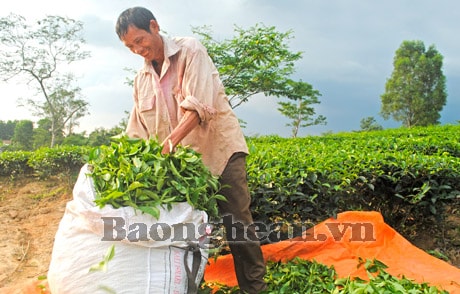
Mr. Nguyen Thanh Dong (Thanh Mai commune - Thanh Chuong district) is harvesting tea.
Visiting the Hanh Lam Tea Processing and Service Enterprise (Nghe An Tea Corporation), Mr. Tran Phi Hung - Director of the Enterprise, added: The total tea area of the Enterprise is currently 550 hectares, of which 500 hectares are already producing tea. This is the peak tea harvesting season for farmers, so the Enterprise's staff are always busy with purchasing and processing tea. The Enterprise's tea processing plant has a capacity of 30 tons of fresh tea buds per day. By contracting out the Corporation's products, the sales team and employees of the Enterprise go down to the local area and make efforts to purchase raw materials, so during peak seasons, the Enterprise's tea processing plant operates at full capacity. According to Mr. Hung's calculations, 1 hectare of tea yields an average of 15 tons of fresh tea buds per year, equivalent to over 45 million VND, of which costs are about 30-35%, leaving tea growers with a profit of 65-70%.
It is known that Thanh Chuong district currently has over 4,000 hectares of tea plantations, with 4 tea processing enterprises under the Nghe An Tea Corporation. In addition, there are approximately 40 small-scale private tea processing workshops located along the Ho Chi Minh Highway. A current problem is the intense competition in buying and selling between the tea enterprises under the Corporation and these private tea processing workshops.
Mr. Hung stated that the biggest difficulty currently is that many tea growers, despite receiving investment from the state through the Tea Corporation and the Enterprise, sell their harvested tea to private factories. As a result, the amount of debt owed by tea growers to the Enterprise still exceeds 2 billion VND.
From our research with tea growers, we learned of four main reasons: Firstly, there is a significant price difference between state-owned enterprises and private processing plants. Currently, state-owned enterprises buy tea at 2,800-3,000 VND/kg, while private enterprises buy at 3,500-3,800 VND/kg. Secondly, payment terms with private processing plants are faster and more convenient than with state-owned enterprises. Thirdly, it's possible that some families, due to laziness and a lack of responsibility, don't want to repay their debts to the state-owned enterprises and instead sell their tea to private enterprises. Finally, some families, lacking labor, hire workers to harvest the tea and sell it to nearby processing plants to save on transportation costs. However, the main reason remains the price difference between state-owned and private enterprises.
Along the Ho Chi Minh Trail, we also came across bee farms nestled under the dense shade of acacia forests. From here, the nomadic beekeeping profession was born...
Xuan Hoang