
A day in Dien Van
A street salt vendor recited a verse from his hometown about salt making: "What kind of matchsticks are these? We thought they were matchboxes, but who knew they were just scooped up and spilled out." Following this witty verse about the traditional craft of Dien Chau, we visited Dien Van one day in mid-July.
(Baonghean.vn) -A street salt vendor recited a verse from his hometown about salt making: "What kind of matchsticks are these? We thought they were matchboxes, but who knew they were just scooped up and spilled out." Following this witty verse about the traditional craft of Dien Chau, we visited Dien Van one day in mid-July.
Mr. Pham Quyet Chien, Deputy Chairman of the Van Nam Cooperative, said: "Previously, Dien Van, Dien Kim, Dien Ky, Dien Bich, and Dien Ngoc produced salt. Now, in Dien Ky, they have stopped. If you go along the dike road, you'll see the salt fields abandoned and overgrown with weeds. Now, Dien Van still has the most households producing salt, forming two cooperatives: Van Nam and Van Dong. In Dien Ngoc and Dien Bich, they are also gradually giving up salt production to work as construction workers, in agriculture, or in aquaculture."
Here, 361 households out of a total of 1444 households are involved in salt production, cultivating 65.7 hectares (77.5 hectares for agriculture and 65 hectares for aquaculture). When asked why salt farmers are abandoning salt production, Mr. Tran Minh Tuan, an agricultural extension officer in Dien Van commune, sighed and shared that salt production is primarily manual, requiring a lot of labor and harsh working conditions, yet yields low income despite advancements in science, technology, and infrastructure.
In recent years, cooperative officials have visited Ninh Thuan and Binh Thuan provinces to learn salt-making techniques, successfully experimenting and encouraging farmers to implement the use of smaller troughs (a type of cement-built "trough" for filtering sand), building many small troughs on the sand drying area instead of one large one, reducing the workload and the compaction of the sand. Another technique is covering the crystallization ponds with HDPE tarpaulin to increase productivity and salt quality. The irrigation canal system leading water to the salt fields has also been concreted thanks to government support. However, the lives of salt farmers in Dien Van in particular and Dien Chau in general remain difficult, even during good harvests: there is an oversupply of salt, the government does not buy it, and middlemen force down prices.
One day in Dien Van, we witnessed the locals processing seafood, making production tools, and tending their rice fields. They call themselves "two-legged salt makers," because with 40 sunny days a year, they cannot rely solely on salt production to make a living; they must supplement their income through other productive activities. Nevertheless, preserving this valuable traditional craft remains the desire and determination of the salt farmers of Dien Van.
Here are some photos taken by the reporter:
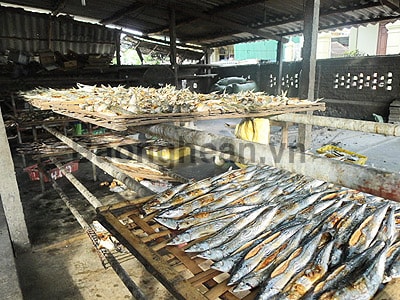
Grilled seafood awaiting distribution.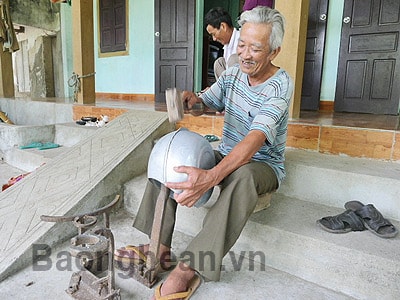
The mound used for scooping water for salt production.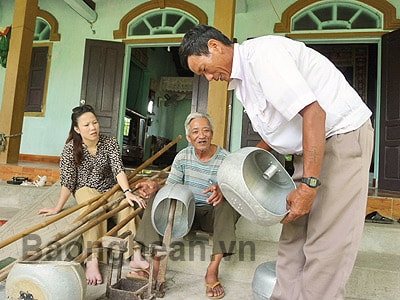
Showing off a new invention that improves tool quality.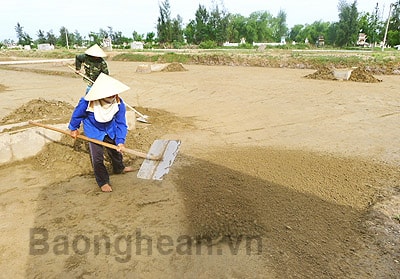
Spread sand on the salt flat.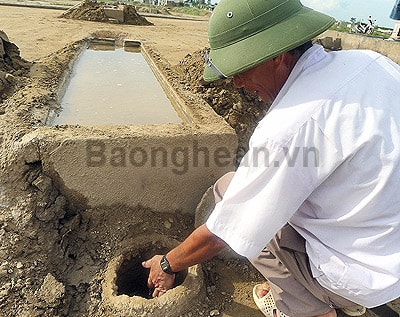
Check the temperature of the brine after filtering through the sand.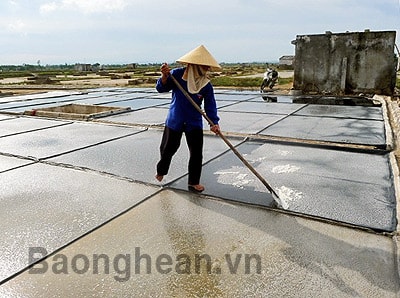
Scrape the salt from the pond after one day when the brine has crystallized.
Hai Trieu - Thanh Luong