
Transformation in a poor village
Lang Khe - Con Cuong is a particularly disadvantaged commune, but thanks to the attention of the State and the dynamic transformation of crop and livestock structures, focusing on cattle farming, bamboo cultivation, cassava... the commune is gradually striving to rise out of poverty.
(Baonghean)Lang Khe - Con Cuong is a particularly disadvantaged commune, but thanks to the attention of the State and the dynamic transformation of crop and livestock structures, focusing on cattle farming, bamboo cultivation, cassava... the commune is gradually striving to rise out of poverty.
Lang Khe is a predominantly agricultural commune, located nearly 30 km from the district center. In 2010, the poverty rate was over 46%. To gradually reduce the poverty rate and improve the material and spiritual lives of the people, the commune has maximized the effectiveness of support from the central government, the province, and non-governmental programs and projects. In addition, the commune has sought new directions in the rational structure of crops and livestock to gradually escape poverty. In the last five years, Lang Khe has focused on strongly developing cattle and pig farming.
Mr. Lo Hung from Khe Thoi village, happily herding his cattle back from grazing, said: "Initially, I borrowed 20 million dong from the Social Policy Bank, and borrowed more from relatives to buy two cows. Now, I've developed a herd of eight cows. Each year, I sell five cows for over 120 million dong, and after deducting expenses, I make a profit of over 70 million dong per year." Not only Mr. Hung, but also Mr. Lang Van Duong in Dong Tien village has more than 30 cows, and Mr. Luong Van Bon raises 20 cows.
From 2010 to 2011, Lang Khe commune received support from the Rural Development Board of Con Cuong district, providing over 40 cows to particularly disadvantaged households. Most households have benefited from this support. The total number of cows in the commune currently exceeds 2,000. In addition, the commune has also developed its pig farming; for example, Ms. Ngan Thi Kim in Pieng Khu village raises over 30 pigs for meat, bringing the total pig population in the commune to over 2,500. Over the years, Lang Khe has also successfully restored and developed the bamboo cultivation industry.
Mr. Loc Vinh Thuong from Chom Lom village shared: "My family has over 5 hectares of bamboo in the Khe Ngon area. Every day we harvest and prune 50-60 bamboo plants, selling them for 8,000-10,000 VND per plant, earning 500,000-600,000 VND per day." According to Mr. Thuong, growing bamboo is "easy money," requiring very little care. Bamboo grows very well along the stream banks, and traders come to buy it every day. It is known that in Chom Lom village alone, 170 households have a total of over 200 hectares of bamboo, and thanks to bamboo cultivation, many families have improved their lives. Currently, Lang Khe district has over 450 hectares of bamboo, concentrated in Huoi Mac, Khe Thoi, Chom Lom, etc., with an average income of over 50 million VND per hectare.
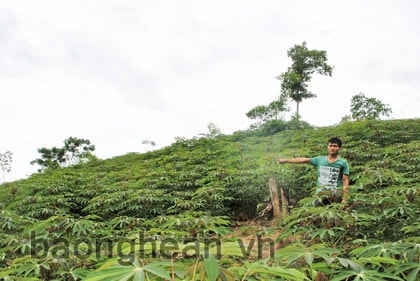
The barren, deforested hills of Lang Khe have been covered with high-yield cassava plants.
Lang Khe has also planted over 120 hectares of mahogany trees in barren areas. Over the past few years, Lang Khe has exploited its potential to plant high-yield cassava on over 70 hectares of barren hills, achieving a yield of over 25 tons/ha. Ms. Luong Thi Tinh from Khe Thoi recounted: "Following the commune's policy, we have planted 5 sao (approximately 0.5 hectares) of high-yield cassava, with a yield of 22-25 quintals/sao. Since 2012, the commune has boldly exploited the potential of hillside land to conduct a trial planting of 7 hectares of sugarcane in Boong village. After achieving success, in 2013 the commune increased the area by another 36 hectares."
To ensure food security over the years, Lang Khe has intensively cultivated over 120 hectares of rice, with an average yield of over 55 quintals/hectare. To achieve this yield, Lang Khe has planted over 80% hybrid rice varieties, followed proper technical procedures for intensive cultivation, and focused on maintaining and repairing small-scale irrigation systems to ensure water supply for rice crops. Lang Khe is currently constructing an irrigation project to install water pipelines for rice cultivation worth 1.2 billion VND (the commune is the investor, with state funding).
The project, designed with 20mm diameter iron pipes, draws water from the upstream Nhoong stream, a 3km stretch, to irrigate over 10 hectares of rice paddies in Huoi Mac village. It is planned to be operational by the end of 2013. Over the past four years, Lang Khe has also utilized its water surface potential to raise dozens of fish in cages on Khe Thoi stream, generating considerable economic benefits. It is known that, to date, the Con Cuong Social Policy Bank alone has provided loans to Lang Khe residents for economic development totaling over 5 billion VND. The capital has been effectively utilized, focusing on livestock farming, forestry, cassava, and sugarcane cultivation.
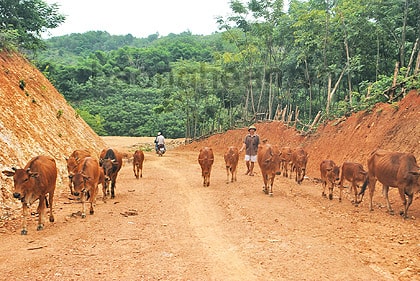
The cattle herd of Mr. Lo Hung's family in Khe Thoi village, Lang Khe district.
Despite some progress in economic development, Lang Khe remains a disadvantaged commune overall, with a current poverty rate of 40.1%. Lang Khe is continuing its efforts to escape poverty, primarily by leveraging its internal resources. The commune will expand the area for cultivating bamboo to over 600 hectares, sugarcane to 150 hectares, and promote the development of cattle and pig farming. With the support and assistance of the government, Lang Khe is confident that it will soon rise out of poverty.
Text and photos: Vuong Tran