
Lesson 4: Driving away harmful winds
There was a time when opium poppies, like a poisonous wind, swept across the lands of Ky Son and Que Phong districts. Back then, people in the border villages cultivated opium poppies as easily as they cultivated rice in the fields… The fight to eradicate this bewitching flower and drug trafficking remains a challenging one even today.
(Baonghean)There was a time when opium poppies, like a poisonous wind, swept across the lands of Ky Son and Que Phong districts. Back then, people in the border villages cultivated opium poppies as easily as they cultivated rice in the fields… The fight to eradicate this bewitching flower and drug trafficking remains a challenging one even today.
>>Lesson 3: The image of a soldier in a green uniform
Drugs are present.
In the mountainous district of Que Phong, the weather is unpredictable this season. One moment it's blazing hot, the next it's dark with clouds gathering. In this region, drugs are like torrential rains and floods, always lurking, threatening, and destroying the peace of the villages. Major Vy Van Giang, Deputy Chief of Police of Que Phong District, mused and worried: “The drug situation in the area remains very tense. In the first seven months of 2013 alone, we discovered and arrested 48 cases involving 61 individuals, seizing 853.1 grams of heroin, 58.42 grams of synthetic drugs, 68.55 grams of opium, and many other pieces of evidence and tools used in the crimes.”
The pain of drug abuse in this area at the end of National Highway 48 is not just about the heartbreaking numbers and haunting deaths, but also about the lost youth. At the detention center of the district police, we met Nguyen Khac MC. He's very young, just over 18. He was arrested on June 6th with 1.65 grams of heroin. The handcuffs were tightly clasped on his plump, white hands. Thinking about the coming months for this criminal, I felt as if someone was rubbing salt into my wounds. Looking at C, tall and fair-skinned, speaking words of repentance, the image of a fragrant cinnamon tree being cut in half at the waist suddenly came to mind…
Life stories like C's in "Golden Land," haunted by the insidious effects of heroin, are not uncommon. At the Social Labor Education Center in Que Phong district, we met trainee Loc Thi Ly. Ly entered the center at only 17 years old, but had already been addicted for two years. Ly's childhood was filled with tragedy: her father died young, her brother-in-law died from drug addiction, and her younger brother is also an addict. Ly became addicted to heroin after being encouraged by friends to try it once. The day we met her was the day she returned to the community. She proudly told us, "My health has recovered well, I'm completely free from withdrawal symptoms, and I've gained 3 kg."
Ly cried a lot on the day she left the camp. She cried for the trainees who no longer had a chance to rebuild their lives, because they had contracted late-stage AIDS due to injecting drugs…
Having only been operating since June 2010, the Que Phong District Social Labor Education Center has welcomed hundreds of trainees from both Que Phong and Quy Chau districts. Most of them are from poor families and, due to a lack of understanding, have become involved with drugs. In the morning, watching the trainees line up for exercise, we noticed that most of them were very young, but there were also some older trainees. Mr. Lo Van Viet (61 years old) is the oldest trainee at the center. He told us about the "deadly allure" of drugs: "I worked as a laborer in the Mong villages, and my friends invited me to try it, so I started, and then I became addicted. I became addicted in September 2010. When I returned home for Tet (Lunar New Year) this year, I tried to quit at home but it didn't work. My family decided to bring me here to quit. My wife is old, my children are grown and have their own families. Being addicted is very shameful."
Along the winding mountain roads, we made our way to Dong Van commune beside the picturesque Chu River. The ancient Thai village of Xop Chao was once devastated by drugs. When asked about drugs, Mrs. Lo Thi Ha (78 years old) said: “Things are better now, but it was very hard before. We were poor and had nothing to eat, so many people turned to opium. My husband was the same; he was addicted to opium for many years. Every time he ran out of opium, he would go to Muong Pom and Muong Piet in Thong Thu, asking someone to buy it from the Hmong people in Laos and bring it over. Many people in the village who didn't have money had to go to the Hmong villages in Laos to work so they could get opium to smoke…” Mr. Luong Van Quang, Mrs. Ha's second son, added: “Although this land can't grow opium poppies, its smoke still travels far here. The 'brown fairy' and 'white death' have devastated and caused suffering to many families. The whole commune now has 25 drug addicts (5 are undergoing rehabilitation), and in the past few years, 20 people have died from injecting drugs, including some who contracted HIV.”
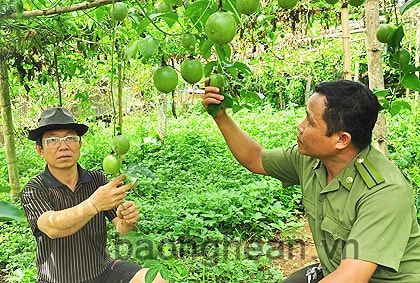
Mr. Vy Van Thiet's passion fruit garden (Yen Son village, Tri Le commune, Que Phong district)
for high income.
The arduous war
About 5 km upstream from Sao Va Waterfall along the Nam Viet River is Pa Kim village, the location of the Hanh Dich Border Guard Post. The post is a model unit for drug prevention and crime prevention. Lieutenant Colonel Tran Van Hoa, Deputy Commander, stated: The Hanh Dich Post manages the area of two communes, Hanh Dich and Nam Giai, with 20.5 km of border. Across the border are the two villages of Nam Bong and Pa Khom, belonging to the Tau village cluster, Sam To district, Hua Phan province, in neighboring Laos.
The area is considered a hotspot for illegal proselytizing activities and a hub for transnational drug trafficking rings. In the fight against drug crime, the officers and soldiers of the border guard post regularly monitor the area and gather intelligence. This year, the Hanh Dich Border Guard Post, in coordination with the Tri Le and Thong Thu Border Guard Posts, organized ambushes and apprehended suspects in two drug trafficking cases, seizing two blocks of heroin and 18.5 grams of synthetic drugs.
Gathering intelligence and conducting ambushes is a difficult and fierce battle. Major Vy Van Giang, Deputy Chief of Police of Que Phong District, recounted: “Many cases required organizing ambushes that lasted from dusk until dawn for 15 nights, such as in Pu Kem (Chau Thon) and Huoi Do (Chau Kim), enduring leeches and mosquitoes biting us all over, soaking in the cold, freezing rain and wind. We only dared to ration the water we carried little by little…” Not only in Hanh Dich commune, but throughout Que Phong district in particular, and along the border between Nghe An and the provinces of Hua Phan, Xieng Khouang, and Bolikhamsai (Laos) in general, there have been countless drug trafficking cases involving fierce gun battles.
Que Phong District has four border communes: Thong Thu, Hanh Dich, Nam Giai, and Tri Le, with 59 villages, nearly 3,000 households, and approximately 16,000 people, comprising four ethnic groups: Thai, Mong, Kho Mu, and Kinh. The lives of the people in the region are very difficult. Vietnamese and Lao people on both sides of the border have long-standing kinship ties, frequently visiting relatives, buying and selling goods, and exchanging supplies. The long-standing practice of cultivating and smoking opium has resulted in a large number of traditional addicts. Recently, while opium has become scarce due to the eradication policies of both governments, drug traffickers are increasingly smuggling synthetic drugs into Vietnam. Nghe An is a "suitable" entry point due to its rugged mountains and numerous rural roads.
Lieutenant Colonel Nguyen Viet Tha, Political Officer of Tri Le Border Guard Station, said: “During the Anti-Drug Action Month (June 2013), in coordination with relevant forces, Tri Le Border Guard Station organized 12 patrol and drug control operations, detecting and arresting 4 cases and 4 individuals involved in drug-related crimes, seizing 25 grams of heroin, along with many other exhibits…” Throughout the province, from the beginning of the year until now, the Provincial Border Guard has detected and arrested 27 cases and 36 individuals, seizing 6.837 kg of heroin, 2,406 synthetic drug pills, 1 grenade, 1 sharp knife, 1 car, 10 motorbikes, 8 mobile phones, and 24,850,000 Lao Kip. The units have initiated legal proceedings, completed initial dossiers, and handed over 25 cases involving 32 individuals to the police for further investigation and processing. One case involving 3 individuals was handed over to the Xieng Khouang Provincial Police in Laos. These figures demonstrate that the fight against drug crime remains fraught with difficulties.
Give up poppies.
Lieutenant Colonel Nguyen Viet Tha stated: "The fight against drug crime must first involve propaganda and mobilization, cleaning up the ranks of our people. This struggle is still very difficult, but there are many positive signs. The people of the ethnic groups in Que Phong in particular and our province in general no longer cultivate opium poppies… Regarding Tri Le, a border commune located about 30 km from Kim Son district town, it was once the capital of opium poppy cultivation."
Mr. Le Xuan Thu, Chairman of Tri Le commune, recalled: "In the 1980s, the people of Tri Le, especially the Mong people, cultivated opium poppies extensively. It was a traditional farming practice that was very difficult to abandon." According to Mr. Thu, from 1982-1984, Pha Ca Tun peak was the capital of opium cultivation, entirely run by the Mong people of Laos and Tri Le. Eight Mong villages—Pa Khom, Pieng Luong, Huoi Xai 1, Huoi Xai 2, Huoi Moi 1, Huoi Moi 2, Muong Long, and Nam Tot—all stretched along a 17.5 km stretch of precarious border road halfway up the mountain, including Pha Ca Tun peak, over 1,500m high, with its ancient forests and pristine valleys—a dreamland for opium poppy cultivation.
However, the sad story of the negative consequences it brought to this beautiful land is now a thing of the past. This time, upon arriving in Tri Le and asking both officials and locals about opium poppies, everyone shook their heads: "The Party and the State have been campaigning against it, so our people stopped growing opium poppies a long time ago." Walking up the forest path to Pu Luong village at midday, the entire village was eerily quiet, not a soul in sight, only the gray samu wooden houses nestled shyly against the mountain slopes.
Luckily, I met Mr. Xong No Ly, still carrying his "lu co" (a woven basket used for carrying crops) and a traditional Hmong knife on his back. Wiping away his sweat, Mr. Ly said, "It's harvest season now, everyone's gone to the fields, they won't be back until evening. You have to wait until sunset to meet them." I asked him, "Do our people still grow opium?" Mr. Xong No Ly confidently replied, "Thanks to the propaganda and persuasion of the officials, our people have given it up a long time ago. Opium is very evil; it has caused so many deaths. We know growing opium brings money, but the government has banned it, so we just follow our instincts, and all seven of our children follow suit. Now we grow rice, cultivate mountain eggplant, and have passion fruit gardens! We abandoned the 'valuable bag' (opium poppy flowers) a long time ago."
On the newly opened, treacherous road to Pà Khốm, we unexpectedly encountered an elderly Hmong couple trudging along. Upon inquiring, we learned that Mr. Thò Già Dê, former Vice Chairman of Phăn Thoong commune (Sầm Tớ district, Laos), and his wife, Xồng Y Mỹ, had walked from Laos to visit their daughter on this side of the border since 5 a.m. He said, "We're just here to visit our daughter; we're not bringing any opium seeds. I've told our children and grandchildren many times not to plant or smoke opium; it's too much suffering!"
In Pa Khom village, village head Va Chia Ninh led us to meet Mr. Tho Giong Nu, a former resident considered to be quite well-off economically, owning 84 buffaloes, cows, and horses. In 2006, a joint inter-agency task force from the district fined Mr. Tho Giong Nu for replanting opium poppies. At that time, according to the task force's report, his garden, about 100 square meters, contained opium poppies, mixed with... cabbage, beans, and even pumpkin leaves. When asked about it, Mr. Nu chuckled: "I only intended to plant them to get some sap to make opium paste, but now that I know, I won't be foolish again."
Following Border Guard Major Dam Thien Thuong, who was seconded as Deputy Secretary of the Party Committee of Tri Le commune, we went to the fields to find Mr. Ly Tong Sua, the head of Huoi Moi 1 village. Upon arrival, we saw Mr. Sua working with district officials to guide villagers in irrigating newly reclaimed fields. When asked about his efforts to persuade villagers to abandon opium cultivation many years ago, Mr. Sua waved his hand dismissively: “I didn’t do anything significant. I just saw how harmful opium cultivation was to our people! As a Party member, I had to lead the way, set an example for the villagers to follow. Tri Le is now drug-free; the people are now diligently cultivating high-value crops and raising livestock…” The smiles and trusting eyes of the Mong people in Huoi Moi are the cornerstone of the fight against drug abuse in this remote highland region.
Reporters' Team