

A love story from the Northwest region.
Though past their eighties, Mr. Nguyen Duc Loc (born in 1929) and Mrs. Tran Thi Anh (born in 1931) still vividly remember the hardships and joys of their first meeting on the Northwest battlefield 59 years ago. Their love blossomed in their hometown of Yen Dung (now Hung Dung ward, Vinh City), and followed each other through the Dien Bien Phu campaign and the years of fighting the Americans, ultimately leading to the joy of peace…
(Baonghean)Though past their eighties, Mr. Nguyen Duc Loc (born in 1929) and Mrs. Tran Thi Anh (born in 1931) still vividly remember the hardships and joys of their first meeting on the Northwest battlefield 59 years ago. Their love blossomed in their hometown of Yen Dung (now Hung Dung ward, Vinh City), and followed each other through the Dien Bien Phu campaign and the years of fighting the Americans, ultimately leading to the joy of peace…
Welcoming us into their small house in Dong Lam Hamlet (Hung Dung Ward, Vinh City), Mr. Loc and Mrs. Anh seemed to become younger. Recalling the past, Mr. Loc's face lit up. Mr. Loc began enthusiastically: “My wife and I used to live in the same neighborhood, participating in the same Young Pioneers and then the Youth Union. Because of that, feelings developed between us early on, and with the encouragement of both families and friends, we grew closer. In 1952, when I enlisted, there were many young men and women from the village at the farewell ceremony. She shyly slipped a few bills into my hand and whispered, ‘Go safely, and remember to send letters home!’ For me, her words became a promise.”
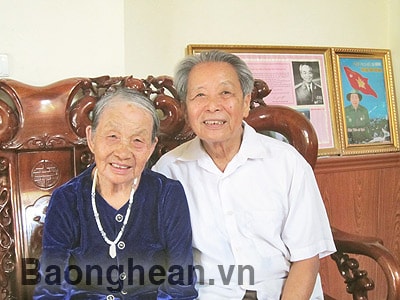
Mr. Loc and Mrs. Anh.
One day, around April 1953, Nguyen Duc Loc's unit, while on a march, stopped in Moc Chau. There, a Youth Volunteer Company and an engineering unit of the 351st Division were building roads to support the Upper Laos campaign. Despite the hardship and fatigue, the soldiers were very happy, and everyone took the opportunity to find fellow countrymen to inquire about the situation back home. Mr. Loc entered the camp of the female Youth Volunteers and asked, "Is there anyone from Nghe An here?" The women replied, "Yes, countless people." Recognizing their voices and fellow countrymen, everyone was overjoyed.
Mr. Loc glanced around the hut and suddenly met the gaze and face of his beloved. The joy came so unexpectedly that they both tried to suppress their emotions and happiness. After chatting for a while, he learned that a few months after he left, during a recruitment drive for Youth Volunteers to serve on the battlefield, Ms. Anh volunteered to join, hoping to contribute to the fight against the enemy. Another motivation was her longing to meet her loved one on the battlefield. Thus, Tran Thi Anh became a platoon leader in the Cu Chinh Lan Youth Volunteer Company (one of the first Youth Volunteer units in Nghe An province). Her longing to see her lover intensified when she learned that her unit would be marching to the Northwest to clear mountains and build roads for the campaign. And that longing and hope became a reality...
The reunion was filled with mixed emotions. The young female volunteer recounted stories from home and then about her work on the front lines. The young soldier could only listen, unable to say much. Seeing her lover barefoot, Tran Thi Anh asked, "Why are you barefoot?" The soldier replied, "I was wading through a stream at night, and the water swept away my sandals!" The young woman then took off her rubber sandals, made from bicycle tires, and gave them to her lover: "Wear my sandals for now. You can't march far barefoot. One of my friends brought two pairs; I'll borrow them, don't worry..." And for the soldier, those sandals became a memento, an inseparable item on his marches. After the reunion, they went their separate ways. His unit marched towards the Vietnam-Laos border, paving the way for our main army to liberate Xieng Khouang and Sam Neua, while her unit continued south towards Moc Chau. Although they live in different places, they occasionally manage to catch up and encourage each other.
Having completed their mission in Laos, Nguyen Duc Loc's engineering unit returned to their base at Ta Khoa ferry crossing on the Da River. This was a crucial location on the route to liberating Dien Bien Phu, frequently subjected to fierce enemy attacks aimed at cutting off our troop movements and supplies from the rear to the front lines. His squad was tasked with establishing an observation post to monitor enemy activity and clearing bombs and mines dropped by the enemy into the Da River.
At this time, he learned that his girlfriend's Youth Volunteer Corps was still operating in Moc Chau and had achieved many accomplishments, with Platoon Leader Tran Thi Anh being honored with a Certificate of Commendation from General Vo Nguyen Giap. Meanwhile, the engineering troops and Youth Volunteers were striving to ensure transportation for a crucial and decisive campaign: the Dien Bien Phu Campaign. Competing with his lover, engineer soldier Nguyen Duc Loc always volunteered to go to the most difficult and arduous places so that our troops could advance safely and smoothly, contributing to the Dien Bien Phu victory that was "renowned throughout the world and shook the earth." At the end of the campaign, the Engineering Corps was praised by President Ho Chi Minh and awarded a flag embroidered with four golden words: "Opening the way to victory." Mr. Loc was overjoyed to have contributed to that achievement and had the opportunity to "show off" to his girlfriend.
With the Geneva Accords signed and peace restored in the North, the combat engineers were granted leave to return home and start a family. Their wedding was simple but incredibly happy. After the wedding, Mr. Nguyen Duc Loc returned to his unit stationed in Bac Ninh. Later, he was sent to the Soviet Union to study security protection. Upon returning to Vietnam, he was assigned to the Security Department of Military Region 4, and in 1968, he was included in the list of troops sent to support the Quang Tri battlefield.
In this "land of fire," the veteran of the Dien Bien Phu battle once again directly confronted the enemy and fought bravely and courageously, earning the title of "Hero of Victory." In 1971, he was wounded and treated at the Military Hospital of Military Region 4, then transferred to the Political Department, Logistics Department, and Economic Department of the Military Region. In 1978, after nearly 30 years of military service, he retired with the rank of Major and officially returned to his family.
After getting married, Mrs. Tran Thi Anh stayed at home and actively participated in social work, being assigned to lead the Women's Association of three communes: Hung Hoa, Hung Loc, and Hung Dung. At that time, Mrs. Anh was assigned as the platoon leader of the Hung Hoa dike-building team (1955). During the resistance war against the US, she actively participated in supporting and assisting combat units defending Vinh town, carrying wounded soldiers to hospitals for treatment. To raise her young children, she had to work in the fields, raise pigs and chickens, and cut grass to sell to earn money to buy rice. Therefore, for 10 consecutive years, she was always awarded the title of "Capable Woman".
Now, having overcome the hardships and storms of life, Mr. Loc and Mrs. Anh are enjoying their happy and warm old age in their homeland. Their greatest joy is that all four of their children have grown up and are contributing members of society; some have retired with the rank of colonel, others hold the position of deputy director in a company. Many of their grandchildren have gone to university and found jobs, always looking to the family tradition and their hometown as a source of support. These days, they often recount stories from the battlefields of Northwest Vietnam and Dien Bien Phu, stories that, though 59 years ago, remain vivid in their memories!
Text and photos: CONG KIEN