
High investment, low return.
The national target program for clean water and rural sanitation is very significant for the poor and ethnic minorities in remote areas. However, for various reasons, many clean water supply projects in highland communes are in disrepair or even abandoned, while people have to use polluted water.
(Baonghean)The national target program for clean water and rural sanitation is very significant for the poor and ethnic minorities in remote areas. However, for various reasons, many clean water supply projects in highland communes are in disrepair or even abandoned, while people have to use polluted water.
In 2008, Lien Hop commune (Quy Hop district), a mountainous area, received state investment for the construction of a gravity-fed water supply system from Program 135. The project included a water pipeline system and water storage tanks, with a total cost of nearly 1.2 billion VND. This system was intended to provide clean water to six hamlets and several schools in the area. The project was a long-awaited dream for the local people, as it would provide them with clean water for daily use. However, shortly after its completion and commissioning, the pipeline system and equipment deteriorated and became damaged, and the water storage tanks were largely abandoned.
Since the self-flowing clean water system deteriorated and broke down, the 400 residents of Na Xai village, Lien Hop commune, have relied primarily on spring water for their daily lives. Ms. Luong Thi Thai, from Na Xai hamlet, Lien Hop commune, said: "The government built a water tank, but it broke down quickly. Without water, the villagers have to bathe, wash clothes, and use this spring water for daily activities. We also get drinking water from here; transporting it to our homes is a long and difficult task." Regarding the cause, Mr. Luong Ba Xiet, head of Na Xai hamlet, added: "Due to the villagers' careless use and lack of maintenance, and because the upstream pipes were swept away by floods, these facilities have been without water for over a year."
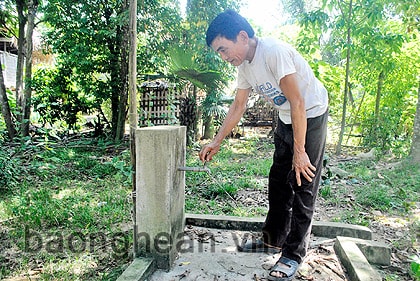
The gravity-fed water supply system in Canh village, Ta Ca commune (Ky Son district) is not functioning effectively. Photo: Cong Kien
Quỳ Châu District has 12 communes and towns, and almost every commune and town has one or two gravity-fed water supply systems. Following the directions of the commune officials, we visited one of these gravity-fed clean water systems in Châu Bình commune. The project was completed and initially handed over at the end of 2012. This system has provided water to 500 households and 3 schools in the area.
However, the residents didn't get to enjoy the benefits for long before the water supply system was damaged and deteriorated. The water supply can no longer reach the households. Without clean water, the people of Binh 1 village, Chau Binh commune, have to use stream water for daily life. Speaking to us, Ms. Lo Thi Vien from Binh 1 village said: “Due to the floods, the clean water system is damaged, so people have to go to the stream to wash clothes and fetch water for use. We hope the government will provide the necessary conditions for repairs soon so that our people can have clean water again, because using this stream water means having to travel a long distance.”
The deterioration of gravity-fed water supply systems in communes under the 135 program is not only occurring in Quy Hop and Quy Chau districts, but many other localities benefiting from this program are facing similar circumstances. As a large area with complex terrain, Huoi Tu commune in Ky Son district has made significant efforts to invest in and develop infrastructure over the years, with water supply projects serving the local population being one of the most important.
These projects have gradually improved the lives of the people in Huoi Tu commune. However, after a period of time, the management and use of these projects have revealed shortcomings and difficulties, not only failing to be effective but also affecting people's lives. Mr. Ly Chia Chu, Secretary of the Party Committee of Huoi Tu commune (Ky Son district), said: "After the project was completed, we only used it for a few months, at most only a year, before the project broke down and became unusable. Currently, people have no water from the main reservoirs, so they have to drive to streams or walk to fetch water."
Upon investigation, the main reason is that after construction is completed, the developer hands over the facility to the community for management and use. However, the residents' awareness of protecting the facility is low; when problems occur, no one reports them for timely repairs, and regular maintenance is lacking due to a lack of funding. This leads to residents arbitrarily digging into the pipelines, causing damage to the infrastructure. And when the infrastructure deteriorates and becomes damaged, no one cares, and the local authorities wait for higher levels of government to "allocate" funds for repairs.
Furthermore, deforestation and mineral exploitation have depleted water sources from streams and springs supplying water infrastructure. On the other hand, the water supply systems in the commune are built in rural, mountainous areas where frequent floods damage the structures. Most of the water supply systems rely on gravity flow, and due to a lack of attention to design and local consulting, the completed projects are often unsuitable. According to Mr. Vi Thanh Tuong, Vice Chairman of the Quy Hop District People's Committee: "The limited and scattered investment in these projects has negatively impacted the quality of the infrastructure."
To improve the effectiveness of programs and projects for mountainous areas in general, and water projects in particular, it is suggested that a mechanism be established to evaluate and monitor the effectiveness of these projects, assigning specific responsibilities to local authorities and villages in their management and protection. Only then can we avoid the current situation where people are left without water despite multi-billion dollar water supply projects.
Bui Tho (Provincial Radio Station)