
That day in Dien Bien...
(Baonghean) - In 1953, we had to study at night. Each of us had a bottle lamp, because French planes flew overhead all day long...
(Baonghean) - In 1953, we had to study at night. Each of us had a kerosene lamp because French planes, the Dakota or Bevanxit (that's what my brother called them), buzzed around all day. They flew close to the bamboo groves, sometimes dropping baskets of leaflets that fluttered like butterflies, other times firing relentlessly across the fields, chasing buffaloes, cows, and people plowing and planting. My brother said they were firing dunk rounds. I didn't know anything about it, I only knew to pick up large, shiny brass cartridges, as big as my thumb, to play with. Because of this, the whole village was deserted during the day. As soon as the rooster crowed, we'd get up to cook rice, wrap it in banana leaves or mashed sweet potatoes, put it in a stone mortar, and press it into giant rice cakes. We'd put water in dried gourds, then carry our loads and evacuate. Some families went to Phung Mountain, hiding in a cave, while my family went to Ma Dao islet, which I heard was a battlefield where my grandfather raised an army against the French following the Can Vuong decree. Their loyalty was great, but the times had run out, so the rebel army was defeated and their bodies littered the beach; from then on, the beach was called "Mã Đảo" (Island Graves).
My brother dug deep holes in the base of the sand dune, using sticks to prop them down from the edge of the dune to the rice field, then spread straw over them to cover. Normally, we'd spread mats under the shelters, but when planes flew, we'd crawl into the frog holes. At dusk, the children would go home to school or play, while the adults would work with the buffaloes plowing and harrowing. During the rice harvest season, the girls would weed and irrigate under the moonlight. At first, it was scary and hard, but we gradually got used to it, and we children even liked it. We'd play in the dirt, make cricket fights all over the field, and whenever we heard a plane, we'd run back and hide in the holes. The "Western" planes flew as slow as turtles, but we ran even faster. Life went on like that…
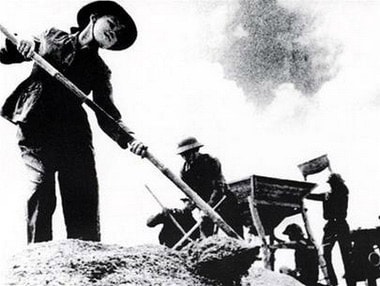
The heroine was tasked with clearing the battlefield and rebuilding the economy.
This month the whole village was buzzing with excitement, because there was an order for my village to hold a general assembly of civilian laborers to go to Dien Bien Phu. The young people all over the village were eager, everyone wanting to volunteer. My cousin Chan was appointed company commander and tasked with recruiting for the village. My seventeen-year-old sister also wanted to go, but when our mother forbade it, she cried and ran back and forth begging my cousin. I don't know how she managed to persuade him, but he agreed. That evening, Chan came to our house. My sister hid behind the bedroom door, visibly delighted.
- Auntie! Although she's still a few months away from turning eighteen, she's quick-witted and healthy. Besides, since I'm going with her this time, please let her go. Hard work makes a man; if she can't handle heavy burdens, I'll let her carry lighter ones.
My mother hesitated for a moment, then said:
"Well, so be it. Auntie will leave it to you to look after her. A girl traveling far from home, surrounded by bombs and bullets, makes Auntie very worried." My sister rushed out of the room and hugged my mother around the neck.
- Hooray, Mom! You can't change your mind now!
- Damn you! Like father, like son.
The next day, my mother bought several meters of black fabric and sewed three pairs of trousers for my sister to wear instead of her skirt. My brother had to go all the way to the town to buy my sister two pairs of canvas shoes. My mother even carefully soaked the shoes in a thick brown solution, dried them, and then smeared mud on them to make them look dirty. She said it was to keep them white in case the airplane saw them, but in reality, it was to make the fabric of the shoes more durable. My brother was busy looking for elastic bands to tie the trouser legs.
That whole week, my village was buzzing with excitement like a festival. My house was spacious, so Chấn chose it as the gathering place. Every household with a large pig brought it over; my family had two, so we slaughtered them too. Five or seven village vendors were brought in, and dozens of white pig carcasses lay on the stone steps of my house. The children each received a piece of liver and bladder, and Chấn gave me a tail, saying that eating pig tails prevented teeth grinding. The whole village crowded around, eating the offal and slurping the broth. My yard was packed with people, laughing and talking noisily like a bustling market.
The meat was butchered, the lean meat separated, the skin, bones, and trotters returned to the pig owner, and the surplus given to the villagers. The fat was rendered in six or seven copper earthenware pots, the lean meat was boiled and thinly sliced, and for every bowl of meat and half a bowl of salt, it was roasted dry in a pot, then pounded in a mortar, roasted again until very dry, allowed to cool, placed in bamboo tubes, sealed with dried banana leaves, and bundled into bunches to be carried to Dien Bien Phu as food for the soldiers.
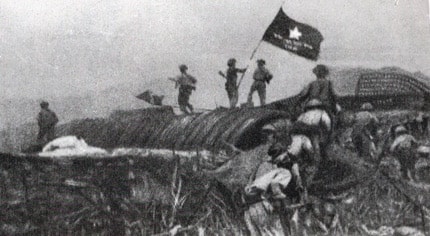
The soldiers planted the victory flag on top of the De Castries bunker.
The lard was fried until almost done, then my mother would scoop a ladleful of salt into each pan, remove the cracklings, and press them into two plates to drain the excess oil. The remaining pieces were then sandwiched between two pieces of dry bread, which she divided among us. I still remember the rich, savory aroma of the lard and the bread after 60 years. Occasionally, I try to make it again, but it never tastes as good as it did back then.
The lard cooled and was poured into individual bamboo tubes, sealed tightly. In the cold weather, the lard solidified, and they carried it up to Dien Bien. Rice was mixed with dried sweet potatoes, fresh bamboo was split and woven like a chicken cage, lined into baskets, and straw and dried banana leaves were spread on top. The rice was then poured in and formed into round balls like water-carrying pots, with two balls per load.
Everything was ready. Two days later, the labor brigade set off. The whole village saw them off, some crying, some laughing, clinging to each other, urging them on until the sun rose before finally letting them go. My brother Chấn carried a pole, while my sister carried salt and meat, five or six bamboo tubes at each end, her trousers cinched at the ankles, her belt fastened, and her feet in shoes—she looked quite dignified. My brother said the group was going to Nho Quan, then across the Hòa Bình stream, through Châu Yên, Mộc Châu, up to Sơn La, over the Pha Đin pass to Tuần Giáo, and then down to Điện Biên Phủ. Even a quick trip would take a month. I heard that, but I didn't know where Tuần Giáo and Sơn La were; I just thought the road must be very long! And I missed my sister. My house suddenly became quiet, no longer filled with my sister's cheerful singing and laughter. My mother often sat alone, sighing.
Three months later, my sister returned, bringing news of the victory at Dien Bien Phu. She was thin and pale, her long, black hair that once reached her heels was gone, replaced by thin, short strands. She said that after more than a month in Dien Bien Phu, she contracted malaria, experiencing bouts every two days, the cold penetrating deep into her bones. My whole family was saddened, because she wore a white headscarf; she was mourning for my brother, Chan.
- After crossing Son La, four days later the group rested in the forest after passing Pha Din. Because they were impatient to reach Dien Bien Phu quickly, they set off at 5 pm. Just as they reached the Tuan Giao intersection, a group of planes swooped down, dropping bombs and firing bullets like a hail of chaff. He ran back and forth, shouting for the group to scatter into the forest. Near his child, he called out his child's name, but a burst of bullets struck him down by the roadside. His child rushed to him; he looked at his child but couldn't say anything more, and then he breathed his last in his child's arms.
My sister told my mother that when she got there, she burst into tears. The whole family cried along with her.
For a whole month, my sister was terribly ill. People suggested digging up earthworms, washing them clean, putting nine of them into a teapot, crushing green tea leaves, pouring boiling water over them, and letting it steep for an hour. Then, pouring it into a bowl, adding molasses, and drinking the whole bowlful, lying under a blanket until she sweated profusely. Thanks to this, my sister's fever subsided, and she gradually recovered.
Now that my sister is almost 80 years old, every time I visit her, we sit and reminisce about those days at Dien Bien Phu, and light an incense stick in her memory…
Xuan Chuan (Quynh Luu)