
"King of betel nuts" in Dong Luoc
Although the generation that blackened their teeth and chewed betel nut is no longer numerous today, the betel nut still holds a significant place in the spiritual life of the Vietnamese people. "A betel quid is the beginning of a conversation," and betel leaves and areca nuts are the first choice for traditional social interactions in Vietnam. Therefore, during wedding season as well as on ordinary days, Mr. Nguyen Quang Vinh's betel nut garden in Dong Luoc hamlet, Kim Thanh commune (Yen Thanh district) is always bustling with traders buying betel nuts to distribute throughout the region. Because he is the largest betel nut grower in the area, the locals call Mr. Vinh the "king of betel nuts."
(Baonghean)Although the generation that blackened their teeth and chewed betel nut is no longer numerous today, the betel nut still holds a significant place in the spiritual life of the Vietnamese people. "A betel quid is the beginning of a conversation," and betel leaves and areca nuts are the first choice for traditional social interactions in Vietnam. Therefore, during wedding season as well as on ordinary days, Mr. Nguyen Quang Vinh's betel nut garden in Dong Luoc hamlet, Kim Thanh commune (Yen Thanh district) is always bustling with traders buying betel nuts to distribute throughout the region. Because he is the largest betel nut grower in the area, the locals call Mr. Vinh the "king of betel nuts."
One scorching hot morning, we made our way to Dong Luoc. Opening the iron gate, Mr. Vinh warmly invited us into his house. Before us was a vast betel nut garden, encircling his small house. The betel nuts were planted in straight rows, each tree tall and bearing heavy bunches of nuts. Mr. Vinh explained: "My family owns 1 hectare of garden land, and I've invested in planting a total of 1,100 trees on 0.5 hectares. Of those, 800 have already borne fruit. These are a type of betel nut with continuous sheathing; every tree produces fruit year-round. Traders from Yen Thanh, Tan Ky, Dien Chau… come here to buy betel nuts and sell them everywhere."
Speaking about his betel nut cultivation, Mr. Vinh confided: “In February 1967, my older brother got married. At that time, the bride's family required a betel nut bunch of 50 nuts as a dowry. At that time, betel nuts were very scarce. Although almost every household in the area grew them, the betel nut season was over. I cycled all over Yen Thanh district and down to Dien Chau, but still couldn't find a beautiful bunch. Then, someone told me that there was a family in Quynh Thien commune (Quynh Luu district) that grew betel nuts continuously. I went there and bought a bunch I liked. After buying the betel nuts, I also ordered 30 seedlings to plant. It wasn't until three years later that they sold me the seedlings. Since then, I've invested in growing betel nuts commercially, using the continuous-stemmed variety, so I always have nuts to sell.”
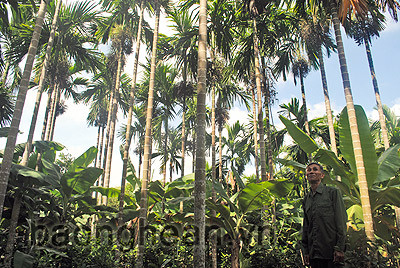
A corner of Mr. Nguyen Quang Vinh's betel nut garden.
When asked about the secret to betel nut cultivation, after a moment of hesitation, Mr. Vinh said: "To be honest with you, after more than 40 years of growing betel nuts, I've learned a few things. This is a type of betel nut tree with continuous sheaths, so each time a sheath falls, a bunch of betel nuts sprouts. Therefore, a single betel nut tree always has 3-4 generations of fruit. Experience shows that in the betel nut season in October, the price is cheap, only 1/15 of what it is now. Therefore, we have to know how to adjust the harvesting to betel nuts out of season. At this time (in July), as soon as a bunch of betel nuts sprouts, we immediately use a sickle to cut it off. Doing so partly avoids harvesting betel nuts in October and partly creates conditions for the betel nut tree to develop and have the strength to nourish off-season crops."
Mr. Vinh's 800 betel nut trees, currently bearing fruit, yield approximately 16 tons of fruit annually. At an average selling price of 10,000 VND/kg, the "king of betel nuts," Nguyen Quang Vinh, earns around 160 million VND per year. He has selected 30 trees planted in 1971 to use for seed propagation; he is willing to provide seedlings and guidance on planting and caring for them if needed.
Besides harvesting the fruit, betel nut trees can provide additional income from their leaves if the owner is healthy and somewhat skillful. The fallen betel nut husks, combined with some rattan and wire, can be woven into brooms, which are very convenient and durable for sweeping. Mr. Vinh says that his betel nut garden produces at least 50 husks a day, meaning that many clusters of betel nuts are in bloom, so he can earn money by making and selling brooms. Because of his weak health, he gathers all the leaves around the base of the betel nut trees to help retain moisture in the soil. Many families in the village ask for the betel nut husks to make hand fans, which they use during power outages. In this mountainous region, electricity is unreliable, so every household proactively makes several hand fans. The betel nut trunk is slender and flexible. Therefore, the trunk of an old betel nut tree, when used to make rafters and purlins for roofing, is very durable, no less so than old bamboo…
Text and photos: Xuan Hoang