
Preserving the cultural heritage of the village.
(Baonghean) - The image of the banyan tree, the riverside, and the village communal house has long been deeply ingrained in the soul of every person from Nghe An province. And so, whenever they leave their hometown, what remains in their childhood memories are moments of waiting for their mother under the banyan tree at the edge of the village, of secretly following their sister to the communal house on moonlit nights hoping to enjoy folk songs, and of seeking solace in sacred places amidst the quiet evening bells during times of sorrow...
(Baonghean) - The image of the banyan tree, the riverside, and the village communal house has long been deeply ingrained in the soul of every person from Nghe An province. And so, whenever they leave their hometown, what remains in their childhood memories are moments of waiting for their mother under the banyan tree at the edge of the village, of secretly following their sister to the communal house on moonlit nights hoping to enjoy folk songs, and of seeking solace in sacred places amidst the quiet evening bells during times of sorrow...
Anyone who has had the chance to visit Bac Son - Van Dien - Nam Dan will see the ancient charm that not every village in Nghe An province is fortunate enough to possess: there are moderately sized, winding roads shaded by the green trees of camellias, jackfruit, mango, and rice; there are as many as eight village ponds within a radius of just over 1km; and especially, Bac Son still preserves a cluster of historical relics including a communal house, temple, pagoda, and pagoda well.
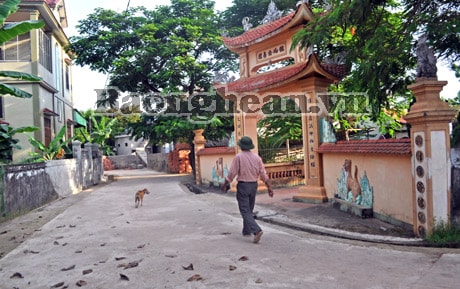
Bac Son Cultural Village, Van Dien Commune, Nam Dan District.
According to Mr. Bui Ba Dao (80 years old), the caretaker of Duc Ong Temple, there are currently five historical sites in the village: Duc Nam communal house, Duc Son pagoda, Duc Ong temple, Thanh Mau temple, and the temple well. Each site has its own unique architectural style: For example, Nam Son temple, also known as Duc Ong temple, is where General Nam Son, a skilled general of Mai Thuc Loan, is worshipped. The temple's architecture consists of two buildings: the main hall and the rear hall, arranged in the shape of the letter "Dinh," with a "gong stand" and "front pillar" structure.
The rear hall is where General Nam Son is worshipped, while the main hall is where the community and his soldiers are worshipped, and also where preparations for ceremonies are made. Similarly, Duc Son Pagoda, also known as Duc Son Temple or Nam Pagoda, was built during the Tran Dynasty and is one of the oldest pagodas in Nghe An province. Notably, Duc Son Pagoda still preserves a bell with a Le Dynasty design, and a unique set of Buddhist statues, representative of Vietnamese pagoda sculptures. The Three Buddhas set consists of three statues of equal size and style, each 1.2 meters tall, seated on lotus pedestals, meticulously crafted from jackfruit wood.
In addition, 210 wooden printing blocks used to print Buddhist scriptures are preserved here. The blocks feature images of Buddha, Bodhisattvas, and scriptures in Chinese characters. According to researchers, these woodblocks date back to the Nguyen Dynasty, during the reign of Emperor Tu Duc… Currently, these relics have all been classified as national heritage sites. Each site has its own management board responsible for overseeing worship and organizing festivals.
Mr. Luong Xuan Son, a resident of Bac Son village, happily shared: “In accordance with the wishes of the people, the village's historical sites are becoming more beautiful thanks to regular repairs and upgrades funded by donations and contributions from the people. It's gratifying that the temple well was restored on its original site last year. However, we are concerned about the deterioration of Duc Nam communal house – the village's guardian deity – and we may need to mobilize community support in the future. The sacred beauty of these ancient communal houses is the eternal beauty of a village, a land, and the Vietnamese nation, and each of us has a responsibility to preserve it.”
Leaving Bac Son amidst the evening bells echoing from Duc Son Pagoda, we made our way to Khanh Trung village (Nghi Khanh) - one of the first cultural villages in Nghi Loc district - which still preserves an ancient village well dating back to long ago.
No one remembers exactly when the Mỏ Phượng well in the village was built, but one thing is certain: that ancient well was the source of water for the entire Ngâm village area (comprising four villages: Khánh Đông, Khánh Thịnh, Khánh Trung, and Khánh Đền) during that period. In the memory of Mr. Võ Mạnh Khởi (70 years old), a resident of Khánh Trung village: The village well was also a meeting place for young people, a place where children played, because there was an ancient banyan tree next to the well.
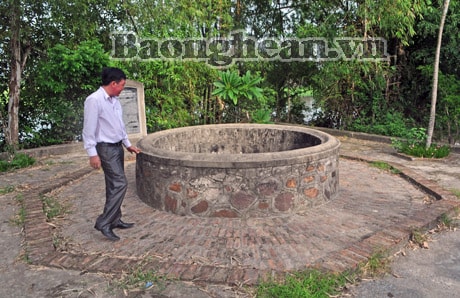
Phuong Mine Well - Khanh Trung Cultural Village, Nghi Khanh Commune (Nghi Loc District).
At the age of 13, Mr. Khoi would wake up at 2-3 am to fetch water for his parents because it was less crowded then; if he went later, he would have to queue until after noon. The well water was very clear and cool, making green tea taste better than using rainwater. The village well was more than 2.5 meters deep, with a diameter of 2.5-3 meters. The well was made entirely of evenly arranged pebbles 30-50 centimeters thick, and notably, the bottom of the well was lined with a thick wooden plank, which still remains today.
Before 1962, the village well provided water for hundreds of households. After 1962, only a few dozen households came to fetch water from it. By 1971, no one came anymore because each household had dug its own well.
Over time, the surface of the well cracked, the wellbed eroded, and trees grew profusely, causing concern among the villagers of Khanh Trung as they passed by... In many village meetings, Uncle Khoi - then the Party branch secretary - expressed his concerns, saying that the well needed to be restored to preserve the village's ancient relics so that future generations could understand what Khanh Trung was like in the past and how it has developed today. Unexpectedly, his suggestion was wholeheartedly supported by the villagers.
In 2007, Mr. Khoi took the initiative to raise funds: those with less contributed 50,000 dong, while those with more resources contributed 500,000 dong and 1,000,000 dong, totaling 18,000,000 dong. In mid-2007, the entire village of Khanh Trung was bustling as if celebrating a major festival: young people, children, and the elderly all joined hands to restore the village well. In just one week, the well was renovated to its original form: with a sturdy embankment around it, and the well floor paved with red bricks… Notably, a large plaque was erected next to the well, inscribed with the words: "Mo Phuong Well Historical Site."
Through Mr. Tinh, a cultural officer of the commune, we learned that Khanh Trung is one of the first villages in Nghi Loc district to be recognized as a Cultural Village. In all the movements launched by the district and commune, Khanh Trung has always been a leading example. In 2012, the percentage of culturally exemplary families in the village reached 94%. Building on the village's tradition of valuing education, an average of 3-4 students are admitted to university each year. Along with Khanh Trung, two wells in the villages of Khanh Tan and Long Dong in Nghi Khanh commune have also been restored with the support of the people in terms of materials and labor, bringing back the cultural beauty of the old villages.
Besides restoring the village well, in recent years, to meet the cultural and spiritual needs of the people, Nghi Khanh has restored the Cua Temple complex and the tomb of General Ninh Ve. The temple was built during the Tran Dynasty to worship Mother Au Co, Cao Son, Cao Cac, the Three Holy Mothers, and famous national and local figures such as King Tran Quang Khai, General Ninh Ve, Duke Nguyen Canh Que, and Confucian scholar Phung Thoi Ta. The temple has three buildings: the Lower Hall, the Middle Hall, and the Upper Hall, built in a beautiful location facing southeast, on land shaped like a phoenix. It is surrounded by villages and densely populated residential areas. Over time, the temple deteriorated, and in 2003, it was renovated and rebuilt in a more spacious manner using local budget and contributions from the people. Since 2010, the Cua Temple Festival has been revived and attracts a large number of people and tourists from within and outside the district. The festival is held annually from the 2nd to the 4th of March in the lunar calendar.
Mr. Nguyen Dinh Suu, Chairman of the Nghi Khanh Commune People's Committee, enthusiastically stated: "The policy of building new rural areas is correct and in line with the people's wishes, with the desire for agricultural and rural life to catch up with urban areas. However, the life of rural people is different from that of urban people. When talking about rural areas, one must mention temples, shrines, bamboo groves, ponds, and village wells... Therefore, in the process of building new rural areas, the commune prioritizes studying each region and area with its different characteristics to find ways to both preserve the charm of the countryside and meet the needs of development, keeping pace with other localities in the district and province."
Mr. Suu's concerns are also the goals that many localities in the province are striving for. "Because no matter what is said or done, no matter how much innovation there is, that space, that village, must belong to the farmers, and be controlled by the farmers," - that's the sentiment of Mr. Vuong Truong Thu, Secretary and village head of Bac Son Cultural Village, Van Dien commune (Nam Dan).
For farmers like Mr. Thu, Mr. Suu, and Mr. Khoi, every banyan tree, every village square... is connected to the many ups and downs of the village's history. Those who have left feel a pang of nostalgia whenever they think of the village, while those who remain feel a greater responsibility in preserving and promoting it.
Thanh Thuy