
Breastfeed your baby.
According to the World Breastfeeding Action Association, breastfeeding not only reduces the risk of infant mortality and malnutrition but also contributes to higher intelligence scores in children aged 7-8 compared to children fed formula. Furthermore, breastfed children have a reduced risk of obesity, diabetes in adulthood, and cardiovascular diseases in old age. However, awareness among young mothers about breastfeeding is currently very limited.
(Baonghean)According to the World Breastfeeding Action Association, breastfeeding not only reduces the risk of infant mortality and malnutrition but also contributes to higher intelligence scores in children aged 7-8 compared to children fed formula. Furthermore, breastfed children have a reduced risk of obesity, diabetes in adulthood, and cardiovascular diseases in old age. However, awareness among young mothers about breastfeeding is currently very limited.
Ms. Nguyen Thi Thu H (35 years old, Le Mao Ward, Vinh City), owner of a beauty salon on Dinh Cong Trang Street, said that she gave birth to two children, and for the first six months, she mainly fed them formula milk. According to Ms. H, "Breast milk only has a certain quantity and quality; at a certain point, it becomes diluted and loses its nutrients. I see that nowadays, people produce good milk for pregnant women, especially milk for children that supplements many components to support the mother's intelligence and physical health. If I have the money and the means, why not give my children that milk?" With a relatively comfortable economic situation, she spends about 1-1.2 million VND each month buying various types of milk for her children instead of breast milk, but the children still suffer from malnutrition and stunted growth. "Perhaps it's due to their physical condition. I don't mind spending money on all kinds of milk and nutritional supplements, but they are still stunted..."
As for Trinh Lam Hoang, an assistant director at a limited liability company, she said, "I know breastfeeding is good, and the media recommends exclusively breastfeeding for the first six months. But my time and work schedule don't allow it. In my profession, regaining my figure after childbirth is crucial. Meanwhile, if I exclusively breastfed, I would have to eat a lot, eat a full range of nutrients, and wouldn't be able to diet... Besides, the longer I breastfeed, the more attached the child will become, leading to less independence later on and a spoiled, pampered personality. So, from the third month, I started giving my child solid food and formula, and he only breastfed a little."
Currently, young mothers have very limited awareness regarding exclusive breastfeeding. They offer a range of reasons to justify using formula instead of breast milk: work schedules, time constraints, and many believe that breast milk is not as nutritious as formula and other foods. A worrying trend is that, in an effort to quickly regain their pre-pregnancy figure, many young mothers diet and limit their exclusive breastfeeding.
According to statistics from the Vietnam Nutrition and Development Program, the rate of exclusively breastfed children in Vietnam has decreased from 34% (in 1998) to 18% (in 2012), which is a leading cause of malnutrition in children. In our province, although there are no official statistics, the rate of exclusively breastfed children in the first six months has also shown a downward trend each year. According to a report from the Provincial Population and Family Planning Department, by the end of 2012, the rate of malnutrition in our province remained high: stunting at 29.8% and underweight at 20.9%. One of the main reasons for this is the misconception among young mothers about breastfeeding.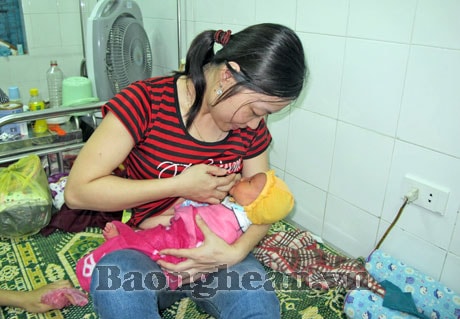
Babies need to be breastfed after birth.
To raise awareness among young mothers about breastfeeding, many programs and projects have been implemented in the province over the past period. First and foremost, the efforts of the Population and Family Planning sector in improving population quality must be mentioned: promoting communication; expanding models such as "Grandmothers' Clubs," "Safe Motherhood," and "Pre-marital Health Clubs," providing young mothers with skills to raise healthy and well-behaved children. In addition, the Prime Minister's "Education of 5 Million Mothers to Raise and Educate Children Well" project has, over the past three years, resulted in 50% of mothers with young children receiving training in scientific knowledge and practices for raising and educating children according to their age; and 15% of fathers attending communication, counseling, and training sessions, learning to share their experiences in raising and educating children.
Furthermore, the current policy of allowing six months of maternity leave is a necessary and sufficient condition for mothers to exclusively breastfeed their children. This will enable mothers to better care for their children and reduce the rate of stunting and malnutrition. However, the biggest obstacle to breastfeeding today is the mindset and awareness of young mothers. Currently, there is no shortage of information about exclusively breastfeeding for the first six months, and any mother can easily access it if they wish.
However, the inconsistent, limited, and unsustainable nature of information dissemination has significantly restricted people's access to knowledge on this issue. Therefore, relevant organizations need to strengthen communication efforts to ensure that every mother and her family has a correct and comprehensive understanding of breastfeeding. Simultaneously, localities should develop "Breastfeeding Clubs" to allow young mothers to share best practices; enhance communication skills for village health workers; organize competitions to raise awareness about breastfeeding; and establish mechanisms to encourage young mothers to breastfeed. Relevant agencies need to tighten management and quality control of breast milk substitutes on the market...
Dr. Tram Anh, Secretary of the Nutrition Program at the Provincial Center for Reproductive Health Care, stated: “The most important thing is the awareness of mothers. They need to understand the benefits of breastfeeding before and during pregnancy. To have enough milk for their children, mothers need to ensure a nutritious diet from the time they are pregnant; after giving birth, they also need to eat a balanced diet, drink plenty of water, milk, fruits and vegetables, and breastfeed frequently... In situations where mothers have to divide their time between work and childbirth, they should try to maintain at least 3 breastfeeding sessions per day for their babies. Exclusively breastfeeding for the first 6 months and continuing until 2 years of age is a great benefit, ensuring a bright future for the child when they grow up. This is also a key factor in improving the quality of the population.”
Duy Nam