

Affirming the system of state ownership of land.
Continuing the working agenda, on the morning of June 17th, the National Assembly discussed in the plenary session several remaining points of disagreement in the draft Law on Land (amended).
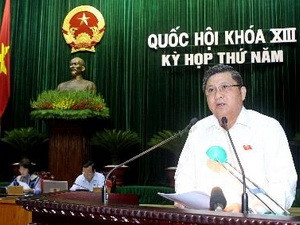
Chairman of the National Assembly's Economic Committee Nguyen Van Giau presents the report explaining, receiving feedback, and revising the draft Law on Land (amended). (Photo: Nhan Sang/VNA)
Nearly 7 million public opinions were submitted regarding the draft amended Land Law.
According to the report explaining, receiving feedback, and revising the draft Law on Land (amended), presented by the Chairman of the National Assembly's Economic Committee, Nguyen Van Giau, at the 4th session, the National Assembly gave its opinion on the draft Law on Land (amended). The draft Law on Land (amended) comprises 14 chapters and 192 articles, an increase of 6 chapters and 46 articles compared to the 2003 Law on Land.
Based on the feedback from National Assembly deputies at the 4th session and the opinions of the Standing Committee of the National Assembly at its 13th and 14th sessions, the Standing Committee of the National Assembly issued Resolution No. 563/NQ-UBTVQH13 assigning the Government to organize public consultations on the draft amended Land Law.
The draft Law on Land (amended), currently open for public consultation, comprises 14 chapters and 206 articles, an increase of 14 articles compared to the draft Law submitted to the National Assembly at its 4th session. It codifies regulations that have been applied consistently in practice, including provisions on the scope of application, subjects of application, definitions of terms, principles of land use, land users, those responsible to the State for land use; those responsible to the State for land allocated for management, incentives for investment in land, land classification; rights and responsibilities of the State regarding land; land use planning and plans; land allocation, land leasing, and land use conversion; land reclamation, compensation, support, and resettlement; land registration, issuance of land use right certificates, ownership certificates for houses and other assets attached to land; land finance and land prices; land information system and land database; and the regime for using different types of land. The rights and obligations of land users; administrative procedures related to land; supervision, inspection, dispute resolution, complaints, denunciations, and handling of violations of land laws.
After two months of soliciting public opinion (from February 1, 2013 to March 31, 2013), a summary report of comments on the draft amended Land Law from ministries, agencies, localities, organizations, and individuals shows that there were 6,958,848 comments on the draft amended Land Law.
The draft Law on Land (amended), after incorporating and revising it based on public opinions, has 14 chapters and 210 articles (an increase of 4 articles compared to the draft submitted for public consultation).
Regarding state ownership of land, the Report on Explanations, Acceptance, and Revisions of the Draft Law on Land (amended) clearly states that the majority of public opinion affirms the system of state ownership of land. Continuing to stipulate state ownership of land is consistent with the nature of our social system.
In response to the suggestion to add a principled provision affirming the state ownership of land in Chapter I to serve as a legal basis for the provisions of the draft Law, Article 4 on Land Ownership stipulates: “Land belongs to the entire people, with the State acting as the representative owner. The State grants land use rights to land users in accordance with the provisions of this Law.”
Strict regulations are needed to prevent abuse in land acquisition.
During the discussion, many opinions agreed with the regulations on land expropriation for national defense, security, national interest, public interest, and socio-economic development projects. However, delegate Nguyen Thanh Thuy (Hau Giang) suggested that stricter regulations are needed to prove that projects are truly for the national interest or public interest, to prevent the abuse of this regulation for land expropriation.
Agreeing with the view that land is a special resource and means of production belonging to the entire people, delegate Nguyen Thanh Thuy concurred with the land reclamation regulations stipulated in Chapter 6. However, according to the delegate, in cases where land is reclaimed and houses and other assets are attached to the land, the state should purchase them. Explaining this issue, the delegate argued that houses and other assets are the property of the people, so the state cannot reclaim them and certainly cannot consider them as compensation assets.
The delegates proposed that the law specifically regulate the State's land reclamation and compulsory purchase of houses and other assets attached to land in cases where land is used for national defense, security, national interest, public interest, and the implementation of socio-economic development projects.
Sharing this viewpoint, delegate Tran Ngoc Vinh (Hai Phong) also argued that assets attached to land, such as houses and architectural structures, are the property of the people, not the State.
Delegates requested that the drafting committee clarify the legal basis for the provision on reclaiming assets attached to land owned by the people. Delegates emphasized the need to ensure a balance between the goal of land reclamation for socio-economic development and the well-being of the people. If the issue of people's well-being is disregarded, the goal of socio-economic development will be difficult to achieve, leading to complaints, disputes, and social complications.
Assessing compensation and resettlement support when the state reclaims land is the key factor leading to land disputes. Representative Tran Ngoc Vinh proposed a comprehensive revision of regulations on compensation and resettlement support when the state reclaims land. When calculating compensation and resettlement, attention should be paid to the livelihoods of those whose land is reclaimed; specific regulations should be applied to groups such as the elderly and those past working age.
Delegates proposed studying the application of a fair mechanism: land for land, house for house; people would not have to pay extra money, and the state would provide additional financial support to help people quickly stabilize their lives in their new homes; increasing the support level for farmers whose agricultural land is confiscated, and mandating vocational training and job retraining for farmers after land confiscation.
Representative Le Thi Cong (Ba Ria-Vung Tau) analyzed that, in practice, allowing investors to negotiate prices directly with residents for socio-economic development projects would be difficult to implement and would affect socio-economic development goals. To facilitate land acquisition for socio-economic development and create consensus among landowners within the project area, the representative agreed to standardize land valuation according to the principles and methods stipulated in Article 110 of the draft Law. The land price at the time of construction must be consistent with the prevailing market price of land of the same intended use.
Representative Ton Thi Ngoc Hanh (Dak Nong) proposed that regulations on land compensation should be studied, allowing people to choose the most suitable option; when providing compensation, the factor of inflation should be taken into account.
Land use planning must be sustainable.
Regarding the planning period and land use plan (Article 37), there is a suggestion to consider extending the planning period to align with real estate projects that typically have land use terms of 50 years or more.
Representative Nguyen Cao Son (Hoa Binh) argued that the regulations regarding the planning period and the land allocation period are contradictory, causing difficulties in implementation. According to the representative, the draft regulations stipulate that during the land allocation period, businesses must relocate their production facilities due to changes in planning, which will cause difficulties and losses, and lead to missed business opportunities. This will result in businesses being apprehensive and unwilling to invest long-term. Representative Nguyen Cao Son suggested that the drafting committee review and revise the planning to align with the land allocation period for land lease.
Regarding this issue, the Standing Committee of the National Assembly believes that the 10-year land use planning period and the 5-year land use plan period have been stipulated and implemented stably by land law. The regulation of land use planning and plan periods reflects a vision and orientation for the future. The nature of land use planning and plans is one of inheritance and development, possessing stability, and therefore does not significantly affect land-use projects under current plans. The current land use planning and plan period is consistent with the socio-economic development strategy and plan, relevant plans, and the ability to forecast land use needs during the period.
Representative Nguyen Thi Hong Ha (Hanoi) assessed that one of the new points in the draft, suitable for urban areas, is the regulation that districts, towns, and cities under provincial administration that already have approved urban zoning plans are not required to prepare land use plans, but must prepare annual land use plans. The representative assessed that this regulation will limit unnecessary overlap and waste. The representative suggested that specific guidance is needed on the content and methods for integrating commune-level land use plans into district-level land use plans.
Regarding the principles of land use planning, Representative Ton Thi Ngoc Hanh (Dak Nong) argued that the third principle of Article 35, which stipulates efficient and economical land use, is difficult to assess. She pointed out that the limitation of this principle is its lack of clarity and its generality. She suggested that if this principle is retained, it should be revised to reflect the principle of sustainable land use planning, ensuring economic, social, and environmental effectiveness, in line with current perspectives.
According to delegate Le Thi Cong, land use planning is the basis for land allocation, land leasing, and land use conversion, reflecting a vision for the future. Therefore, land use planning must be based on the overall socio-economic development plan… approved by the competent authority. The delegate agreed that the land use plan should be 10 years, and the land planning should be 5 years; and agreed that the content of land use planning should remain at three levels: national, provincial, and district. The delegate argued that abolishing planning at the commune level is consistent with the requirements of administrative reform, saving costs, manpower, and time.
Regarding this issue, delegate Bui Van Phuong (Ninh Binh) held a different view, suggesting that the current regulations at the commune level should be retained. He argued that the principle of land use planning must ensure consistency with socio-economic development plans and national defense and security plans. He noted that communes are a level of government with a complete political system, a leading Party organization, and the function and responsibility of leading and directing the development of five-year and annual socio-economic plans. To ensure a correspondence between socio-economic development plans and land use planning, the entity responsible for developing land use plans should be at the commune level.
Representative Khuc Thi Duyen (Thai Binh) also proposed maintaining the current four-level land use planning system as stipulated in the law. According to the representative, land use planning at the commune level is a very important criterion for evaluating the achievement of standards in building new rural areas.
There are still differing views on the Land Development Fund.
Regarding the establishment of the Land Development Fund as stipulated in the Draft Law, many opinions suggest that the provision stipulating that the financial resources for forming the land development fund are drawn from land use fees, land lease fees, and other sources as prescribed by law, and used for compensation, support, and resettlement when the State reclaims land, is inappropriate. This is because the land development fund only provides advance capital for compensation and land clearance and operates on the principle of capital preservation.
Representative Nguyen Thanh Thuy (Binh Dinh) pointed out that Article 109 of the Draft Law adds a Land Development Fund to carry out tasks such as capital allocation, land acquisition, compensation for site clearance, creation of land and housing funds for resettlement, construction of resettlement housing areas, and direct management of the land fund by this organization. However, according to the representative, the financial source of the Land Development Fund is derived from land use fees and land lease fees, while the Draft Law stipulates that the land development fund organization is a public service unit and will gradually transition to operating as a business enterprise.
Delegates argued that establishing the Fund and entrusting its management to a land development fund organization is inconsistent with legal regulations, leading to the dispersion of national financial resources and an increase in bureaucracy and personnel. Furthermore, delegates cited statistics from 35 provinces and cities that have established land development funds, showing that due to specific local conditions, the management model of these funds still has many limitations.
Delegates proposed not establishing a Land Development Fund. Delegate Nguyen Cao Son (Hoa Binh) also agreed with this view, arguing that establishing the fund is inconsistent with the State Budget Law and would increase the size of the bureaucracy. He suggested that if the fund is still to be established, it must comply with the State Budget Law, focusing on a centralized and streamlined approach.
On the afternoon of June 17th, National Assembly delegates continued their discussion in the Assembly Hall on the draft Law on Land (amended).
According to (VNA) - LT