
Lesson 2: The Thai people in Bai Gao village
We arrived at Bai Gao village (Chau Khe commune - Con Cuong district) on a sunny afternoon. Tall palm and coconut trees cast abundant shade, and the stilt houses nestled among ancient trees evoked the ancient atmosphere of a Thai ethnic village. Located on the banks of the Lam River and not far from National Highway 7A, the relatively flat terrain allows the Thai people of Bai Gao village to plan and arrange their houses neatly, and the paved roads further enhance the prosperous appearance of this highland village. To this day, Bai Gao is one of the very few Thai ethnic villages in Con Cuong that still preserves the distinctive features of its traditional culture.
(Baonghean)We arrived at Bai Gao village (Chau Khe commune - Con Cuong district) on a sunny afternoon. Tall palm and coconut trees cast abundant shade, and the stilt houses nestled among ancient trees evoked the ancient atmosphere of a Thai ethnic village. Located on the banks of the Lam River and not far from National Highway 7A, the relatively flat terrain allows the Thai people of Bai Gao village to plan and arrange their houses neatly, and the paved roads further enhance the prosperous appearance of this highland village. To this day, Bai Gao is one of the very few Thai ethnic villages in Con Cuong that still preserves the distinctive features of its traditional culture.
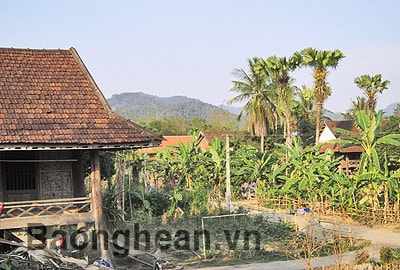
The ancient charm and prosperity of Bai Gao village.
The village of Bai Gao has 87 households (374 people) of the Thai ethnic minority. Due to the availability of arable land, sugarcane and bamboo have been the main crops for many years. These two crops have provided the people here with a relatively comfortable life compared to other highland villages. Many households have even been able to purchase plows and tractors to support agricultural production. Despite having advantages in terms of terrain and socio-economic development, the Thai people always uphold the importance of preserving and promoting their ethnic cultural identity.
The most vivid and easily observable evidence is the preservation of traditional housing architecture. To this day, nearly 80% of households in Bai Gao still live in stilt houses, solidly built and designed according to the traditional architecture of the Thai ethnic group. In recent years, many people have come to the highland villages to "hunt" for stilt houses to take back to the lowlands, and many have sold their wooden stilt houses for short-term profit to build cement houses. But the people of Bai Gao always consider stilt houses to be the "soul" of their Thai villages, so almost no one would dare sell the house passed down from their ancestors. The households still living in houses on the ground are mainly young couples who have recently moved out on their own and do not yet have the means to build stilt houses. Speaking to us, Mr. Lo Xuan Minh (75 years old) said: “A few years ago, people occasionally came here asking to buy stilt houses, but I told my children and grandchildren absolutely not to sell them, because without stilt houses, we would lose more than half of the essence of the Thai people. And luckily, no one in this village has sold their house!”
Leaving Mr. Lo Xuan Minh's house, we went to Ms. Lo Thi Tuy's house. Ms. Tuy's stilt house was located right in the middle of the village. Climbing the stairs, we immediately encountered a loom where the owner was diligently working with the shuttle and thread, trying to finish a skirt before dark. Ms. Tuy said, "I learned to weave when I was less than 15 years old, and now I'm over 45. My eldest daughter is married, and my youngest is still in school; they both know how to weave."
Watching Ms. Tuy move the shuttle with such agility and meticulousness, we knew she was a skilled and experienced weaver. And it wasn't just Ms. Tuy's family; most families in Bai Gao had looms set up in front of their houses. The main occupation of the people in Bai Gao is sugarcane farming, so the women here only sit at the loom during the off-season or at night. The woven brocade products mainly meet the needs of their families; if any women have surplus products, they are only enough to sell within the village. This is because the weaving craft in Bai Gao is currently limited to individual families; there haven't been the conditions to establish groups, teams, or cooperatives to expand the model, exchange experiences, and find markets. However, the brocade weaving craft still thrives in Bai Gao because the Thai people here still maintain their traditional clothing.
The elderly wear skirts year-round, while middle-aged women and teenagers often own four or five sets of dresses and blouses for weddings, festivals, and other special occasions. Besides that, the villagers still maintain beautiful wedding customs. For example, before getting married and moving into a new home, a girl must prepare a dowry consisting of dresses, blouses, scarves, blankets, and mattresses to demonstrate her diligence, skill, and ability to manage household affairs. Therefore, even in the age of industrialization, the sound of looms still resonates in Bai Gao. And we realized that the weaving craft here still retains many of its original features, from the shuttles and threads to the looms, which are simply constructed, not as large-scale or elaborate as in other brocade weaving villages.
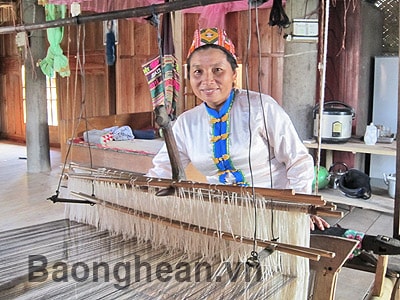
Ms. Lo Thi Tuy, Bai Gao village (Chau Khe - Con Cuong)
I have been involved with the loom for over 30 years.
If the stilt house is the "soul" of the Thai ethnic village, then the folk songs (khap, lam, nhon), folk dances (xoe, lam vong, khac luong), and traditional musical instruments (gongs, cymbals, mouth organs, flutes) are the "soul" of the Thai people. Therefore, despite opportunities for cultural exchange, the Thai people in Bai Gao are determined to preserve their ethnic "soul." To prove this, Mr. Loc Xuan An (Party Secretary) led us to visit a family in the village holding a small wedding. Here, both families were gathered and happily enjoying a meal. When the feast ended, Ms. Loc Thi Hoang (village head), representing the bride's family, sang a lam song. Ms. Hoang's lam song recounted the bride's good qualities, her family's circumstances, and the hard work of her parents in raising her.
Now that she is about to go to her husband's home, her parents still have many worries and concerns to share. In response to the bride's family, Ms. Luong Thi Tinh (representing the groom's family) also sang a lam dance, praising the love of the young couple and thanking the bride's parents for giving the groom's family a healthy and hardworking daughter-in-law. At the same time, the groom's family will love and raise their daughter-in-law as their own daughter. The exchange ended, and at the same time, the sound of gongs and drums resounded, the sound of the bamboo flute became melodious, and the sound of the flute was inviting. Everyone joined hands, expanded the circle, and danced rhythmically to the lam dance. Secretary Loc Xuan An said: "In Bai Gao, everyone knows how to dance lam-vong; every woman knows how to sing, and every man knows how to play the flute and bamboo flute. Whenever Tet (Lunar New Year) comes or there is a wedding or festival in the village, everyone comes to celebrate together..."
In a conversation with us, Village Head Loc Thi Hoang happily shared: “Bai Gao Village has been recognized as a cultural village and is preserving many beautiful traditional cultural features of the Thai ethnic group. In the near future, we will strive to establish a folk song and musical instrument club and a brocade weaving group to create opportunities for learning, exchanging experiences, and passing on these beautiful traditions to the younger generation, preventing their disappearance.”
Text and photos: TUONG ANH