

Initial effectiveness of the "Vice Chairman of the Commune Project"
Following the government's policy of deploying 600 young, university-educated Vice Chairmen of communes to 62 impoverished districts nationwide, Nghe An province selected 26 individuals to serve in Ky Son, Tuong Duong, and Que Phong districts. After more than a year of operation, these newly appointed Vice Chairmen have initially adapted to their work. However, to achieve outstanding results, they need more time and there are still many issues that need attention and resolution.
(Baonghean)Following the government's policy of deploying 600 young, university-educated Vice Chairmen of communes to 62 impoverished districts nationwide, Nghe An province selected 26 individuals to serve in Ky Son, Tuong Duong, and Que Phong districts. After more than a year of operation, these newly appointed Vice Chairmen have initially adapted to their work. However, to achieve outstanding results, they need more time and there are still many issues that need attention and resolution.
Ha Ba Ly, 23 years old, recently graduated from university. After a short training course, this young Hmong man was selected to be the Vice Chairman of Huoi Tu commune, Ky Son district. Initially, he felt a bit lost, but fortunately, he was able to work among his own people (Huoi Tu has 94.8% Hmong population), making his interactions with the villagers much easier. Huoi Tu commune is nearly 40km from the Muong Xen district center and currently lacks electricity and has limited communication. Through numerous mediation efforts regarding land disputes, Ha Ba Ly has successfully persuaded the villagers to abide by the law and maintain unity. After a year of working there, Ha Ba Ly shared: “I'm young and lack experience, so I've boldly asked for advice from the older members of the commune. Now, with the guidance of the Party Committee, the government, and various organizations, I'm more confident. Currently, I'm working with the commune and the people to promote poverty alleviation, and to complete the planning and build a more decent new rural area.”
As for Luong Thi Hien, born in 1989 in Cao Veu village, Phuc Son commune, Anh Son district, she graduated from the University of Forestry and was selected as the Vice Chairwoman of Thach Giam commune, Tuong Duong district. Being far from home and having limited communication skills, Hien became even more aware of the necessary efforts. Vice Chairwoman Hien rented accommodation, always staying close to the villages, encouraging the people to actively increase production, raise income, and improve their lives. Therefore, in addition to their fields, the people of Thach Giam commune are now following the "Vice Chairwoman's" advice, utilizing every available plot of land to grow clean vegetables for the market. They are also raising livestock and poultry using proper techniques to create marketable goods… Now, the people have adapted to farming and livestock raising according to market demands.
Speaking about her more than a year in office as the Vice Chairman of the commune, Luong Thi Hien shared: "I feel luckier than many of my colleagues because the commune I'm in charge of is near Hoa Binh Town, right next to National Highway 7A. Furthermore, being of the Thai ethnic group, I find it easier to interact with the local people and integrate better. Therefore, all difficulties quickly pass. Now, the people treat me like family, so when I implement work in the villages, it's faster and more effective. I also realize that I need to try harder to do more for the people."
In reality, not everyone is as fortunate as the Vice Chairmen of Huoi Tu commune (Ky Son district) and Thach Giam commune (Tuong Duong district), because many of the newly appointed Vice Chairmen are from the lowlands, so they initially faced numerous difficulties. A typical example is Nguyen Van Hue from Anh Son district who became Vice Chairman of Yen Tinh commune, Tuong Duong district. Having just graduated from the University of Forestry, Hue was immediately assigned to the remote Yen Tinh area, which is mainly inhabited by the Thai and Khmu ethnic groups.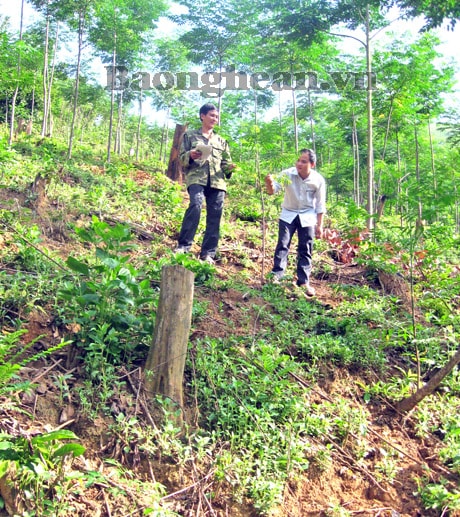
Deputy Chairman of the commune, Nguyen Van Hue, discusses forest care techniques with local people.
Out of 939 households in the commune, only 3 are Kinh (Vietnamese majority), and over 82% are classified as poor. When he first arrived in this area, Nguyen Van Hue faced countless difficulties: he had learned the local language but only knew how to greet people, and couldn't communicate much with the locals; the terrain was difficult, and life was impoverished. But with the determination of youth, Nguyen Van Hue gradually adapted to the work, learning the local language daily. Today, he confidently boasts that he communicates very well with the local people in Thai. Despite the complex terrain, he has visited all 9 villages in the commune, encouraging people to plant forests and develop livestock farming.
In 2012, the district assigned Yen Tinh commune a target of planting 80 hectares of forest. Nguyen Van Hue, along with the local government, propagated and mobilized the people to plant more than the target, achieving 143 hectares. In 2013, the district assigned a target of planting another 85 hectares, but the people of the commune registered for nearly 200 hectares. Currently, he is working with the People's Committee of the commune to conduct surveys and reviews to prepare dossiers for issuing 1,000 land use right certificates to people, organizations, and schools in the area.
Tuong Duong District has the highest number of young commune-level Vice Chairmen (PCBs) in the province, with 13. According to the initial assessment of the District People's Committee, the Project to recruit 600 commune-level Vice Chairmen is a breakthrough in the Party and State's policy. The commune-level Vice Chairmen recruited to the district all possess professional qualifications, skills, and work capacity; they are healthy, diligent in learning practical skills, and closely monitor the grassroots level to implement programs and projects in the district. Many of these Vice Chairmen strive to adapt to their work, integrate with others, and closely coordinate with local departments and organizations to carry out their assigned tasks.
However, similar to localities in Ky Son and Que Phong, in Tuong Duong, some commune-level Party committees and authorities have not truly paid attention to organizing the evaluation and assessment of the performance of the Vice-Chairmen. The chairmen of some communes have not genuinely cared for or assisted the Vice-Chairmen, still having a tendency to "delegate" assigned tasks entirely, lacking inspection and supervision, causing the Vice-Chairmen to hesitate to interact, share, and fully demonstrate their abilities in the work process. In addition, the Vice-Chairmen lack practical experience and do not fully understand the customs and traditions of the local people, so they face many difficulties when approaching, guiding production, and disseminating laws.
Mr. Bui Tram, Chairman of the Ky Son District People's Committee, stated: “Although the newly recruited Vice-Chairmen possess professional qualifications, the actual working conditions in the locality differ significantly from the knowledge they acquired in school. These Vice-Chairmen are new to the job and therefore still feel unfamiliar with the implementation, direction, and management of socio-economic development plans. The low level of education and awareness among the people, along with conservative thinking and a tendency towards dependence, has greatly affected the work of disseminating information and mobilizing the people to implement socio-economic development plans. Some Party and government leaders have not fully grasped the State's policy on strengthening and attracting young intellectuals to participate as Vice-Chairmen, and have not been bold enough to assign tasks, thus preventing these individuals from fully demonstrating their capabilities. In the coming time, the District Party Committee and the District People's Committee will strengthen guidance to accurately assess the capabilities of young cadres, promote exemplary individuals, and contribute to socio-economic development.”
The project to strengthen commune-level Party Committees in difficult areas has a duration of 5 years. The effectiveness of the work of young commune-level Party Committees is not simply demonstrated by how much rice and corn they help the people produce, or how many livestock and poultry they raise, but more importantly, through practical experience, they contribute to training a source of successor cadres for poor districts.
Nguyen Son