

Painful memories amidst peace
One afternoon, along the Lam River, on dike 42, I was suddenly struck speechless when I came across a small cemetery by the dike. The locals call it the "Dike Martyrs' Cemetery"... Inevitably, this article of mine began with fragmented memories, with the pain that still lingers in the hearts of the people of Hung Khanh and Hung Thang (Hung Nguyen)... A shared memorial day.
(Baonghean)One afternoon, along the Lam River, on dike route 42, I was suddenly struck speechless when I came across a small cemetery by the dike. The locals call it the "Dike Martyrs' Cemetery"... Inevitably, this article of mine began with fragmented memories, with the pain that still lingers in the hearts of the people of Hung Khanh and Hung Thang (Hung Nguyen)...
Joint memorial day
“That was the 4th day of the 8th lunar month every year,” Mr. Vo Trong Tuy, frail and thin, gazed into the distance with his cloudy eyes, recounting to me in his small house in Hamlet 4, Hung Khanh Commune. “At that time, I was a militia member in Hung Khanh Commune. After a bombing raid, the dike was torn apart, littered with rocks, earth, and trees. So many people died, their bodies shattered. The whole village echoed with cries of grief…” The 85-year-old man may forget many things in his life, but that fateful day, according to him, he “will never forget”; it felt as if it had just happened before his eyes yesterday or the day before…
On that tragic day of August 27, 1967 (the 4th day of the 8th lunar month), from dawn, militiamen from the two communes of Hung Khanh and Hung Thang (Hung Nguyen district) gathered on the crucial dike running through their territory to carry out dike reinforcement work and fill bomb craters throughout the long night to keep the supply route open for the South to fight the Americans. Around 5 a.m., as dawn broke, some had finished their work and were returning to their villages with hoes and shovels, while others were still working overtime. Suddenly, two American planes spotted them and swooped down to drop bombs. The deafening sound of bombs exploded amidst the incessant sound of air raid sirens. Bombs fell on the dike, bombs exploded on the dike roofs, leaving the village in ruins. It was too late; the young men and women who had sung their songs the night before were gone. It was too late; the small shelters were no longer safe from the destructive power. It was too late; the breakfast simmering on someone's stove was gone...
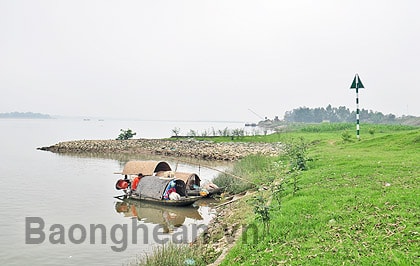
At Hung Khanh dike, where the American forces once attacked, 15 militiamen lost their lives.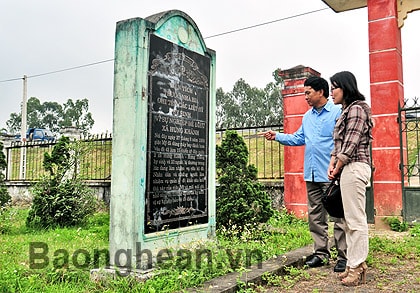
Memorial plaque commemorating the martyrs of the dike construction project.
At that moment, Mr. Tuy only had time to jump down to the ground, next to a banana grove, and before being buried under mud and leaves, he saw the bodies of many militiamen on the village dike being tossed into the air by bombs. After the bombing, he was pulled out of the mud and helped through the devastation and grief. His eyesight had faded. He could only hear the sound of running footsteps, heart-wrenching cries, and the shadows of people digging through the earth and rocks. Fifteen people died, and 23 were wounded, lying scattered on the dike. Many houses in the village had been hit by bombs. In Mr. Bui Dinh Thue's family, all four died in the bunker. In Mr. Vo Trong Thung's family, out of seven, five died. More than 40 people lost their lives after the bombing. More than 40 memorial services were held on that same day. Fifteen militiamen sacrificed their lives to save the dike; few had their bodies intact, and some were never found...
Ms. Phan Thi Nghia, then the Deputy Secretary of the Party Committee of the commune, tearfully recounted the story of her comrades: “Mr. Nguyen Luu Tuan was the Vice Chairman of the commune in charge of agriculture, and Mr. Hoang Duc Suu was the commune police officer. That morning, Mr. Tuan went to the dike to resolve a matter concerning a banana clump belonging to a resident along the dike to ensure the work was completed on schedule. Who would have thought… When we carried Mr. Tuan back to the village on a stretcher, he had already passed away. As for Mr. Suu, he was preparing to go to the district when he received orders to go and reinforce the dike. He immediately left without even having time to eat. The next morning, Mr. Suu sacrificed his life; his body was not intact, but he still clutched the national flag in his hand. Many militiamen fell in battle at the age of eighteen or twenty. Some faces will stay with me for the rest of my life. They were so young, so innocent, and so heroic. I also remember another person, not one of those who died in that bombing, but in my opinion, he also deserved to be considered a hero. That was Mr. Tran Van Phuc. After the bombing, he went around collecting pieces of human remains, hiding himself in the bamboo thicket.” He endured thorns and waded through the rice paddies to search for the remains of the villagers. And it wasn't just one bombing raid; he was present at countless bombings and tragedies, meticulously collecting every bone and piece of flesh with utmost care..."
...And as the years passed, the dike, ravaged by bombs and bullets, the strategic route, bearing the scars of war, embracing the blood and bones that had gradually turned green with grass. It became a peaceful feature of the homeland, a source of longing and nostalgia for those far away. How many who pass by still remember the brutal times? But in the hearts of the people of Hung Khanh and Hung Thang, the pain seems to linger. And in the hearts of those who deeply mourn the sacrifices of their fathers and brothers for this crucial dike, that sacrifice must be remembered...
Let's not forget.
One of the people I met to write this article was engineer Le Dinh Long, currently the Deputy Head of the Dike Management and Flood Control Department of Nghe An province. He played a major role in proposing the construction of the "Dike Martyrs' Cemetery," officially named the Memorial Monument for Martyrs who contributed to the construction and protection of dikes, located along the Hung Khanh dike now.
For over 80 years, the 42-kilometer dike has stretched along the Lam River, embracing and protecting the villages of Nam Dan, Hung Nguyen, Nghi Loc districts and Vinh City. This dike is considered crucial among the more than 470 km of dikes surrounding rivers and the sea throughout the province. From a point where it could only hold water at alert level 2 to now exceeding the peak flood level of 1978, "So much sweat, tears, and blood were poured into building this dike," Mr. Long shared. "So many people donated land, fields, and houses... to build the dike. My family, therefore, has seven ponds. In 1954, after the dike broke, the troops who had gathered came here to help the people rebuild their houses. After that flood, my father told me, all that was left of our house was a stone mortar. Then, thanks to the soldiers and the villagers helping each other, everything was rebuilt... In those days, my family mainly ate the soldiers' food. And every year, whenever the soldiers passed through the village, stopping to wait for their march, they would help the villagers build the dike. In those days, building dikes to protect the people was an important task, second only to fighting to protect the Fatherland. The image of Uncle Ho's soldiers in rescue and dike restoration work is truly heroic in my mind and in the minds of the children." "Magnificent and beautiful. The men competed to carry soil, from 4, to 8, then 10 baskets. They worked, sang, and joked around, it was so much fun. To me, these dikes have been with us throughout the history of our nation, a nation that grows rice and fights invaders..."

Mr. Vo Trong Tuy is recounting the tragic day for the people of Hung Khanh.
1968 was also the year Long, nearly 10 years old, returned to his village after evacuating with his parents. He heard stories of the devastating bombing, witnessed families grieving immense pain, and heard people calling for collective memorial services each year. These things never ceased to haunt him. After studying irrigation engineering, Long had the opportunity to become closely involved with dikes. Every time he walked along the dikes in his hometown, he felt indebted to those who had fallen. He asked himself: "Why should this vital dike system and the sacrifice of the 15 militiamen be forgotten?" He sought ways to make this concern a reality. A memorial to the martyrs who sacrificed their lives for the cause of dikes was erected beside the old bomb crater where the 15 militiamen perished. Their names have been engraved on a stone monument in this peaceful homeland...
Only those who were wounded and returned from the bombing that year have yet to receive any benefits. Mr. Vo Trong Tuy, who was dug out of the mud, returned suffering from headaches and blurred vision. He said, "I'm like a lamp in the wind now, I don't know when it will go out. At least I'm luckier than those who sacrificed their lives." He listed the names of those wounded that time; many of them have passed away. Now only one or two people remain alive in the village. Some were seriously injured, still suffering from aftereffects, walking with a limp, but they don't receive any benefits because they lack the necessary documentation... After saying this, Mr. Tuy sighed sadly...
Conclusion
I returned along the windy riverbank dike. For over 80 years, the dike has stood tall, growing and rising alongside the land of my homeland. Only now do I understand that, before entering poetry and music, that dike was an integral part of the lives of the people in this village... And as I drifted further away, that special cemetery quietly turned green, a symbol of peace.
Text and photos: Thuy Vinh