

A vote of confidence is a measure of individual responsibility!
(Baonghean)Following the National Assembly, People's Councils at all levels are also preparing to conduct confidence votes for positions elected by the People's Councils. A reporter from Nghe An Newspaper interviewed Mr. Tran Van Mao, Standing Member of the Provincial People's Council, about related issues.
PV:Sir, currently, along with the National Assembly, People's Councils at all levels are also implementing a plan to conduct confidence votes for positions elected and approved by the People's Councils. Therefore, could you please explain the methods, procedures, and processes for conducting these confidence votes to ensure objectivity, honesty, and fairness?
Mr. Tran Van Mao:According to Resolution No. 35/2012/QH13 dated November 21, 2012, of the National Assembly; and Resolution No. 561/2013/UBTVQH13 dated January 16, 2013, of the Standing Committee of the National Assembly, the list of positions subject to a confidence vote by the Provincial People's Council at its 9th session of the 16th term includes: Chairman of the Provincial People's Council, Vice-Chairman of the Provincial People's Council, Standing Committee members of the Provincial People's Council, and heads of committees of the Provincial People's Council; Chairman of the Provincial People's Committee, Vice-Chairman of the Provincial People's Committee, and members of the Provincial People's Committee. Those subject to the confidence vote are individuals who held the position subject to the vote one year prior to the meeting.
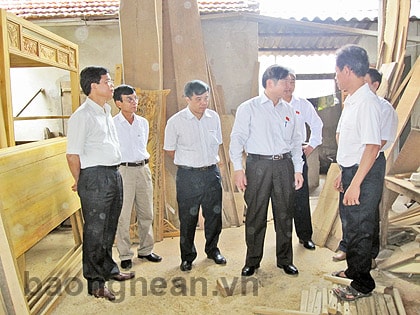
Members of the National Assembly and Provincial People's Council supervise environmental protection work in Tay Ho carpentry village (Nam Dan).
The purpose of conducting confidence votes for positions elected by the Provincial People's Council is to "test" the level of confidence of the Provincial People's Council representatives in the person holding the position elected by the People's Council. This helps the person being evaluated to understand their level of trust so that they can continue to strive, improve, and enhance the quality and effectiveness of their work; and at the same time, it serves as a basis for competent agencies and organizations to consider, evaluate, and assign personnel.
On the other hand, this is also an activity aimed at improving the effectiveness and efficiency of the Provincial People's Council's supervision of positions elected by the People's Council as well as of its members. Therefore, the confidence vote places very high demands on objectivity, fairness, democracy, and ensuring that it accurately reflects the results of the performance of duties and responsibilities, as well as the political qualities, ethics, and lifestyle of the person being evaluated. This is not only the wish of the People's Council members but also the wish of all voters - those who elected the People's Council members.
To ensure that the confidence vote meets the above requirements, it is necessary to comply with the procedures and methods for taking and casting votes as stipulated in Resolution 35/2012/QH13 of the National Assembly. Specifically, those holding positions subject to the confidence vote must submit reports on their work performance, as well as their compliance with the law, ethics, and lifestyle, and provide explanations regarding the contents related to the confidence vote to the Standing Committee of the Provincial People's Council at least 20 days before the opening of the first annual session of the Provincial People's Council (the first session of the Provincial People's Council in 2013 is scheduled to take place from July 11 to 13, 2013).
The Provincial Fatherland Front Committee is responsible for promptly and comprehensively gathering and summarizing the opinions and recommendations of voters regarding those holding positions elected or approved by the Provincial People's Council (if any), and submitting them to the Standing Committee of the Provincial People's Council no later than 20 days before the opening of the Provincial People's Council session. Subsequently, the person subject to the confidence vote is responsible for providing a written explanation to the People's Council representatives upon request from the Standing Committee. The confidence vote is conducted by secret ballot.
PV:What will this vote of confidence reflect, and what is its significance, sir?
Mr. Tran Van Mao:The confidence vote is defined as a "test" of confidence, through which the effectiveness of work, responsibility, ethics, and lifestyle of the person being evaluated are assessed by the People's Council representatives, with levels of confidence being "high," "confidence," and "low confidence." Only when more than 50% of the People's Council representatives rate a position as "low confidence" will the next "consequence" occur: if, in the following year's vote, that position again fails to achieve a majority of the confidence votes, it will be moved to a no-confidence vote.
Thus, this confidence vote is a positive move aimed at "awakening" and reminding those elected by the People's Council to strive harder, be more diligent, and be more responsible in their assigned work, as well as towards the voters, in order to gain the trust of the People's Council representatives. However, if, in the first vote, a position receives a "low confidence" rating from more than two-thirds of the total number of People's Council representatives, it will be moved to a confidence vote no later than the next session, unless that person submits a resignation letter and it has been accepted by the competent authority (the relevant agencies prepare a replacement if the person put forward for the vote is not considered confident).
If more than half of the People's Council delegates vote "no confidence" on a person subject to a confidence vote, the agency or person with the authority to nominate that person for election or approval by the People's Council is responsible for submitting the matter to the People's Council for consideration and decision on dismissal, removal from office, or approval of the dismissal, removal from office, or demotion of the person who received no confidence vote at that session. For those subject to the confidence vote, a high level of confidence vote contributes to providing a basis for competent agencies and organizations to consider, evaluate, and assign personnel.
On the other hand, the confidence vote has entrusted the People's Council representatives with the responsibility of expressing their opinions on the achievements and shortcomings of the officials subject to the vote. To do this, each representative must ensure they have access to all necessary information channels, carefully study the reports of the officials being evaluated to understand and grasp the specific work of those officials over the past period, and consider how the press and news agencies have commented on the activities of those officials. Furthermore, they must also consider public opinion within their agencies, among those close to and working with those officials; and, if possible, consider the opinions of the officials' communities and families to ensure their participation in the confidence vote is genuine and not merely ceremonial.
The vote of confidence is a measure of individual responsibility, not only for the positions being voted on but also for the responsibility of the People's Council representatives at all levels. The responsibility of People's Council representatives in the vote of confidence demonstrates democracy in the parliamentary activities of the People's Councils at all levels, affirming that Central Resolution 4 on "Some urgent issues concerning Party building today" has been put into practice.
MAI HOA (compiled)