

A steadfast border
(Baonghean) - As a district sharing the longest border with Laos in the province (192/419km), Ky Son is an important gateway to the southwest of Nghe An. To defend this border region, in addition to the efforts of the armed forces, the people of the Thai, Mong, Kho Mu, Kinh, and Hoa ethnic groups always work together in unity. This creates the spirit of a unit awarded the title of Hero of the People's Armed Forces.
(Baonghean) - As a district sharing the longest border with Laos in the province (192/419km), Ky Son is an important gateway to the southwest of Nghe An. To defend this border region, in addition to the efforts of the armed forces, the people of the Thai, Mong, Kho Mu, Kinh, and Hoa ethnic groups always work together in unity. This creates the spirit of a unit awarded the title of Hero of the People's Armed Forces.
Located in the northernmost region of Vietnam, Ky Son is known for its harsh weather, rugged terrain, and the difficult living conditions of its people. So what makes this unit a heroic one? Without a moment's hesitation, Mr. Bui Tram, Deputy Secretary of the District Party Committee and Chairman of the District People's Committee, immediately replied: "It is the strong unity among the ethnic groups. Despite many difficulties and shortages, the people here, for generations, have persevered, gradually developing the economy and society, maintaining national defense and security, and protecting the sovereignty of the national border."
I recall that during the 1960s and 1970s, dozens of bandit groups, including the "Chau Pha" and "Vang Pao" groups, armed with weapons, plundered and caused riots in Ky Son. In response, under the leadership of the Party, the people of various ethnic groups in Na Ngoi, Nam Can, Keng Du, Bao Nam, and other areas, along with the armed forces, fought side-by-side to defeat the bandits and restore peace to their villages. During that period, Mr. Vu Chong Pao, former Chairman of the People's Committee and Chairman of the Fatherland Front Committee of the district, held a meeting with village elders, heads of hamlets, and influential figures from various clans to persuade their children not to be misled by the bandits, while simultaneously strengthening unity among ethnic groups to protect their villages and the government. Following the campaigns to defeat the bandits, the strength of unity and cooperation among the ethnic groups in Ky Son was further consolidated and highly promoted in eradicating opium cultivation, eliminating backward customs, focusing on production and livestock farming, and gradually improving and raising living standards.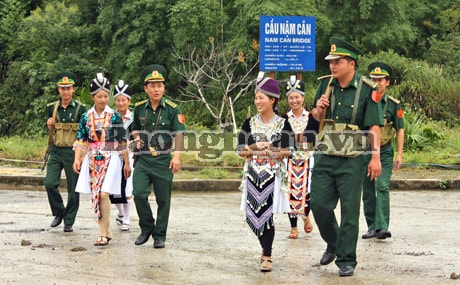
The Nậm Cắn Border Guard Post, in coordination with local villagers, patrols and monitors the border situation. Photo: Hải Thượng
Recognizing the important role of village elders, community leaders, and influential figures within clans, Party committees, government agencies, the Fatherland Front, and mass organizations have regularly held conferences over the years to evaluate, commend, and discuss necessary actions for each specific period. Through these village elders and community leaders, all Party guidelines, policies, and State laws are widely disseminated to all segments of the population.
In patriotic emulation movements, village elders, community leaders, and influential figures set a good example by taking the lead, thereby creating a strong ripple effect among the people. Particularly after the Prime Minister issued Directive 06/2008/CT-TTg on "Promoting the role of influential figures among ethnic minorities in the cause of national construction and defense," many exemplary individuals have been honored by the community. They are active in mobilizing people to participate in the "All People Protect National Security" movement; establishing security and order cooperation clusters in border areas; and directly participating in resolving some emerging issues at the grassroots level. At 75 years old, village elder Lầu Tổng Xo of Phà Nọi village, Mường Típ commune, is still very agile. When there is an issue concerning the village, he readily crosses the mountains to inform the people so they can take action.
“I’ve lived longer than my children and grandchildren, and I’ve earned the trust of the Party and the State, so I have an even greater responsibility to encourage my people to unite under the Party, care for their lives, and protect the Fatherland. Now, our people know many techniques for producing corn and rice, and raising more buffaloes, cows, pigs, and chickens. Together with our children and grandchildren, we actively cooperate with the border guards to fight crime and keep our villages safe… The only thing is that the Hmong people still marry early and have many children. I’m also advising my children and grandchildren to overcome this,” Elder Lầu Tổng Xo confided.
Nguyen Son